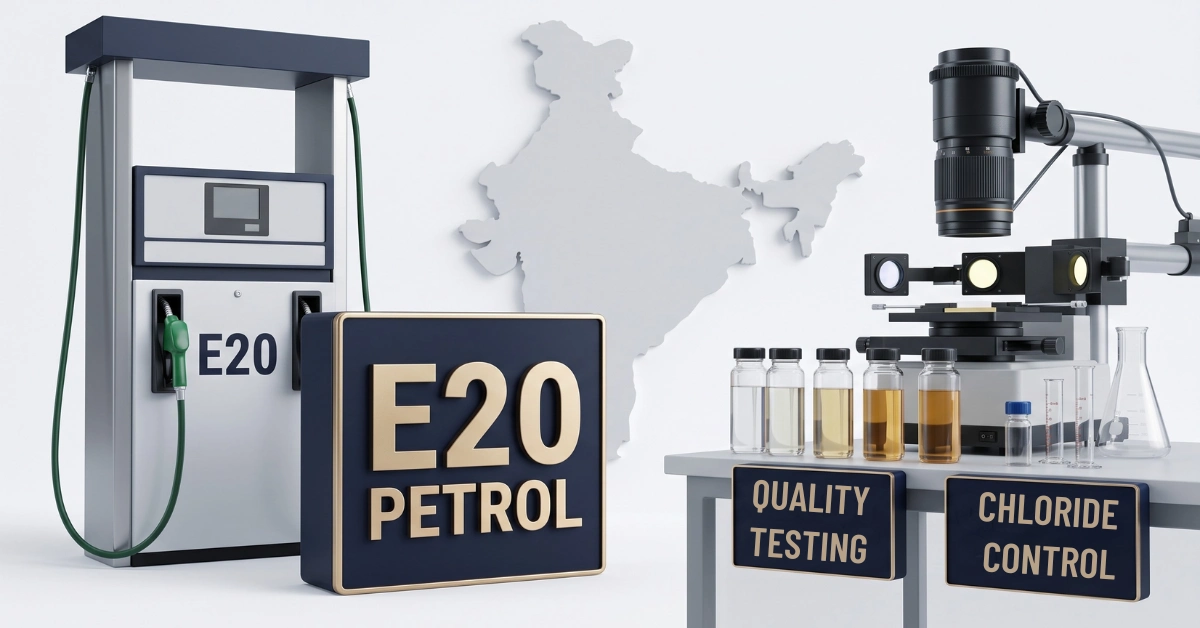
New Delhi: Recent concerns over the quality of E20 petrol have led oil companies to intensify testing across refineries, distilleries, terminals and fuel stations, with the government saying the latest checks have not supported claims of widespread chloride or moisture contamination.
The Ministry of Petroleum and Natural Gas said on 8 August that additional testing carried out by Oil Marketing Companies (OMCs) found chloride levels largely within prescribed limits across the E20 petrol supply chain.
At refineries, more than 100 randomly selected petrol samples were tested and chloride levels were found at or below 1 part per million (ppm) in all cases.
A dedicated task force comprising representatives of OMCs and the Centre for High Technology also tested ethanol samples from 80 distilleries across the country over the past 10 days.
All the ethanol samples tested from these distilleries recorded chloride levels below 3 ppm, according to the ministry.
Testing was also carried out at OMC terminals, where more than 80 ethanol and E20 petrol samples were checked. Chloride levels in these samples were also found below 3 ppm.
At retail outlets, an intensified monitoring programme covering more than 1,000 samples is underway. Of these, 160 test reports analysed so far showed chloride levels in the range of 0-3 ppm.
However, the monitoring exercise also detected four isolated instances of elevated chloride levels.
Fuel supplies at those locations were immediately suspended, followed by root-cause analysis and corrective measures before supplies were restored, the ministry said.
The government said the findings did not support recent claims suggesting chloride levels of up to 500 ppm in E20 petrol.
Monitoring has also been strengthened to check possible water contamination in fuel storage systems.
Around 90,000 retail outlets have started mandatory inspection and monitoring of underground storage tanks, with checks being conducted eight to 12 times every day.
According to the ministry, these inspections have so far not revealed any water ingress.
Oil companies have also deployed mobile fuel-quality testing laboratories and are carrying out validation through fuel laboratories as part of the intensified monitoring mechanism.
E20 petrol contains 20 per cent ethanol blended with petrol. The government has prescribed quality specifications for ethanol used in petrol blending and monitoring is carried out at different stages of the supply chain.
Read also: India plans 6.48 lakh circuit km transmission network by 2032 to meet 388 GW peak power demand
Read also: No evidence of widespread engine damage from E20 fuel, government tells Lok Sabha