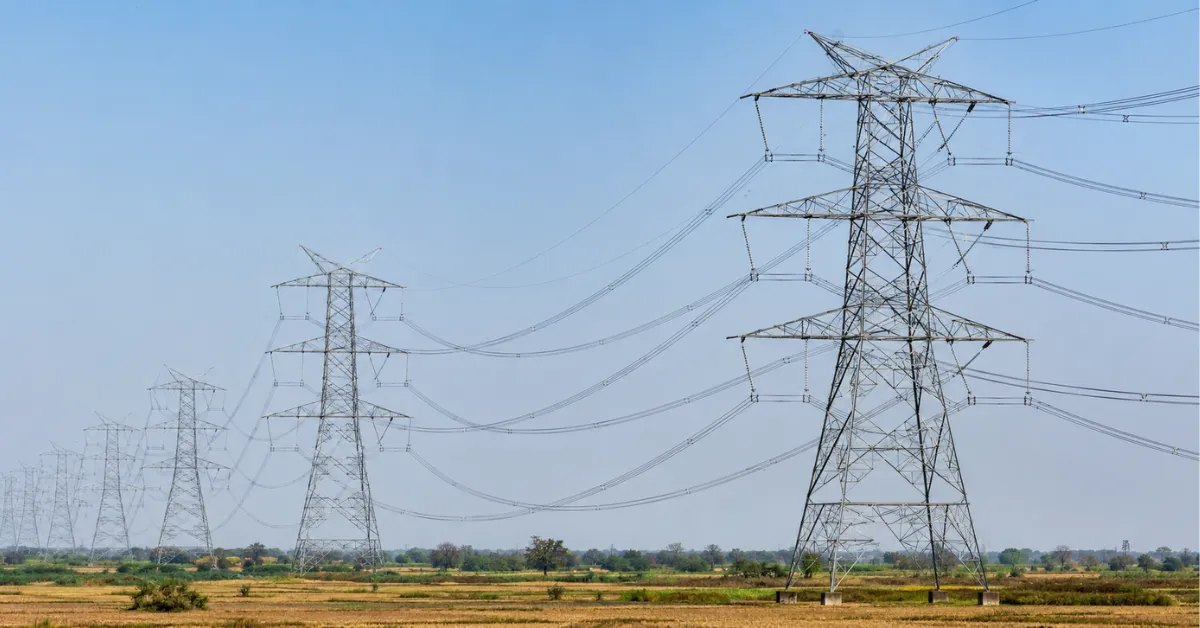
New Delhi: India plans to expand its electricity transmission network to 6.48 lakh circuit kilometres by 2032 to meet a projected peak power demand of 388 GW, the government informed the Lok Sabha on Thursday, 30 July.
Minister of State for Power Shripad Naik provided the details in a written reply, outlining planned transmission-capacity expansion, grid-modernisation measures, battery-storage deployment and cybersecurity initiatives.
The network stood at 5.09 lakh circuit kilometres in June 2026, indicating a planned addition of around 1.39 lakh circuit kilometres over the next six years. Transformation capacity is also planned to increase from 1,478 GVA to 2,345 GVA during the same period.
Inter-regional transmission capacity, which enables electricity transfers between different parts of the country, is set to rise from 120 GW to 168 GW by 2032.
The expansion is part of the National Electricity Plan for transmission, which the government notified in 2024. The plan covers transmission-system requirements between 2023 and 2032 and considers expected generation-capacity additions and growing electricity demand from sectors including electric mobility, data centres and industrial expansion.
It also accounts for emerging load centres and the infrastructure required to integrate renewable energy into the national grid while maintaining reliability.
Over 35,000 Circuit Km Added In Three Years
India commissioned 35,172 circuit kilometres of transmission lines operating at 220 kV and above between FY2023-24 and FY2025-26.
Of this, 15,944 circuit kilometres were added under the Inter-State Transmission System, while state transmission networks accounted for 19,228 circuit kilometres.
Annual additions stood at 14,203 circuit kilometres in FY2023-24, 8,830 circuit kilometres in FY2024-25 and 12,139 circuit kilometres in FY2025-26.
Transformation capacity increased by 2,70,174 MVA during the three-year period. This included 1,44,060 MVA under the inter-state system and 1,26,114 MVA under intra-state networks.
The largest annual addition came in FY2025-26, when 1,13,013 MVA of transformation capacity was commissioned, compared with 86,433 MVA in FY2024-25 and 70,728 MVA in FY2023-24.
Battery Storage Capacity Crosses 2,900 MW
India’s installed Battery Energy Storage System capacity for projects larger than 1 MWh reached 2,927.85 MW, with total energy-storage capacity of 8,660.20 MWh, as of June 30, 2026.
The projects include a 1,200 MW merchant-sale battery-storage facility in Gujarat, an 800 MW facility in Rajasthan and a 220 MW pilot deployment in Maharashtra.
Other operational systems include projects in Delhi, Gujarat, Karnataka, Rajasthan, Bihar, Chhattisgarh, Uttar Pradesh, West Bengal, Lakshadweep and the Andaman and Nicobar Islands.
Battery-storage systems support the grid by storing electricity and supplying it when required, helping balance variations in renewable-energy generation.
Smart Grid And Cybersecurity Measures Expanded
The government is deploying technologies such as Static Synchronous Compensators, Synchronous Condensers and other Flexible AC Transmission System devices to strengthen voltage stability and support renewable-energy integration.
Regional Energy Management Centres are being used for renewable-power forecasting and real-time grid management. Automatic Generation Control and ancillary services have also been introduced to support frequency regulation and balance electricity supply with demand.
The government established the Computer Security Incident Response Team–Power in April 2023 to coordinate the reporting of and response to cybersecurity incidents in the electricity sector.
Funding has also been approved for a Security Operations Centre and Network Operations Centre to strengthen continuous monitoring and incident response.
The national grid is monitored by CSIRT-Power, GRID-INDIA, CERT-In and the National Critical Information Infrastructure Protection Centre. Periodic vulnerability assessments and penetration testing are also being conducted across information-technology and operational-technology systems.
The government is separately working to make electricity infrastructure in coastal areas more resilient to cyclones. Proposed measures include mobile substations, emergency restoration systems, ring- or mesh-based distribution networks, drone inspections and underground transmission corridors along coastal highways.
Read also : No evidence of widespread engine damage from E20 fuel, government tells Lok Sabha