The National High Speed Rail Corporation Limited (NHSRCL) has initiated the lowering and assembly of Tunnel Boring Machines (TBMs) for a key underground stretch of the Mumbai-Ahmedabad Bullet Train project, covering a 16 Km tunnel between Bandra Kurla Complex (BKC) and Sawli near Ghansoli in Maharashtra.
This segment is part of a larger 21 Km underground alignment between BKC and Shilphata, which includes India’s first 7 Km undersea rail tunnel beneath Thane Creek.
In a statement on Thursday, 9 April, NHSRCL stated that while 5 Km of tunnelling using the New Austrian Tunnelling Method (NATM) has already been completed, the remaining 16 Km will be executed using TBMs.
The tunnel is being designed as a single tube structure of 13.1 metres diameter to accommodate twin tracks.
Construction depth will vary between 25 metres and 57 metres below ground level, with the deepest point reaching approximately 114 metres below Parsik hill.
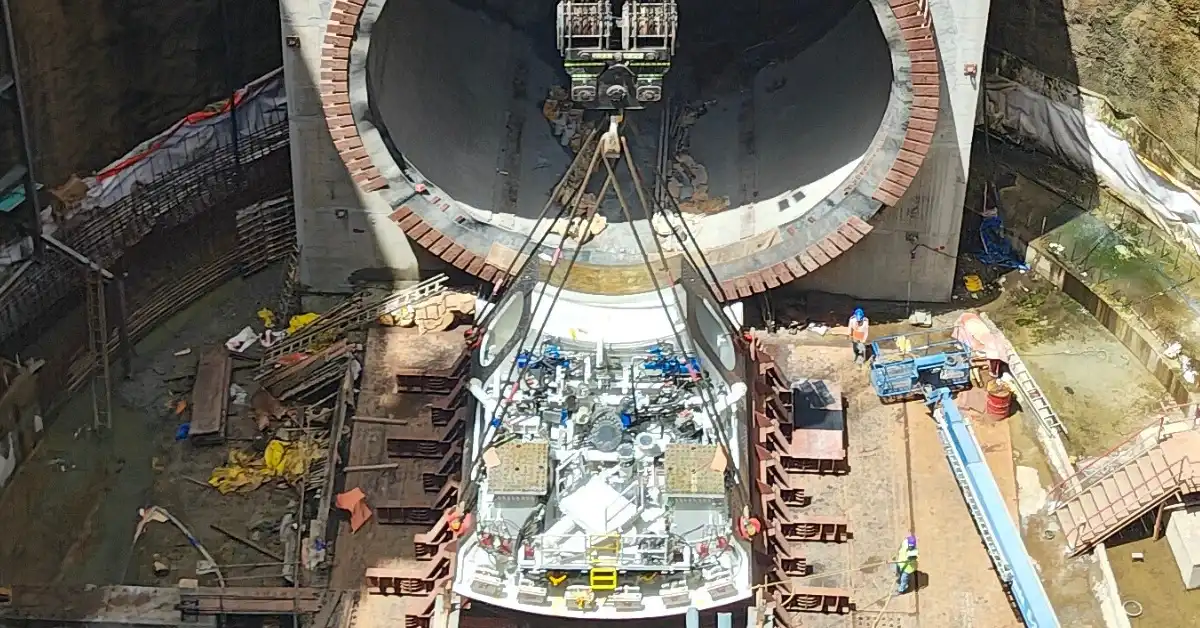
The TBM assembly activity commenced at Vikhroli with the lowering of one of the six main shield segments.
The segment, weighing around 170 metric tonnes and measuring 8.66 metres in length and 7 metres in width, was lowered to a depth of 56 metres below ground level.
NHSRCL has deployed two high-capacity TBMs for this stretch, weighing 3080 tonnes and 3184 tonnes respectively.
These machines are based on Mix Shield or Slurry technology and are engineered to handle complex geology, including marine and soft ground conditions associated with the undersea section.
Read also : Jaipur metro phase-2 gets Union Cabinet nod: ₹13,037.66 crore, 41 Km north-south corridor to add 36 stations
Each TBM is approximately 95.32 metres long and comprises multiple integrated systems, including the cutter head, main bearing, erector, shields, and support gantries required for continuous tunnelling operations.
Three shafts have been constructed along the alignment to facilitate TBM operations.
The first is located at BKC, the second at Vikhroli, and the third at Sawli near Ghansoli. TBM-1 will be launched from Vikhroli towards BKC, while TBM-2 will advance from Sawli towards Vikhroli.
According to NHSRCL, the initial TBM drive is scheduled for July 2026, with the main tunnelling drive expected to begin in October 2026 after testing and commissioning.
The TBMs are designed to operate at a maximum cutterhead speed of 4 revolutions per minute, with an excavation rate of up to 49 millimetres per minute, allowing controlled and stable tunnelling progress.
Supporting infrastructure for the tunnel works includes a dedicated casting yard in Mahape, Thane, spread over 11.17 hectares.
The facility will produce approximately 77,000 precast segments to form 7,700 tunnel rings, with each ring consisting of nine standard segments and one key segment.
The casting yard is equipped with automated handling systems, batching plants, and steam curing units to ensure consistent quality in segment production.
NHSRCL stated that a range of monitoring systems, including surface settlement points, optical displacement sensors, strain gauges, and seismographs, are being deployed to monitor ground movement and ensure the safety of nearby structures during excavation.