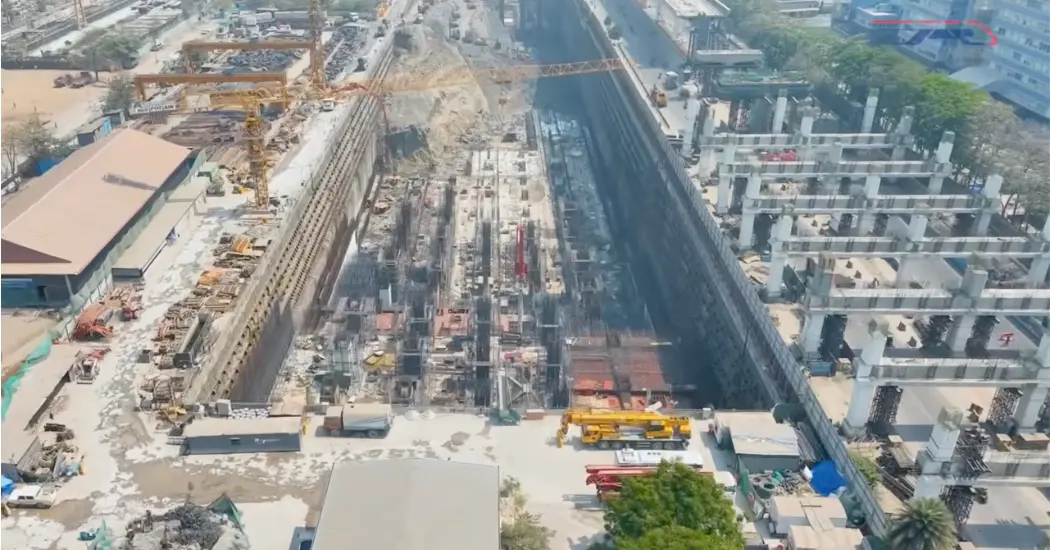
The Mumbai-Ahmedabad High-Speed Rail (MAHSR) project’s underground station at Bandra Kurla Complex (BKC) is progressing steadily, with excavation work nearing completion and structural development advancing across key components.
The BKC station, the only underground station on the 508 Km Mumbai-Ahmedabad Bullet Train corridor, is being developed at a depth of about 26 metres below ground level, equivalent to a 10-storey building. Excavation at the site is being carried out up to approximately 32 metres (around 100 feet).
The station will have a three-level underground structure comprising the platform level, concourse level, and a service floor. It is planned with six platforms, each around 415 metres in length, sufficient to accommodate a 16-coach bullet train.
At the surface level, the station will include entry and exit points, ventilation shafts, security and baggage screening areas, along with a central landscaped space with skylight provisions for natural lighting.
The design also ensures seamless connectivity with metro and road networks, including access to the nearby Metro Line 2B station and the MTNL building.
The first basement level will house equipment rooms, while the second basement level will include both unpaid and paid concourse areas, waiting lounges, ticketing facilities including ticket offices and ticket vending machines, customer care centres, and commercial retail spaces.
The third basement level will function as the terminal platform level, along with platform operational and station control rooms.
As per the latest progress cited in the Indian Railways magazine (April 2026 edition), approximately 94 per cent of excavation work has been completed, translating to around 17.51 lakh cubic metres of earthwork. In total, about 18.7 lakh cubic metres of excavation is required for the station site.
Construction activity at the site is being supported by three batching plants with a combined capacity of 120 cubic metres per hour. These are equipped with ice and chiller plants to regulate concrete temperature, ensuring quality during large-scale casting operations.
The station is also equipped with an on-site concrete laboratory, where tests such as water permeability and rapid chloride penetration are conducted. Additional samples are periodically sent to external laboratories for validation.
For structural works, M60-grade concrete is being used for the base slab, while M80-grade concrete is being used for columns. The base slab represents the deepest level of construction for the station. Around 2 lakh cubic metres of concrete is expected to be used for base slab casting, of which 84,349 cubic metres has already been poured.
Each base slab casting operation requires between 3,000 and 4,000 cubic metres of temperature-controlled concrete, produced through in-situ batching and chilling systems.
Foundational works have been completed, including 100 per cent of secant piling (3,384 numbers), capping beams extending 2,203 running metres, and flood wall construction covering 2,078 running metres.
The BKC underground station is designed to handle high passenger volumes, with ample circulation space and amenities across levels, while skylight provisions are expected to enhance natural lighting within the underground structure.