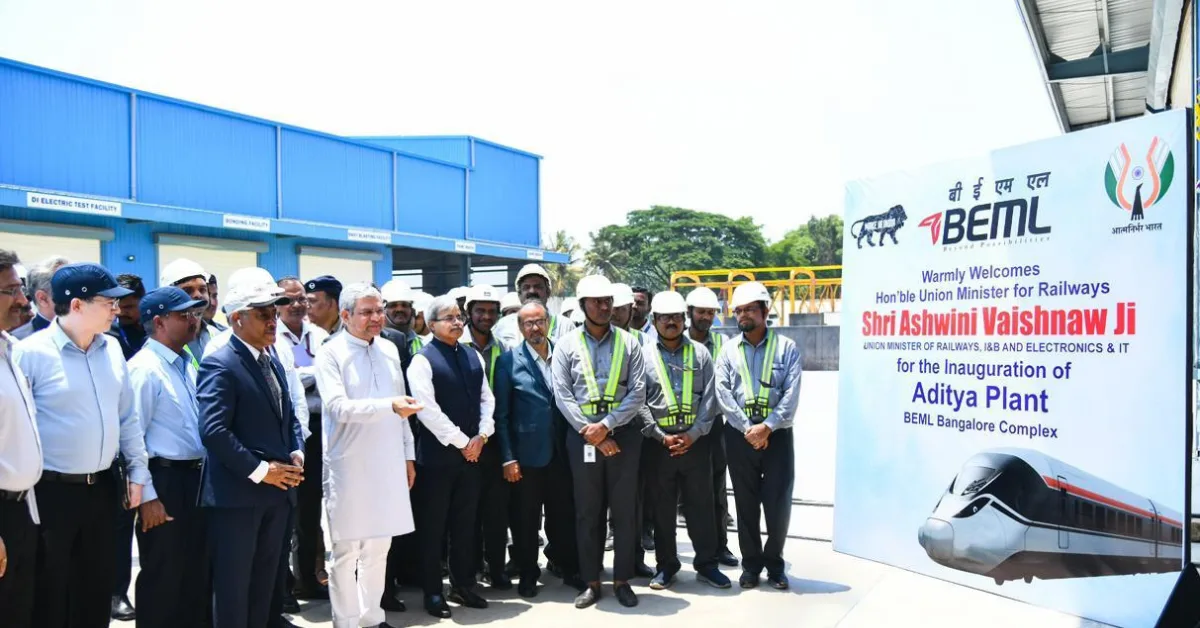
India’s indigenous high-speed train manufacturing programme has moved into a dedicated production phase, with Union Railways Minister Ashwini Vaishnaw inaugurating the Aditya complex at BEML’s Tippasandra campus in Bengaluru on Saturday, 25 April.
During his visit to BEML’s Tippasandra campus, Vaishnaw said high-speed rail technology is highly complex and intricate, and that its development within India marks a significant milestone for indigenous engineering, according to a statement by the Ministry of Railways.
The minister also linked high-speed rail to the creation of integrated regional mobility corridors, saying the arrival of such trains would change how major cities are viewed in relation to one another.
Citing the proposed Chennai-Bengaluru high-speed rail route, Vaishnaw said the travel time between the two southern cities is expected to drop to just 73 minutes, effectively making them part of a single integrated hub.
Vaishnaw praised the engineering talent at the Tippasandra facility and said the work being carried out there on next-generation rolling stock is central to the vision of a developed India.
The BEML facility has been set up for high-speed rail manufacturing and is currently designed to manufacture B-28 coaches.
The B-28 programme is being taken forward after challenges in sourcing rolling stock from Japan for the high-speed rail project.
According to the Ministry of Railways’ earlier submissions to the Parliamentary Standing Committee on Railways, it was decided to start high-speed rail operations on the Mumbai-Ahmedabad corridor using B28, India’s indigenous bullet trainset.
The indigenous trainsets are being developed by BEML under a ₹866.87 crore contract awarded by the Integral Coach Factory in October 2024 for the design, manufacturing and commissioning of two high-speed trainsets. Each trainset will comprise 8 cars.
The trainsets are being designed for a speed of 280 kmph and an operating speed of 250 kmph.
They will have a fully air-conditioned Chair Car configuration, reclining and rotatable seats, special provisions for passengers with restricted mobility, and onboard infotainment systems.
The first indigenous high-speed trainset is likely to be ready by the first quarter of 2027, after which it will undergo extensive testing and trials.
The ministry has earlier indicated that efforts are underway to start operations using B28 on the 97 Km Surat-Vapi section of the bullet train corridor in August 2027.
The 508 Km Mumbai-Ahmedabad High Speed Rail corridor, India’s first bullet train project, is being implemented with Japanese technical and financial assistance.
The corridor will connect Mumbai and Ahmedabad through 12 stations, including Thane, Virar, Boisar, Vapi, Bilimora, Surat, Bharuch, Vadodara, Anand and Sabarmati.
Read also: Mumbai-Ahmedabad bullet train project hits 59.1% physical progress as spending crosses ₹90,396 crore