
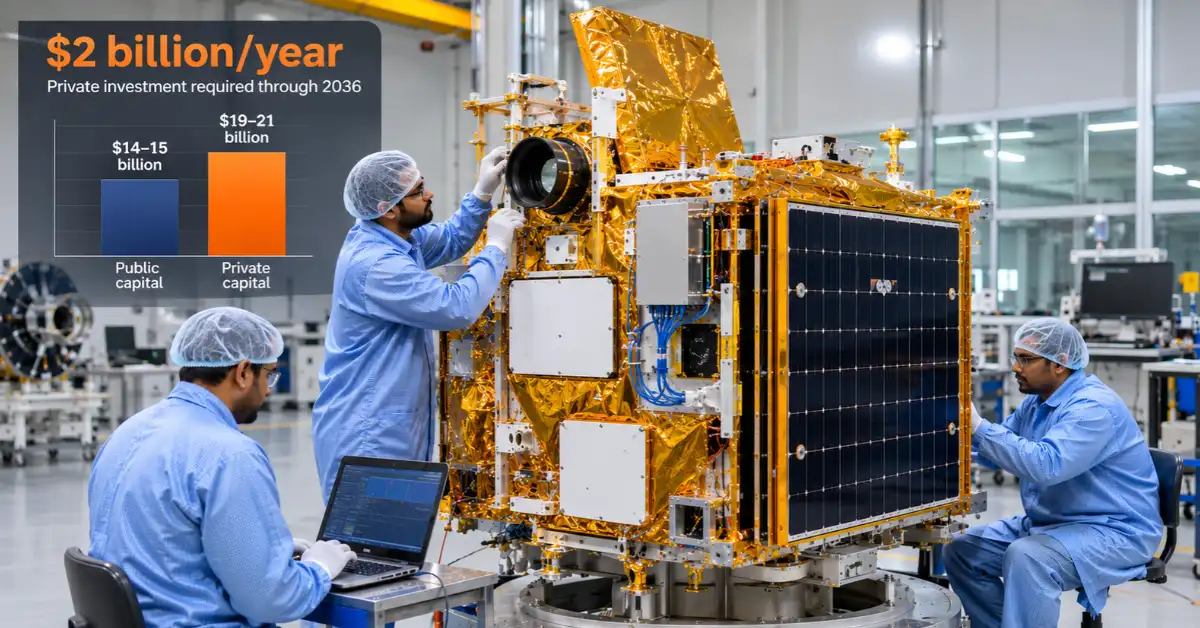
New Delhi, November 25: India’s space industry will need approximately $2 billion in private investment annually through 2036 to expand its satellite, launch and manufacturing capabilities, according to a new industry blueprint released in New Delhi on November 24.
The report, titled “Space Economy 2036: The India Blueprint”, was launched at the India International Space Conclave, held on November 23–24. Prepared by Starfleet India Capital Advisors in partnership with the Indian Space Association (ISpA), it outlines financing and institutional measures needed to support the growth of India’s space industry over the next decade.
The report estimates that India’s space sector will require $34–37 billion in capital investment between 2026 and 2036. It projects that public budgets could contribute around $14–15 billion, leaving an estimated $19–21 billion to be financed by private investors and financial institutions.
These figures represent estimated investment requirements rather than approved government expenditure or funding commitments.
According to the blueprint, India’s space industry has developed technological capabilities in satellite manufacturing, launch services and related applications, but access to long-term financing remains a major challenge.
The report says start-up equity currently provides only a fraction of the approximately $2 billion in private capital required each year. It recommends encouraging banks, insurance companies, pension funds and other institutional investors to participate in the sector to support larger commercial projects.
The proposed financing measures are intended to help private companies expand satellite manufacturing, launch infrastructure, ground networks, communication systems and other space-related operations.
One of the report’s main recommendations is the creation of an India Space Growth Fund at Gujarat International Finance Tec-City’s International Financial Services Centre (GIFT IFSC).
The proposed fund would be privately managed, with a target size of $500 million to $1 billion and public anchor participation capped at 25%.
The blueprint suggests establishing the fund by 2028 to improve access to growth capital for space companies. However, the proposal has not been announced as an approved government financing programme.
The report also recommends developing specialised financing mechanisms, including credit guarantees, infrastructure investment options and insurance arrangements to address risks associated with space projects.
Another major recommendation concerns government procurement. The blueprint suggests that government agencies increasingly purchase space-based services through funded contracts rather than relying solely on traditional equipment procurement.
It proposes a rolling three-year statement of funded government demand, milestone-based payments and pilot service contracts.
According to the report, predictable government contracts could help private space companies demonstrate reliable revenue and attract loans and long-term investment.
The blueprint also calls for stronger insurance and liability arrangements to improve investor confidence.
Among its recommendations are a national space-risk database, a proposed insurance pool for initial missions and a clearer legal framework governing liability for space activities.
It also suggests expanding export financing through the Export-Import Bank of India and improving access to infrastructure financing for launch facilities, testing centres and ground-based space assets.
The report recommends exploring bonds and infrastructure investment trusts to finance operational space infrastructure once projects demonstrate stable revenue.
The blueprint uses India’s existing target of developing a $44 billion space economy by 2033 as the basis for assessing future financing needs. The target includes projected space-related exports of $11 billion.
India’s space economy was estimated at approximately $8.4 billion in 2022–23, representing around 2% of the global space economy.
Separately, Union Minister of State for Space Jitendra Singh said at the conclave on November 24 that India’s space economy, currently valued at nearly $9 billion, could grow to $40–45 billion in less than a decade.
According to the Department of Space, Singh highlighted the increasing role of private companies in satellite manufacturing, launch services and other space-related activities.
He said India’s space ecosystem had expanded from a single-digit number of start-ups to around 400–500 companies following reforms that opened the industry to greater private participation.
The minister also pointed to the establishment of NewSpace India Limited (NSIL) and the Indian National Space Promotion and Authorisation Centre (IN-SPACe) as important steps in encouraging private investment and commercial activity.
He encouraged Indian businesses and international investors to explore opportunities in the country’s expanding space industry.
The blueprint identifies financing as a critical requirement for converting technological progress into commercially sustainable businesses.
It proposes a phased approach through 2036, beginning with improvements to funding arrangements and government contracts, followed by greater participation from lenders and institutional investors.
However, the report’s recommendations remain proposals. Its publication does not mean that the government has approved the suggested investment funds, committed the estimated capital or adopted the proposed financing measures.
The release of the blueprint places long-term funding, commercial demand and industrial expansion at the centre of discussions about the future growth of India’s space sector.
Read also: Government issues new guidelines to address rural workers’ complaints over jobs and wages
Read also: Fuel and power inflation jumps to 32.84%, pushing India’s wholesale inflation higher