
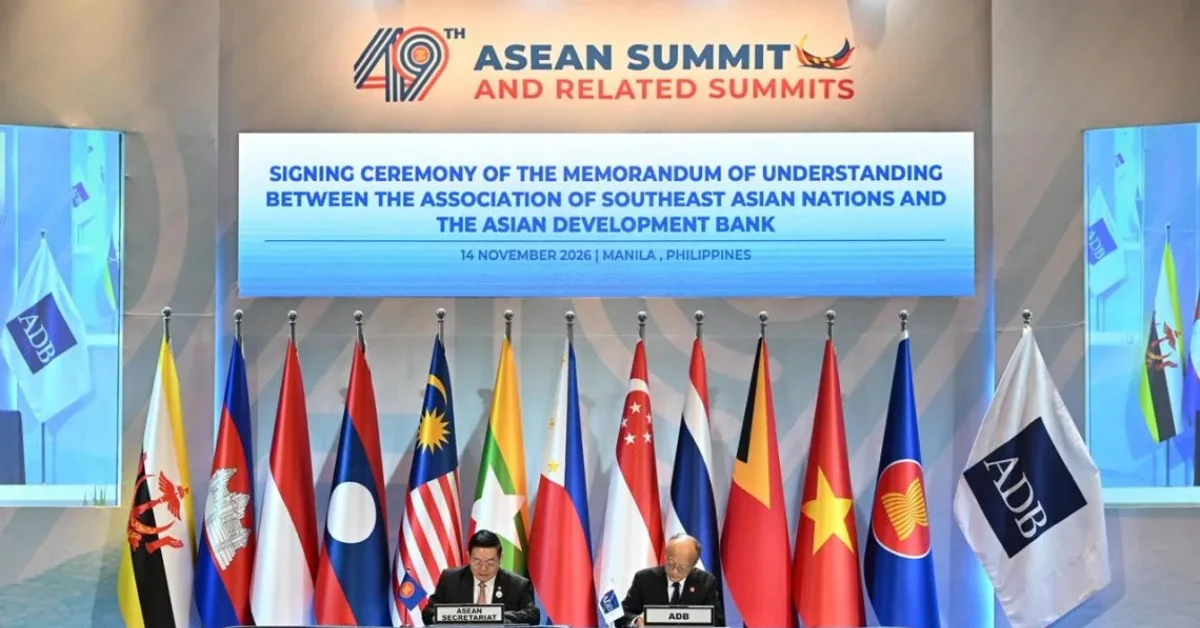
ADB and ASEAN sign five-year partnership, target $13 billion for water security and digital economy
Manila, November 15: The Asian Development Bank (ADB) and the Association of Southeast Asian Nations (ASEAN) have signed a five-year cooperation agreement and announced two initiatives targeting up to $13 billion in public and private financing for water resilience and digital economic development across Southeast Asia by 2030.
The memorandum of understanding (MoU) was signed on November 14 in Manila, the Philippines, by ADB President Masato Kanda and ASEAN Secretary-General Kao Kim Hourn.
The agreement was signed on the sidelines of the 28th ASEAN Economic Community Council Meeting, held alongside the 49th ASEAN Summit and related meetings.
According to ASEAN, the partnership aims to strengthen cooperation in sustainable development, economic competitiveness, human capital development and technical assistance.
Speaking at the ASEAN Business and Investment Summit, Kanda announced two financing initiatives intended to address the region’s growing infrastructure and development requirements.
The first, the ASEAN Resilient Rivers Initiative, aims to mobilise up to $8 billion by 2030 to improve water and food security and strengthen protection against floods and droughts.
The initiative will support investments in river basin management, modern irrigation systems, flood protection infrastructure, nature-based solutions and improved water resource management.
According to ADB, the programme is intended to help ASEAN countries identify and develop projects that address climate-related risks while improving the resilience of communities and agricultural activities.
The investments could also support food production, protect livelihoods and reduce economic losses associated with extreme weather events.
The second initiative, the ASEAN Regional Platform for AI and Digital Economy, aims to mobilise up to $5 billion in public and private financing by 2030.
The platform will support investments in digital infrastructure, cross-border payment systems, cross-border data connectivity, verifiable digital identities, cybersecurity and artificial intelligence readiness.
It is also intended to strengthen digital inclusion and improve interoperability between digital systems across ASEAN member countries.
The initiative will support the implementation of the ASEAN Digital Economy Framework Agreement (DEFA), which was signed on November 14, 2026.
The agreement is intended to facilitate digital trade, strengthen regional economic integration and create opportunities for businesses operating across Southeast Asia.
The proposed investments could particularly benefit micro, small and medium enterprises by improving access to digital services, payments and regional markets.
ADB will also work with governments to identify viable projects, support their preparation and attract investment from public and private financing sources.
The two newly announced initiatives form part of ADB’s broader commitment to mobilise up to $30 billion for ASEAN development priorities by 2030.
Kanda originally announced the $30-billion commitment in Cebu, the Philippines, in May 2026.
The latest initiatives, comprising up to $8 billion for resilient rivers and $5 billion for the digital economy, complete the sectoral financing targets under that previously announced commitment.
They do not represent an additional $13 billion beyond the original $30-billion package.
The wider financing programme also includes up to $6 billion for regional capital markets, $5 billion for the ASEAN Power Grid and $6 billion for the blue economy.
Together, the five initiatives account for the $30-billion financing mobilisation target.
However, these figures represent intended financing mobilisation rather than funds already approved for individual projects or disbursed.
The announced targets include potential public and private investment, and ADB has not specified how much of the latest $13 billion will come directly from its own financial resources.
The November 14 MoU also formalises ADB’s role as ASEAN’s main development bank under a five-year cooperation framework.
The partnership will focus on four priorities: sustainability and resilience, growth and competitiveness, human capital development, and knowledge exchange and technical assistance.
According to ASEAN, the agreement is intended to align ADB’s financial and technical assistance more closely with regional development priorities under ASEAN 2045: Our Shared Future.
The announcement comes as Southeast Asia faces substantial infrastructure investment requirements.
According to an ADB assessment published on November 10, ASEAN countries will need an estimated $7.1 trillion in infrastructure investment between 2026 and 2040, equivalent to approximately $476 billion annually.
The assessment estimates that public financing could cover about 45% of the region’s infrastructure requirements, leaving a significant need for private investment.
ADB also estimates an annual infrastructure financing gap of approximately $264 billion.
These estimates highlight the scale of investment required for transport, energy, water, digital connectivity and other essential infrastructure across Southeast Asia.
The newly announced water resilience and digital economy initiatives are intended to help address part of these requirements by supporting project development and mobilising investment.
For ASEAN member countries, the partnership could strengthen their ability to develop climate-resilient infrastructure, improve digital connectivity and attract financing for regional development priorities.
However, the eventual impact will depend on the selection of viable projects, financing arrangements, government implementation and participation by private investors.
The November 14 agreement marks a formal step towards strengthening cooperation between ADB and ASEAN, while the $13-billion initiatives establish financing mobilisation targets for water resilience and digital economic integration through 2030.
The announcements do not confirm that the full financing has been secured or that the proposed projects have already been completed.
Read also: Ola fined ₹10 lakh over misleading pre-ride tipping, CCPA orders practice to stop