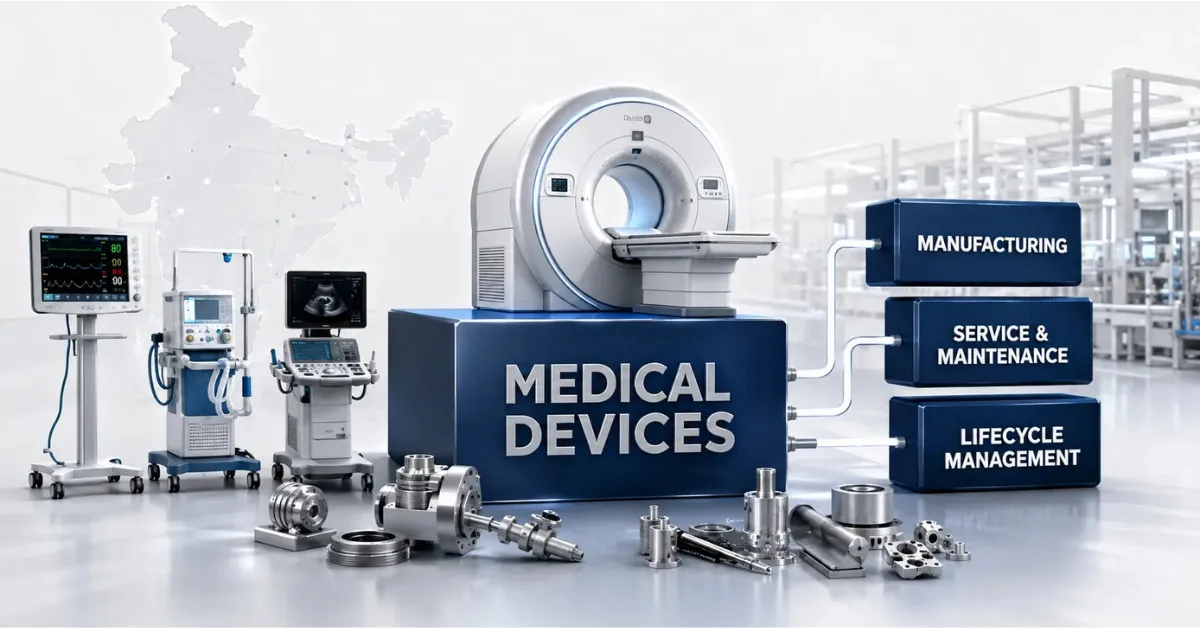
New Delhi: India’s medical device sector is expected to expand sharply over the coming decades, but sustaining that growth will require more than manufacturing capacity alone, with equipment servicing, maintenance and lifecycle management emerging as key areas of focus.
The country’s medical device industry, currently valued at around $14 billion, could grow to $30-50 billion within this decade and reach $250 billion by 2047, according to a FICCI-DUA Consulting white paper released on 7 August.
The white paper, titled Service and Maintenance of Medical Equipment in Indian Healthcare – Towards a Safe, Reliable and Sustainable Medical Device Maintenance Ecosystem, was released during the inaugural session of the ninth edition of India Medical Device 2026.
The event was organised by the Department of Pharmaceuticals in association with the Federation of Indian Chambers of Commerce and Industry (FICCI).
According to the white paper, rising healthcare demand, greater adoption of advanced medical technologies, government support for indigenous manufacturing and India’s ambition to emerge as a global medical technology hub are expected to drive growth in the sector.
The paper said initiatives including the Production Linked Incentive Scheme and the Strengthening of Medical Devices Industry Scheme have enhanced domestic manufacturing capabilities and improved the competitiveness of Indian manufacturers.
However, the white paper underlined that expansion of manufacturing alone would not be sufficient as the deployment of increasingly sophisticated medical equipment grows across hospitals and healthcare facilities.
It called for the development of a stronger ecosystem for servicing, maintenance, calibration and lifecycle management of medical devices.
The paper noted that medical equipment plays a critical role across diagnosis, emergency care, surgeries and advanced treatment, while reliable servicing throughout the operational life of equipment is important for maintaining safety and performance.
Regular and effective maintenance can help reduce equipment downtime, extend the useful life of medical devices and improve utilisation of healthcare investments, according to the white paper.
Among its key recommendations, the paper proposed a risk-tiered hybrid framework linked to the Central Drugs Standard Control Organisation’s classification system for medical devices.
Under the proposed framework, maintenance requirements would be aligned with the risk category of individual devices rather than applying the same approach to all medical equipment.
The white paper also recommended the creation of a national certification architecture for medical equipment service engineers and stronger technical training to develop skilled personnel capable of handling increasingly complex devices.
It further called for innovation in commercial models and rationalisation of the fiscal framework to encourage compliant maintenance practices.
Digital technology is also expected to play a larger role in the management of medical equipment.
The paper recommended wider adoption of predictive maintenance, digital monitoring and lifecycle management systems to improve equipment reliability and reduce downtime.
Read also : Cabinet approves ₹3,030 crore BHAVYA-Rasayan scheme to establish three dedicated chemical parks across India
Read also : India’s PLI schemes attract ₹2.40 lakh crore investment, exports exceed ₹15.2 lakh crore