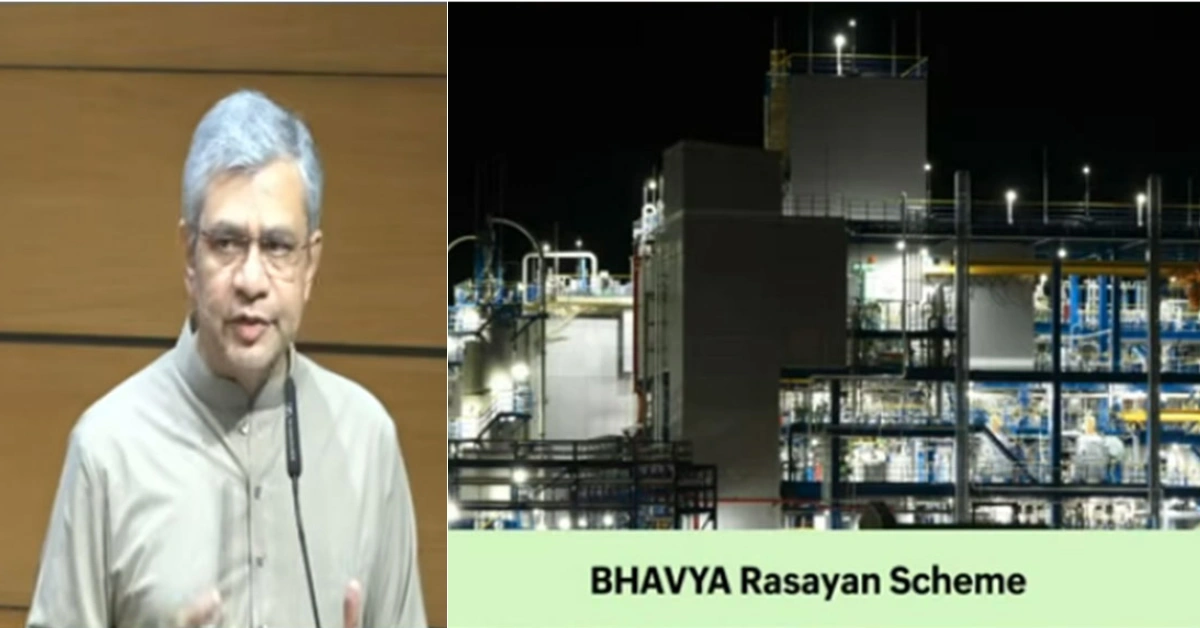
New Delhi: The Union Cabinet has approved the ₹3,030 crore Bharat Audyogik Vikas Yojana-Rasayan, or BHAVYA-Rasayan Scheme, to establish three dedicated chemical parks in the country.
The scheme was approved by the Cabinet chaired by Prime Minister Narendra Modi on 24 July 2026. It had earlier been announced in the Union Budget for 2026-27.
Of the total financial outlay, ₹3,000 crore will be used to develop common infrastructure facilities and basic utilities inside the proposed parks, while ₹30 crore has been allocated for administrative expenditure.
The scheme will run for five years from 2026-27 to 2030-31.
The Centre will provide a grant of up to ₹1,000 crore for each chemical park, subject to a minimum contribution of ₹500 crore from the respective state government.
The three parks will be developed by state governments through a Challenge Route selection process.
Each park will require at least eight square kilometres, or 2,000 acres, of contiguous and encumbrance-free land.
The proposed parks will offer plug-and-play infrastructure designed for chemical manufacturing and related industries.
Common facilities will include effluent treatment plants, treatment, storage and disposal facilities, hazardous-waste management infrastructure, water supply and distribution systems, solvent recovery and distillation facilities, and steam-generation networks.
The parks will also include interconnected pipeline networks, logistics facilities and warehousing infrastructure.
According to the government, shared infrastructure and utilities are expected to lower logistics costs and improve the cost competitiveness of domestic chemical manufacturers.
The scheme is also intended to support the development of the chemical industry across upstream, downstream and ancillary segments and improve India’s integration with global value chains.
The government expects the parks to support higher exports, import substitution, domestic production, investment and employment generation.
Chemical and petrochemical products are used across several downstream industries, including agriculture, textiles, pharmaceuticals, nutraceuticals, construction, automobiles and electronics.
The Cabinet said the scheme would also support environmentally compliant chemical manufacturing through centralised waste-treatment and hazardous-material management facilities.
The official release did not identify the states where the three chemical parks will be established or provide a park-wise implementation schedule.
Read also : India’s PLI schemes attract ₹2.40 lakh crore investment, exports exceed ₹15.2 lakh crore
Read also : Amul launches ₹700 crore Howrah dairy project, plans world’s largest curd manufacturing plant