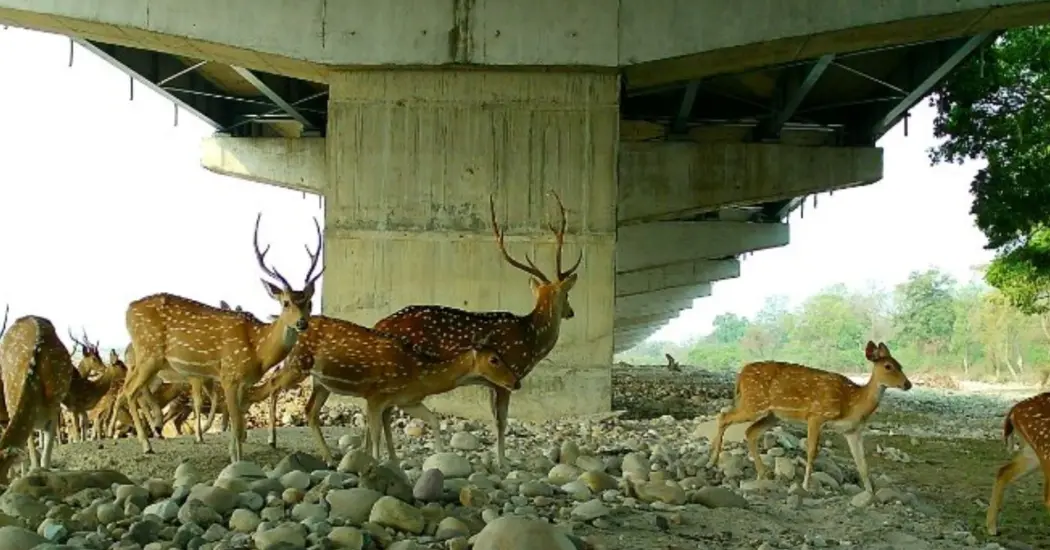
The government has said that a joint study by the National Highways Authority of India (NHAI) and the Wildlife Institute of India (WII) has provided the first empirical evidence of wildlife actively using animal underpasses along the Delhi-Dehradun Economic Corridor, highlighting the effectiveness of mitigation measures in ecologically sensitive areas.
A report titled ‘Landscapes Reconnected’ has been released by NHAI in collaboration with WII. The report documents the first evidence of wildlife using animal underpasses on the Delhi-Dehradun Economic Corridor.
The study was conducted along an 18 Km stretch between Ganeshpur and Asharodi and focused on assessing wildlife movement patterns, usage behaviour, and the effectiveness of underpass structures designed to ensure safe animal crossings.
The area of study was strategically divided into three distinct zones. Zone I covered 5.43 Km long stretch between Ganeshpur and Mohand, Zone II was 9.80 Km-long stretch from the Mohand settlement to Asharodi police check post and Zone III extended 3.14 Km from Asharodi police check post to Mohabewala in the Doon valley, covering flat Riverbed, Hilly terrain and mixed stretches of Sal Forest in the Shivalik range, the Ministry of Road Transport and Highways said in a statement on Friday, 10 April.
According to the study, a total of 111,234 images were captured during a 40-day monitoring exercise using 150 camera traps and 29 acoustic recorders.
Of these, 40,444 images corresponded to 18 unique wild species utilising the underpasses, including carnivores, herbivores, ungulates, pheasants, and primates.
The Golden Jackal emerged as the most frequently recorded species, followed by Nilgai, Sambar, and Spotted Deer.
The study also documented 60 instances of elephants using the corridors, demonstrating that even large mammals are able to navigate the infrastructure safely.
The corridor section studied includes approximately 10.97 Km of dedicated animal underpasses within a broader 20 Km stretch, featuring elevated structures with an average height of 6 to 7 metres to accommodate large wildlife.
The findings also highlighted the role of sound management in influencing animal movement.
While species such as jackals and wild boar were found to adapt to traffic noise, sensitive species like elephants and spotted deer preferred quieter segments of the underpasses, indicating the importance of noise mitigation strategies.
The ministry said the development of Delhi – Dehradun Economic Corridor has not only significantly reduced the probability of Human – wildlife conflict but also mitigated the risk of population isolation in the Shivalik landscape.
According to the statement, NHAI remains committed to integrating environmental sustainability into National Highway development and will continue to adopt innovative mitigation strategies and measures including data driven approaches to balance infrastructure growth with ecological and biodiversity conservation.
Read also : NHAI Launches ‘Arogya Van’ Initiative To Develop Medicinal Plant Corridors Along National Highways