
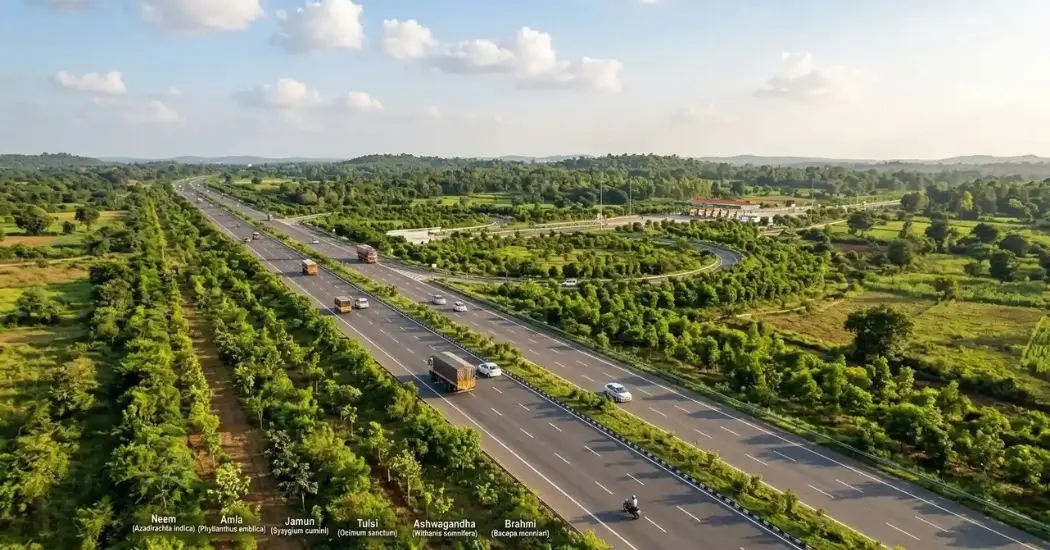
The National Highways Authority of India (NHAI) has launched a new initiative titled ‘Arogya Van’ to develop thematic medicinal tree plantations along vacant land parcels on National Highways, aimed at enhancing biodiversity and promoting ecological sustainability.
According to a statement issued by the Ministry of Road Transport and Highways on Wednesday, 8 April, the initiative focuses on introducing medicinal plant species along highway corridors to support pollinators, birds, and microfauna, thereby strengthening ecosystem resilience.
In the first phase, an action plan has been prepared covering 17 land parcels spread across more than 62.8 hectares.
Around 67,462 medicinal trees are proposed to be planted across National Highway stretches in states including Madhya Pradesh, Haryana, Delhi-NCR, Andhra Pradesh, Gujarat, Karnataka, Odisha, Tamil Nadu, Rajasthan, Maharashtra, and Chhattisgarh.
NHAI has identified approximately 36 species of trees with established medicinal properties, such as Neem, Amla, Imli, Jamun, Lemon, Gular, and Maulsari. These species will be planted based on their suitability to local agro-climatic conditions.
The authority stated that priority locations for plantation will include areas near toll plazas, wayside amenities, interchanges, cloverleaf junctions, and other prominent highway stretches to maximise public awareness and outreach.
Traditionally, plantation along National Highways has focused on a mix of native and avenue tree species aimed at greening and stabilisation.
The ‘Arogya Van’ model introduces a thematic approach by focusing specifically on medicinal plants, enhancing the ecological as well as educational value of these green corridors.
NHAI has also identified around 188 hectares of vacant land for plantation activities during the upcoming monsoon season, which is expected to improve survival rates and ensure long-term sustainability of the plantations.
The initiative aligns with the Government of India’s broader objective of promoting traditional systems of medicine such as Ayurveda, while also contributing to the conservation of indigenous medicinal flora.
According to the ministry, these plantations are envisaged as living repositories that will help raise public awareness about traditional medicinal knowledge and its relevance in contemporary healthcare practices.
The ‘Arogya Van’ initiative is part of NHAI’s ongoing efforts to integrate environmental sustainability into infrastructure development, with the aim of creating green highway corridors that serve both ecological and public awareness functions.