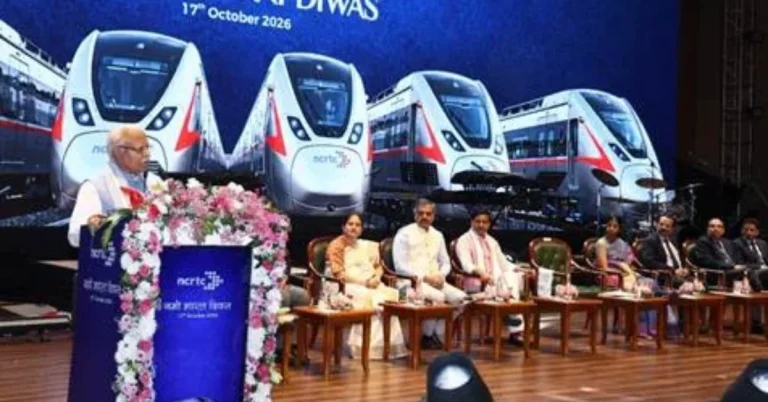
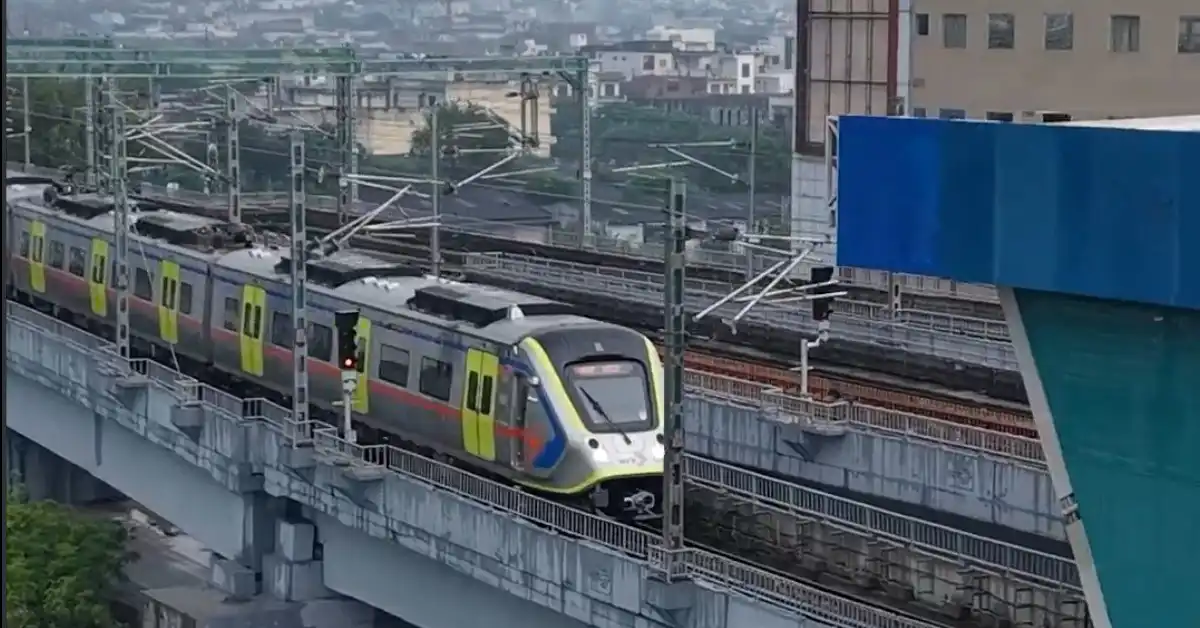
Prime Minister Narendra Modi on Sunday, 22 February, flagged off the Namo Bharat train and Meerut Metro services, formally dedicating the entire 82 km Delhi-Meerut Regional Rapid Transit System corridor to the nation.
The Prime Minister launched the services at Shatabdi Nagar Namo Bharat Station and undertook a ride, marking the full commissioning of India’s first Namo Bharat Regional Rapid Transit System.
The Prime Minister inaugurated the remaining 26 km of the corridor, comprising the 5 km stretch between Sarai Kale Khan and New Ashok Nagar in Delhi and the 21 km section between Meerut South and Modipuram in Uttar Pradesh.
With this inauguration, the complete 82 km Delhi-Meerut corridor has become operational.
Designed for a maximum speed of 180 km per hour, Namo Bharat is India’s first Regional Rapid Transit System and is expected to enable travel between Delhi and Meerut in under an hour, including intermediate stops.
The high-speed corridor connects Delhi with key urban centres such as Sahibabad, Ghaziabad, Modinagar and Meerut.
Sarai Kale Khan, the originating station of the corridor, is among the four Namo Bharat stations commissioned with this inauguration.
It has been developed as a major multi-modal hub connecting Hazrat Nizamuddin Railway Station, Delhi Metro’s Pink Line, Veer Haqeeqat Rai ISBT and Ring Road.
The other three newly commissioned Namo Bharat stations – Shatabdi Nagar, Begumpul and Modipuram – are located in Meerut.
In a first-of-its-kind initiative, the Prime Minister also inaugurated Meerut Metro services between Meerut South and Modipuram.
Operating on the same infrastructure as Namo Bharat, the metro system enables seamless integration of high-speed intercity and intra-city travel.
With a maximum operational speed of around 120 km per hour, Meerut Metro will cover the full stretch in approximately 30 minutes, including scheduled stoppages.
The integrated Namo Bharat and Meerut Metro model is expected to decongest road traffic across the Delhi-Meerut corridor and within the city, while contributing to reduction in vehicular carbon dioxide emissions.
The corridor is operated by the National Capital Region Transport Corporation, a joint venture of the Government of India and the states of Delhi, Uttar Pradesh, Haryana and Rajasthan.
Read also : Mumbai Metro Line 2B achieves key milestone with launch of two 20 m U-girders over Halav bridge in Kurla