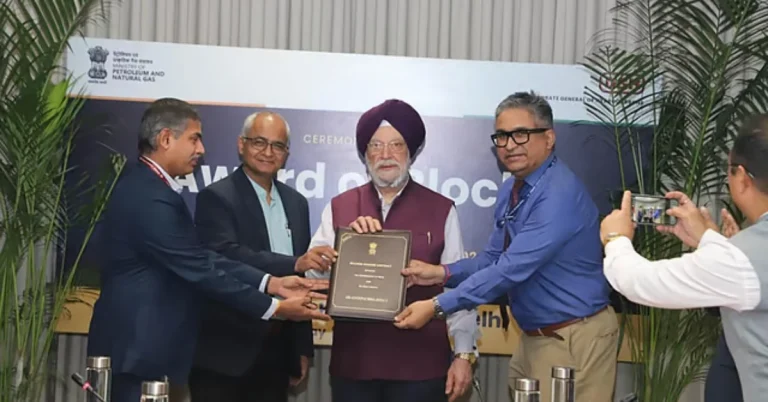
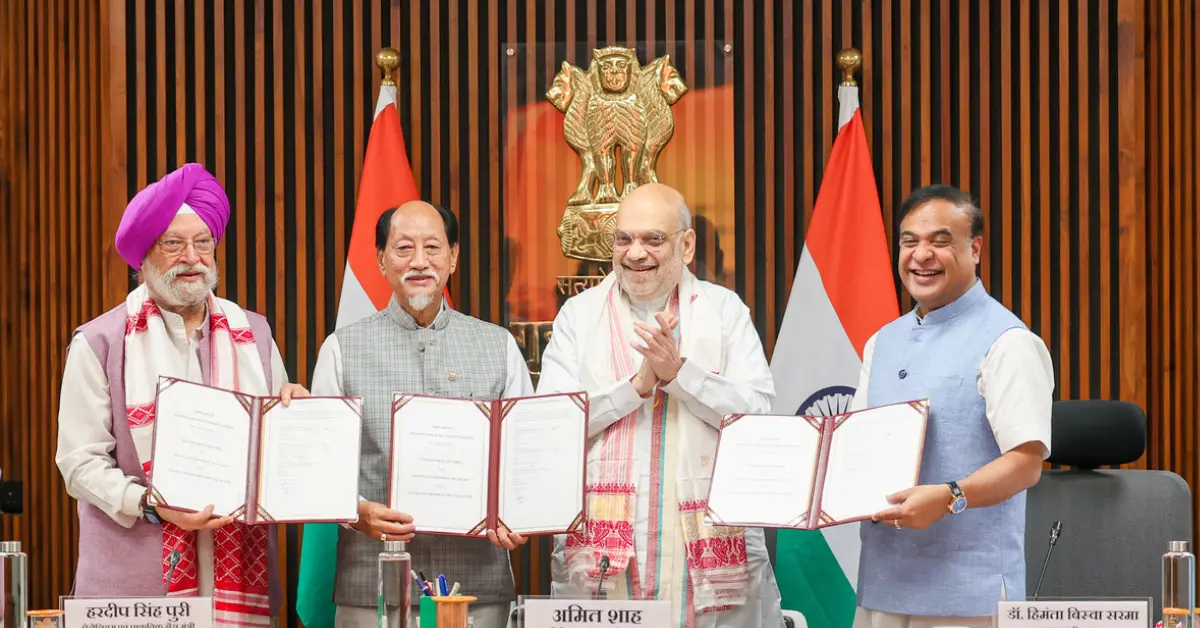
Nagaland is set to resume oil and gas production after a gap of 31 years, following a tripartite Memorandum of Understanding signed between the Centre, Assam and Nagaland to facilitate mineral oil operations in the Assam-Nagaland boundary areas.
The agreement was signed in New Delhi on 11 June in the presence of Union Home Minister Amit Shah.
Union Petroleum and Natural Gas Minister Hardeep Singh Puri, Assam Chief Minister Himanta Biswa Sarma and Nagaland Chief Minister Neiphiu Rio were also present.
Puri said the Northeast, which gave birth to India’s petroleum industry, is now ready to power the next chapter of the country’s energy journey.
He said the MoU marks a major step in India’s efforts to increase domestic exploration and production of hydrocarbons, as it opens up a new basin for fresh wildcat exploration.
According to Puri, Assam accounts for nearly 22% of India’s crude oil reserves and around 15% of the country’s natural gas reserves, while Nagaland has significant hydrocarbon potential in the Naga-Schuppen Belt of the Assam-Arakan Basin.
Nagaland commercially produced crude oil and natural gas between 1981 and 1994.
The Oil and Natural Gas Corporation (ONGC) first discovered oil at the Champang field in the Wokha district in 1973. During its 13 years of operational extraction, ONGC drilled approximately 25 wells and successfully produced over 1.036 million metric tonnes of crude oil from the region.
Operations abruptly halted in May 1994 due to severe constitutional, environmental, and security disputes.
The Ministry of Home Affairs said the agreement will facilitate mineral oil operations in the Assam-Nagaland boundary areas and provide a coordinated framework for operational continuity, safety and security of personnel and assets, and better coordination among stakeholders.
Shah said the agreement will open possibilities for oil and natural gas exploration as well as mineral mining, and remove a major obstacle in the economic development of both Assam and Nagaland.
He said Nagaland had agreed to oil exploration across the entire state, beyond the six designated fields.
The Home Minister also said the current extraction capacity of 1,000-1,500 barrels per day could increase more than tenfold after the signing of the MoU.
The government said the MoU is expected to encourage investment in the upstream petroleum sector and support India’s energy security objectives by providing greater certainty and stability for ongoing and future hydrocarbon operations in the area.
Puri said the framework will provide certainty to investors, facilitate operational continuity, enable regulatory coordination and create conditions needed for long-term investment decisions.
He added that the resumption of mineral oil operations will generate direct and indirect employment, stimulate local entrepreneurship, strengthen physical infrastructure and create opportunities for contractors, service providers and small businesses.
The agreement is also being seen as a significant step for the Northeast’s economic development, with the government saying it reflects cooperative federalism and constructive engagement between the Centre and the two state governments.
Read also : India assesses over 102 GWp floating solar potential, dedicated scheme in the works