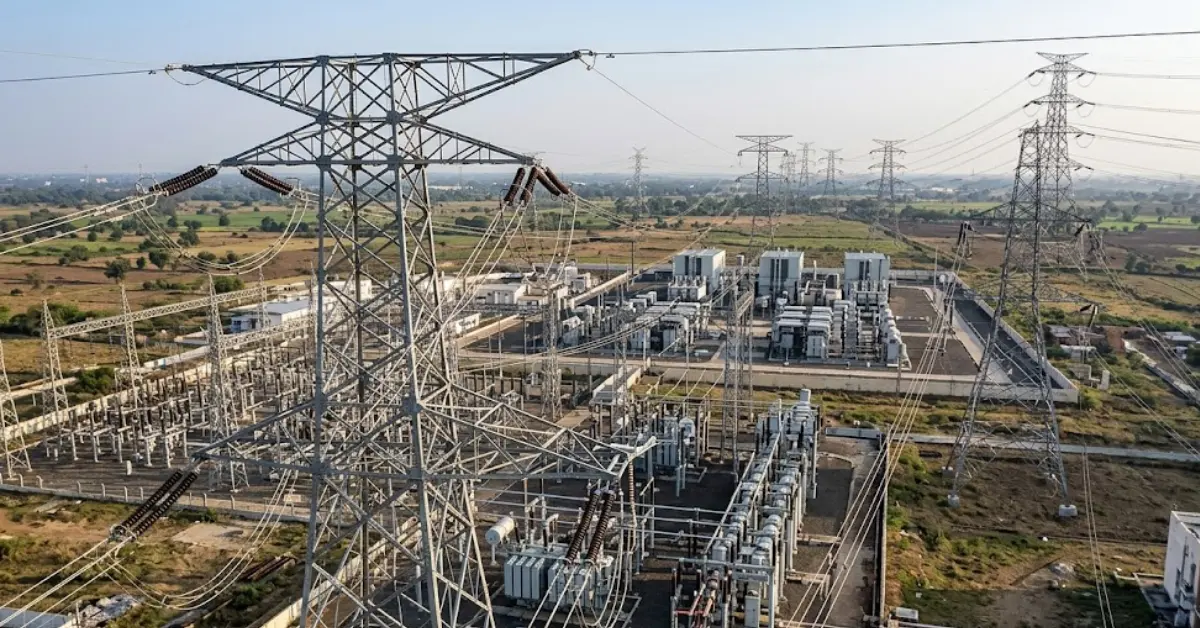
The Central Electricity Authority has issued standard implementation timelines for Inter-State Transmission System projects, bringing a uniform schedule for planning and execution of key transmission works across the country.
The timelines were approved by the National Committee on Transmission in its 40th meeting held on 15 April 2026.
The move is aimed at improving predictability and ensuring coordinated development of India’s transmission network.
According to the office memorandum by the CEA, greenfield AIS, GIS or hybrid substations at 765 kV or 400 kV level will have an implementation timeline of 36 months, while similar substations at 220 kV or 132 kV level will have a timeline of 24 months.
HVDC systems, including transmission line and substation works, have been given a longer implementation window of 48 to 54 months.
For transmission lines, the CEA has fixed 30 months for 765 kV double-circuit lines of less than 100 km length and 36 months for lines above 100 km.
For 400 kV double-circuit lines, the timeline will be 24 months for lines below 50 km and 30 months for lines above 50 km.
The implementation timeline for 220 kV or 132 kV lines has been fixed at 24 months.
The memorandum also sets timelines for augmentation works at existing substations.
Read also : Non-fossil capacity crosses 53% of India’s installed power base as solar reaches 157 GW
Augmentation at existing AIS substations of 400 kV and above will take 30 months, while such works at 220/230 kV and below will have a 24-month schedule.
Augmentation at existing GIS or hybrid substations of 132 kV and above will have a timeline of 30 months.
For hilly and difficult terrains in the North Eastern Region, Sikkim, Jammu and Kashmir, Ladakh and Himachal Pradesh, an additional period of 6 to 12 months may be added on a need and merit basis.
The CEA has also clarified that if a transmission scheme includes multiple types of projects, the timeline of the activity with the maximum implementation period will be considered for the scheme as a whole.
However, in urgent cases, a compressed schedule may be considered on a case-to-case basis.
Generation developers, transmission developers, discoms, bulk consumers and other stakeholders have been advised to factor these timelines into their generation and load schedules, financial closure, equipment procurement and related project milestones.
The standardisation is expected to help align generation and demand planning with the corresponding transmission infrastructure, reducing uncertainty in project execution and grid development.
Read also : Centre denies Oman–Gujarat deep-sea pipeline talks, says no proposal under consideration