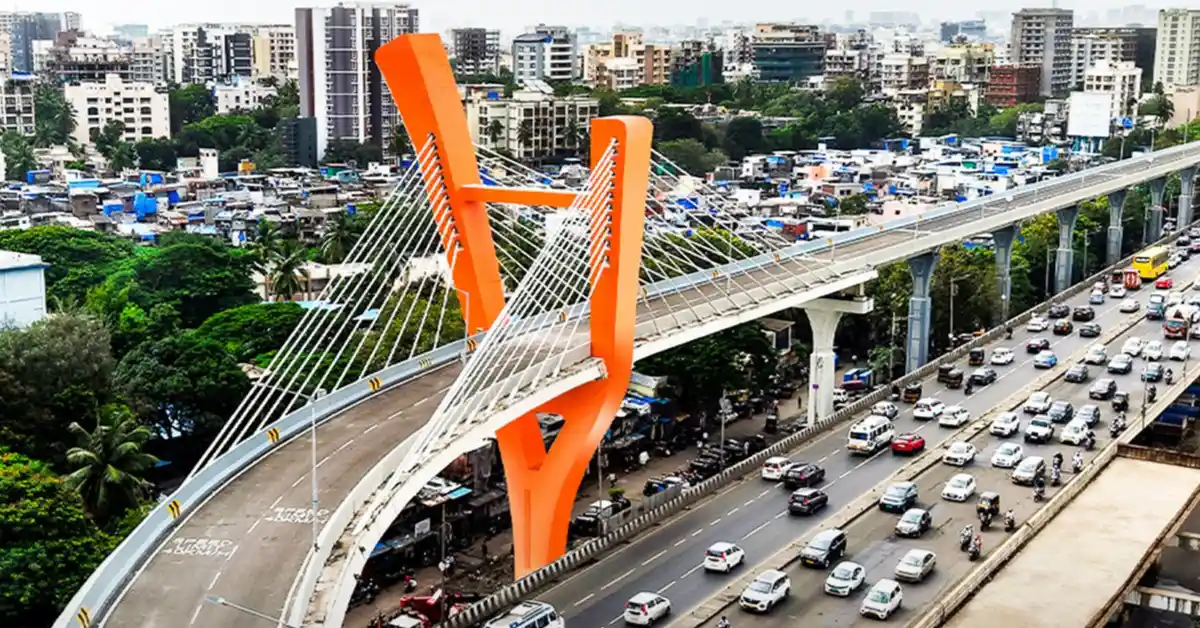
The Mumbai Metropolitan Region Development Authority (MMRDA) has completed the final structural link of the Santacruz-Chembur Link Road (SCLR) Phase-II, bringing the 10.88 Km east-west corridor to the verge of completion.
The milestone was achieved with the successful launch of twin 54-metre composite girders, weighing approximately 358 metric tonnes, at two levels over the existing Vakola Nallah bridge between Bharat Diamond Bourse, BKC and Vakola.
The operation involved the use of 700MT and 500MT heavy-duty cranes and was executed without traffic disruption, with MMRDA stating that full-span launching was adopted due to site constraints where conventional support systems were not feasible.
With this, the BKC-Vakola arm — considered the last critical missing link across the corridor — has been structurally completed.
The section spans around 1.4 Km and includes 500 metres of 4-lane elevated carriageway along with 900 metres of 2-lane connecting arms.
Once operational, the SCLR corridor will function as a continuous, signal-free east-west connectivity spine, integrating multiple elevated arms, bridges and connectors into a unified mobility network.
The corridor will provide direct connectivity between the Eastern Express Highway and the Western Express Highway, while linking key urban nodes including Bandra Kurla Complex, Santacruz, Vakola, Kalina, Kurla and Chembur.
Maharashtra Chief Minister Devendra Fadnavis said the completion of the final arm transforms the SCLR into a fully integrated east-west corridor of nearly 11 Km, highlighting its role in reducing congestion and improving travel efficiency across Mumbai.
Deputy Chief Minister and MMRDA Chairman Eknath Shinde described the project as a lifeline for daily commuters, stating that the integration of multiple arms into a seamless network will help ease traffic pressure across the city.
MMRDA Metropolitan Commissioner Sanjay Mukherjee said the milestone marks the transition from isolated project segments to a unified mobility system, adding that the corridor will significantly improve travel times and network efficiency.
The BKC-Vakola elevated connector is expected to play a key role in dispersing traffic across multiple routes, reducing bottlenecks at key junctions.
With the final structural works now in place, the corridor is moving towards full completion, marking a shift from fragmented connectivity to an integrated urban transport network in Mumbai.
Read also : India launches first barrier-less tolling system on Surat-Bharuch section of NH-48 in Gujarat