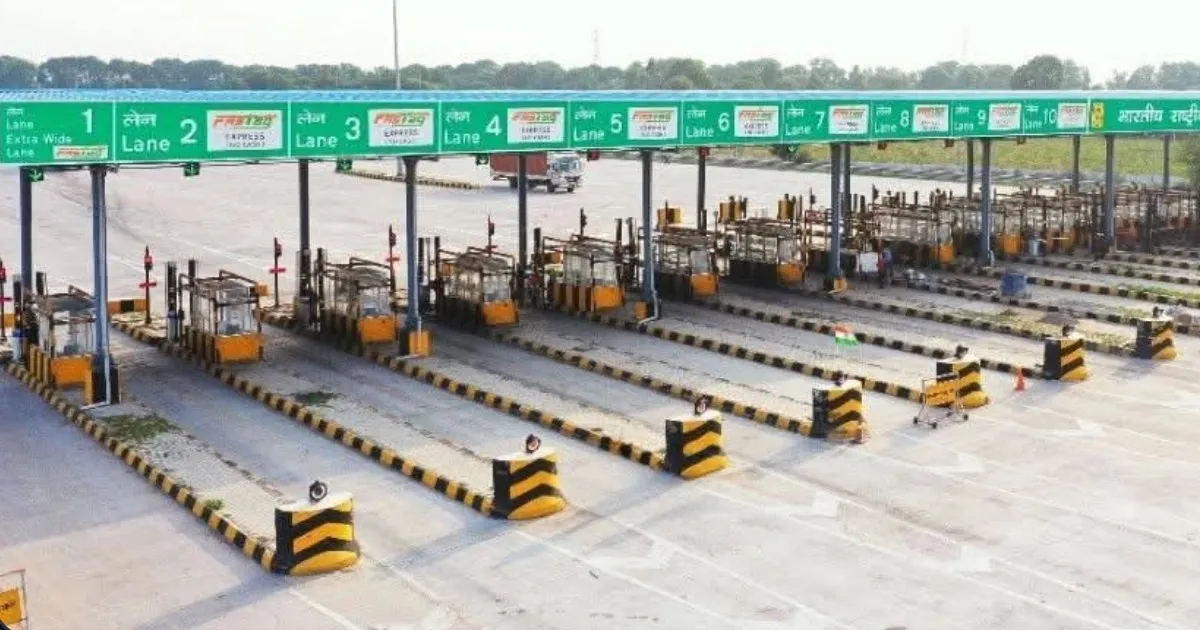
India collected about ₹2,27,178 crore in user fee from toll plazas on National Highways over the last five financial years, with collections rising steadily year after year, according to the data presented by the government in Parliament on Thursday, 12 March.
Replying to a question in the Lok Sabha, Road Transport and Highways Minister Nitin Jairam Gadkari said that the revenue collected by the Central Government from user fee collection is deposited in Consolidated Fund of India (CFI) and the funds provided through budgetary allocation are utilised for further maintenance, development and augmentation of National Highways.
According to the data shared by the minister, toll collections stood at ₹27,926.67 crore in financial year 2020-21. The figure rose to ₹33,928.66 crore in 2021-22 before increasing significantly to ₹48,032.40 crore in 2022-23.
Collections continued to grow thereafter, reaching ₹55,882.12 crore in 2023-24 and further rising to ₹61,408.15 crore in 2024-25, marking the highest annual toll revenue recorded in the five-year period.
The minister informed Parliament that toll rates on National Highways are revised annually in accordance with the National Highways Fee (Determination of Rates and Collection) Rules, 2008, with revisions linked to the wholesale price index.
Read also : India’s high-speed highway network expands as 3,644 Km of expressways and HSCs become operational
The minister added that government has also reviewed the tolling framework periodically to maintain a balance between revenue requirements for highway development and minimising the burden on road users.
Several policy measures have been introduced to rationalise toll collection and improve user convenience.
These include restrictions on user fee for highways with a higher proportion of structures such as bridges and tunnels, and reduced toll rates when highways are upgraded from two-lane paved shoulder configuration to four or more lanes.
The government has also introduced an annual pass for non-commercial vehicles such as cars, jeeps and vans.
The pass allows up to 200 crossings at National Highway fee plazas or one year of validity, whichever occurs earlier, for a payment of ₹3,000.
In addition, rules have been amended to reduce the penalty for vehicles without FASTag or with inactive FASTag from two times the applicable toll to 1.25 times when the user opts to pay through UPI.
The government is also moving towards Multi-Lane Free Flow electronic tolling, which will enable barrier-less toll collection using technologies such as automatic number plate recognition, artificial intelligence-based analytics and RFID-based FASTag systems.
Under the system, toll charges will be deducted automatically without vehicles needing to stop or slow down at toll plazas.
The minister also clarified that collection of user fee at fee plazas on National Highways is not related to the recovery of project development cost.
Read also : 667-km Delhi-Amritsar-Katra Expressway moves forward with multiple sections completed and others advancing