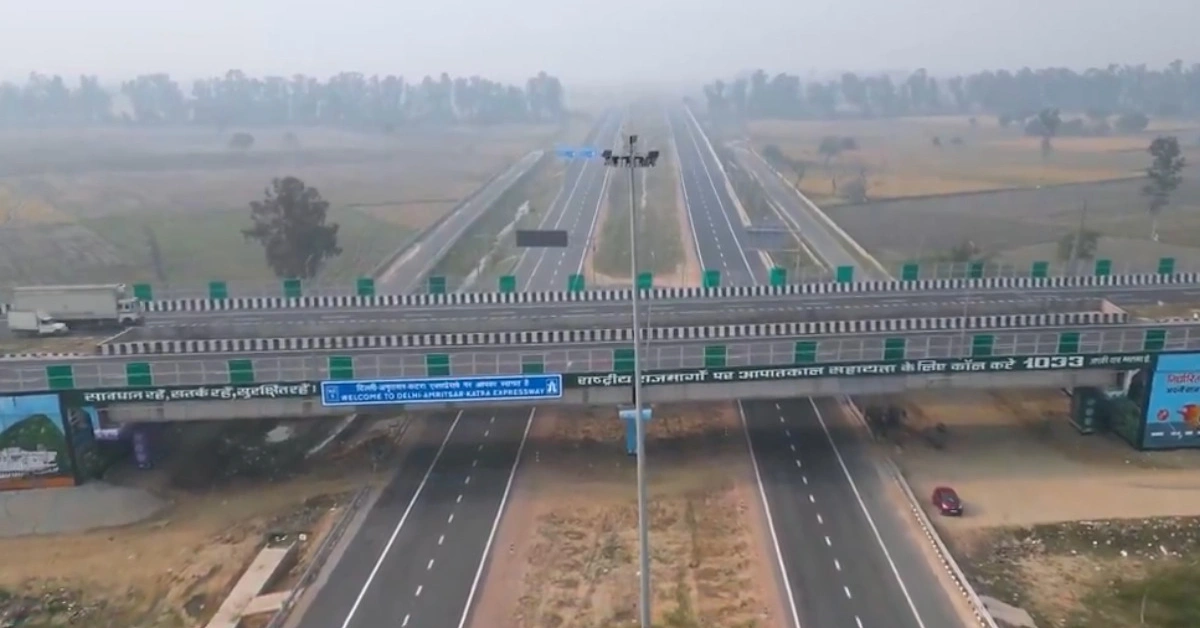
Union Road Transport and Highways Minister Nitin Gadkari informed the Rajya Sabha that construction of the 667 Km Delhi-Amritsar-Katra Expressway is at different stages across Haryana, Punjab and Jammu and Kashmir, with several sections already completed while multiple packages have missed their originally scheduled completion timelines.
The details were shared in a written reply in the Rajya Sabha regarding the status and progress of the expressway project.
The corridor is being developed to provide high-speed connectivity between Delhi, Amritsar and Katra and link major cities across northern India.
According to the information provided by the minister, the expressway is expected to reduce the distance between Delhi and Amritsar or Katra by around 40 Km.
Travel time between Delhi and Amritsar is projected to fall to about 5 hours, while the journey between Delhi and Katra could take about 7 hours once the project is fully completed.
Progress data shows that four sections located in Haryana have already been completed. These include Section I (34 Km), Section II (26.8 Km), Section III (30.6 Km) and Section IV (28.85 Km).
All four stretches have achieved 100 per cent physical progress and are now completed, though their originally scheduled completion dates ranged between December 2023 and January 2024.
Section V, spanning Haryana and Punjab with a length of 37.67 Km, has achieved 99.10 per cent physical progress.
While the stretch was originally scheduled for completion in May 2024, its revised expected completion date is March 2026.
Section VI in Punjab, measuring 30.91 Km, has recorded 95.33 per cent physical progress and has been completed despite its earlier scheduled completion date of May 2024.
Section VII, which is 36.94 Km long, has achieved 95.80 per cent progress and is now expected to be completed by March 2026 against an earlier scheduled completion target of July 2024.
Several stretches in Punjab remain under construction with varying progress levels.
Section IX (43.04 Km) has reached 71.81 per cent progress and is expected to be completed by June 2026, although its scheduled completion date was July 2024.
Section X (39.5 Km) with 62.99 per cent progress and Section XI (43.02 Km) with 43.45 per cent progress have seen contracts foreclosed and fresh bids invited for completing the remaining works.
Section XII in Punjab, which is 35.28 Km long, has achieved 26.12 per cent progress and is currently targeted for completion by February 2027.
Section XIII covering the Pathankot-Amritsar stretch of 25.8 Km forms part of the existing NH-54 alignment.
In the Punjab and Jammu and Kashmir segments, Section XIV (44.6 Km) has reached 82.81 per cent progress and is expected to be completed by June 2026 against an earlier scheduled completion date of September 2024.
In J&K, section XV (35.15 Km) has recorded 88.87 per cent progress and is now expected to be completed by October 2026, also later than the original September 2024 schedule.
Section XVI (20.39 Km) has achieved 92.93 per cent progress and is expected to be completed by June 2026.
Section XVII (28.92 Km) has reached 59.06 per cent progress and is targeted for completion by September 2026, while Section XVIII (15.3 Km) has achieved 59.11 per cent progress and is expected to be completed by August 2026.
The project’s another section in Punjab (spur to Amritsar) comprises three separate packages.
Section I (16.9 Km) has recorded 28.64 per cent progress and is expected to be completed by March 2028.
Section II (30.05 Km) saw its contract terminated and fresh bids have been invited for the remaining works.
Section III (28.07 Km) has achieved 29.70 per cent progress and is currently expected to be completed by February 2027.
The expressway connects Rohtak and Jind in Haryana; Sangrur, Malerkotla, Patiala, Ludhiana, Jalandhar, Kapurthala and Gurdaspur in Punjab; and Kathua and Jammu in the Union Territory of Jammu and Kashmir.
Apart from improving connectivity to the religious destinations of Amritsar and Katra, the corridor is also expected to strengthen regional industrial connectivity and support tourism in northern India.