The Department of Telecommunications has removed a key licensing barrier for connected vehicle and advanced car safety technologies, clearing the way for wider use of vehicle-to-vehicle and vehicle-to-everything communication systems in India.
The move follows an earlier announcement by Road Transport and Highways Minister Nitin Gadkari, who had said in January that the Centre was working to bring V2V communication to new cars.
At the time, Gadkari had said DoT had agreed in-principle to provide 30 MHz spectrum for V2V communication and that onboard units would be installed in cars for wireless data exchange between vehicles.
DoT issued separate notices on Thursday, 11 June, exempting radio spectrum used by these safety systems from licensing requirements.
One notification covers radar sensors in the 77 GHz to 81 GHz band, while another covers systems operating in the 5.9 GHz band, which is used for communication between vehicles and roadside infrastructure.
In practical terms, this allows automakers and component suppliers to deploy standard vehicle safety hardware in India without going through separate spectrum allocation for each use case.
The change also brings India closer to regulatory practices followed in markets such as the US and the European Union.
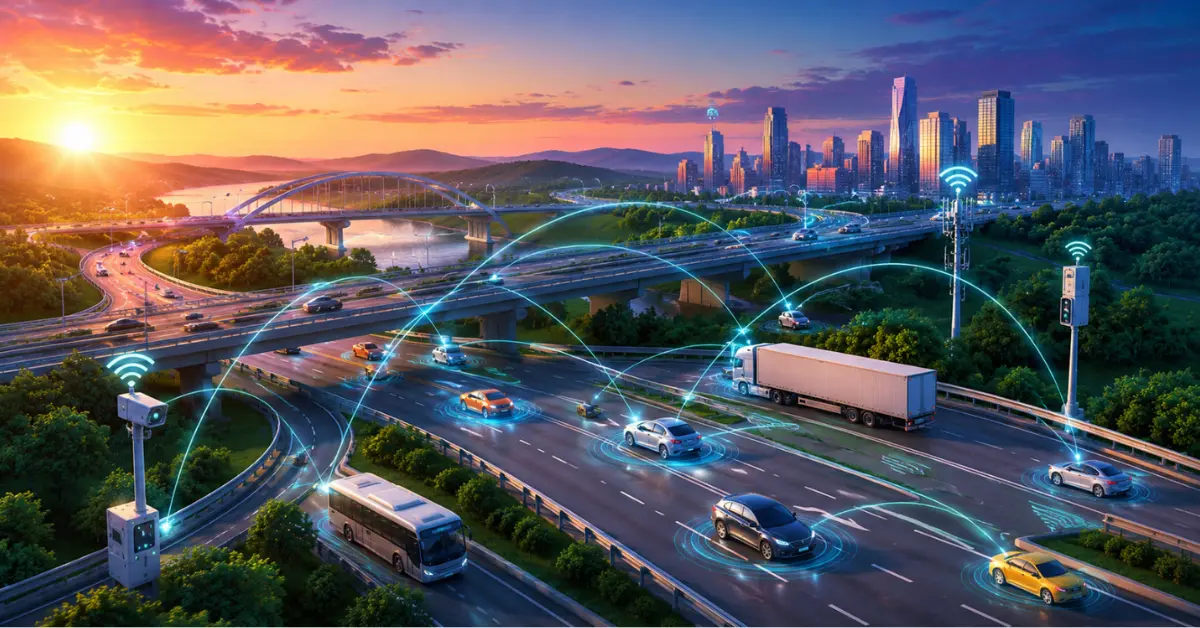
V2V technology allows vehicles to exchange real-time information such as speed, direction, location and braking behaviour.
If a vehicle suddenly slows down, changes direction or comes into a blind spot, nearby vehicles can receive an early warning before the driver visually detects the risk.
V2X is the wider version of the same system. It allows vehicles to communicate not only with other vehicles, but also with road infrastructure such as traffic signals, roadside units, emergency vehicles and, in future, connected pedestrian devices.
For India, the biggest use case is road safety. The system can help in situations where normal sensors or human vision have limits – blind curves, dense fog, sudden braking on highways, wrong-side movement, accident-prone junctions and emergency vehicle movement through traffic.
Read also: From satellite monitoring to slope stabilisation: How India is making hill roads safer
The 77-81 GHz radar band is also important for advanced driver assistance systems.
Radar sensors are used in features such as adaptive cruise control, emergency braking, blind-spot warning and collision avoidance.
By easing licensing requirements, the government has reduced one more hurdle for automakers to bring these features into more models.
India has one of the highest road accident burdens in the world.
According to a statement by Minister Gadkari in Lok Sabha last year, about 1.80 lakh lives are lost every year in road accidents.
Gadkari has repeatedly said that reducing road fatalities remains one of the road government’s key targets.
The latest DoT notifications do not mean that all new vehicles will immediately get V2V or V2X systems.
Automakers will still need compatible hardware, common technical standards, testing frameworks and coordination with road infrastructure agencies.
However, the spectrum clearance is a necessary first step.
Without licence-free or clearly permitted access to the relevant bands, large-scale deployment of connected vehicle safety systems would have remained difficult and expensive.
The development also comes at a time when TRAI is examining the regulatory framework for V2X communication in India.
Issues such as spectrum use, device certification, cybersecurity, privacy, interoperability and responsibility in case of system failure will need to be settled before mass deployment.
For car buyers, the impact may be gradual. Premium vehicles are likely to get these systems first, followed by wider adoption as costs fall and standards become clearer.
For the mobility sector, the decision marks an important shift from crash response to crash prevention.
If implemented well, V2V and V2X can make Indian roads more aware, allowing vehicles to warn each other before danger becomes visible.
That is the core promise behind the technology Gadkari had earlier described as a way for cars to communicate with each other and reduce accidents.