New Delhi: The Indian Space Research Organisation (ISRO) has successfully launched the EOS-05 Earth observation satellite aboard GSLV-F17, placing the spacecraft into its intended Sub-Geosynchronous Transfer Orbit (Sub-GTO).
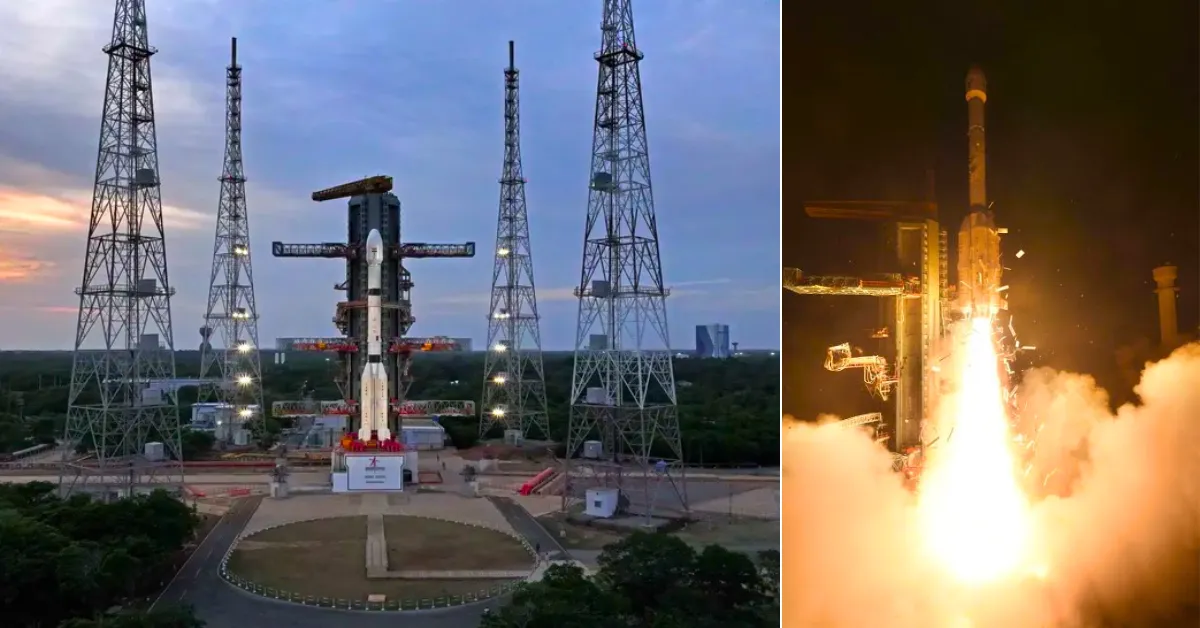
The GSLV-F17/EOS-05 mission lifted off from the Second Launch Pad at the Satish Dhawan Space Centre, SHAR, at 2:55 am IST on September 4.
ISRO said the mission was successfully accomplished and EOS-05 was placed into the intended orbit.
EOS-05 is a state-of-the-art Earth observation spacecraft and has been described by ISRO as India’s first-ever imaging satellite designed to operate from geosynchronous orbit.
The satellite has a payload mass of about 2,367 kg.
According to the mission brochure, EOS-05 was targeted for a Sub-GTO with a nominal perigee of 170 km and an apogee of 28,934 km. The specified orbital inclination was 19.28 degrees, with a tolerance of 0.1 degree.
GSLV-F17 marks the 19th flight of India’s Geosynchronous Satellite Launch Vehicle.
The three-stage launch vehicle stands 51.7 metres tall and had a lift-off mass of 420.5 tonnes for the EOS-05 mission.
Its first stage comprises an S139 solid rocket motor assisted by four L40H liquid strap-on boosters. The second stage uses a GL40HT liquid engine, while the third stage is powered by the CUS15 cryogenic upper stage.
The launch vehicle was also equipped with a 4-metre-diameter composite ogive payload fairing.
According to ISRO’s mission brochure, the S139 motor carried 138 tonnes of HTPB-based solid propellant, while the four L40H strap-ons together carried 170 tonnes of UH25 and nitrogen tetroxide propellant.
The second stage carried 42 tonnes of UH25 and nitrogen tetroxide, while the cryogenic upper stage carried 15 tonnes of liquid hydrogen and liquid oxygen.
The planned flight sequence involved successive stage separations and ignitions, followed by burnout of the cryogenic upper stage and separation of EOS-05 in the targeted transfer orbit.
GSLV-F17 follows the GSLV-F16 mission, which launched the NASA-ISRO Synthetic Aperture Radar satellite NISAR on July 30, 2025.
GSLV is ISRO’s three-stage launch vehicle equipped with an indigenous cryogenic upper stage and is designed to place spacecraft in the roughly 2,000-kg class into geosynchronous transfer orbit.
Read also: L&T delivers first indigenous multi-purpose vessel Samarthak to Indian Navy
Read also: India moves to procure Javelin anti-tank guided missile systems from US