
The Indian Air Force (IAF) has received the Final Operational Clearance (FOC) for the indigenous Netra Airborne Early Warning and Control system, marking an important step in India’s effort to build advanced airborne surveillance and battle management capability within the country.
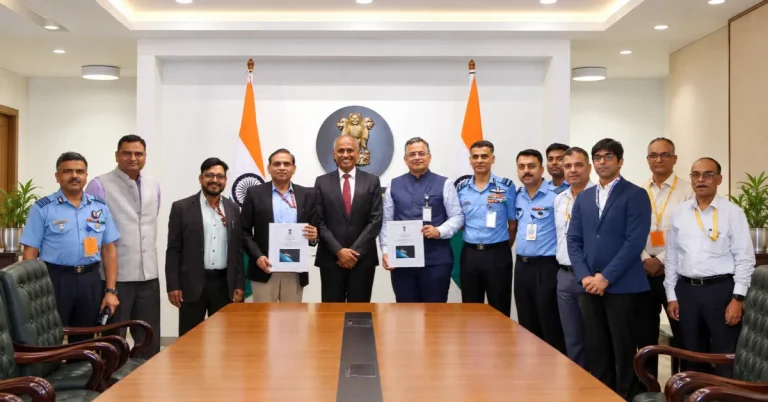
The FOC certificate was handed over by the Defence Research and Development Organisation to the Indian Air Force at a ceremony held in Bengaluru on 25 June 2026.
The event was presided over by Deputy Chief of the Air Staff Air Marshal Awadhesh Kumar Bharti.
Netra has been developed through close collaboration between the IAF, DRDO and associated Indian industries.
The system is designed to enhance airborne surveillance, situational awareness and battle management capability during air operations.
The system had received Initial Operational Clearance in 2017.
The latest clearance marks its transition from initial operational configuration to full operational acceptance by the user service.
Netra is mounted on the Embraer-145 aircraft platform and works as an airborne command-and-control system.
It uses onboard sensors to detect, track and identify aerial and sea-surface targets, while also helping controllers build a wider air situation picture.
The system can share this air situation picture with networked fighter aircraft and ground stations through secure data-links.
This makes it useful not only for surveillance, but also for coordinated air defence and combat management operations.
According to DRDO’s published details, the AEW&C system has radar and sensors for long-range detection and identification, onboard electronic support measures, communication support measures, and multiple operator workstations for command-and-control roles.
The importance of such systems has grown as modern air warfare depends heavily on early warning, real-time information sharing and network-centric operations.
Airborne surveillance platforms can look beyond the limitations of ground-based radars and support faster decision-making during high-pressure air operations.
During the Bengaluru event, Air Marshal Bharti referred to the operational utilisation and reliability of Netra during Operation Sindoor and the Balakot strikes.
He also highlighted the advantage of indigenous systems, saying such technologies give the services flexibility to modify and adapt platforms according to evolving war scenarios.
Senior DRDO officials also underlined the role of system engineering, flight testing and coordination between scientists, users and industry in bringing the programme to operational maturity.
The clearance is significant for India because airborne early warning aircraft are among the most complex defence systems to develop.
They combine aircraft integration, radar, electronic intelligence, secure communications, command-and-control systems and real-time data processing.
For the IAF, Netra adds an indigenous layer to airborne surveillance and battle management.
For India’s defence ecosystem, it represents a long-term capability that can support future upgrades and larger indigenous airborne warning programmes.