New Delhi, November 8: Defence Minister Rajnath Singh has urged India’s armed forces to strengthen their preparedness against cyberattacks, drone swarms and misinformation, warning that modern security threats increasingly extend beyond conventional warfare.
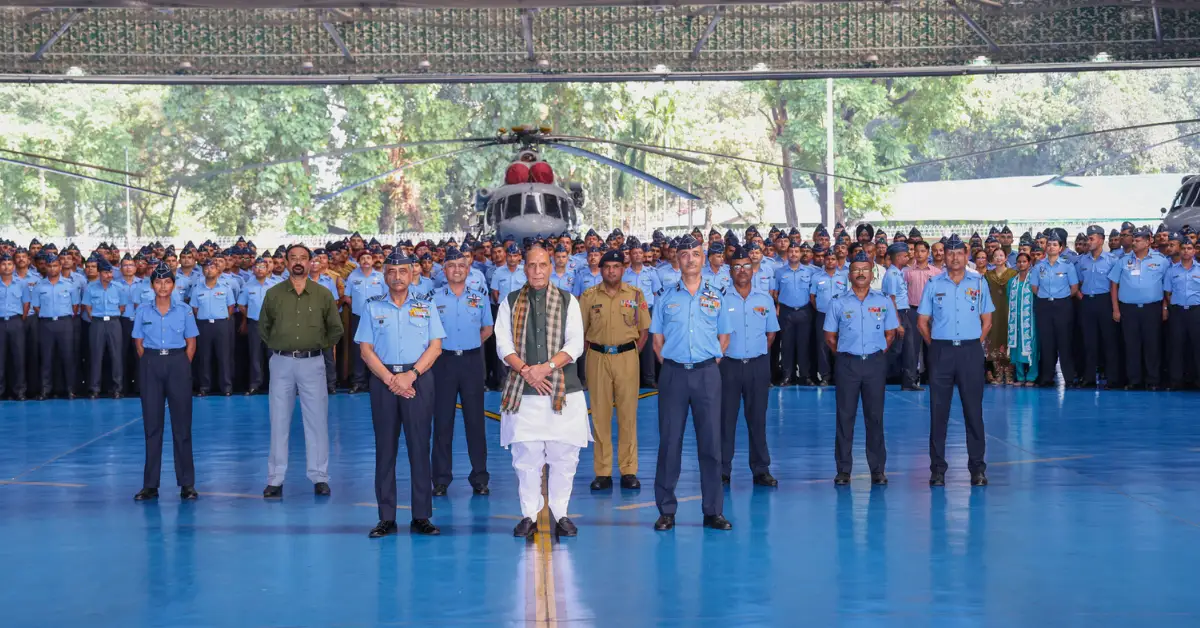
Addressing Indian Air Force (IAF) personnel at Air Force Station Bagdogra in West Bengal on November 7, Singh stressed the need to maintain a high level of operational readiness, particularly in cyber resilience, domain awareness and information security.
According to the Ministry of Defence, Singh highlighted the growing complexity of modern warfare, including asymmetric threats, proxy wars, drone swarms, cyberattacks and information operations.
He warned that adversaries could exploit security vulnerabilities without engaging in direct military confrontation, making technological preparedness and vigilance essential for the armed forces.
The Defence Minister also expressed concern about the spread of misleading information through social media, particularly when it targets military personnel and communities living near defence installations.
He emphasised the importance of maintaining public trust and preventing misinformation from undermining confidence in the armed forces.
During his visit, Singh described Bagdogra as a strategically important location in India’s defence framework because of its proximity to the North-Eastern region.
He praised Air Force personnel stationed there for their contribution to maintaining security and operational readiness in the eastern sector.
Singh also encouraged military personnel to maintain strong relationships with local communities, saying public trust and cooperation were important for national security.
He highlighted discipline, courage and responsible conduct as essential qualities for service personnel, regardless of advances in military technology.
The Defence Minister also referred to the Union Cabinet’s approval of the Second Tour of Duty initiative for Agniveers, announced on November 4.
Under the revised arrangement, 25% of Agniveers will continue to be considered for regular service after completing their initial four-year tenure, based on merit.
The remaining 75% will be offered an additional two-year engagement, subject to their willingness.
After completing the extended engagement, these Agniveers will have an opportunity to enter regular military service, provided they are willing and meet the prescribed selection criteria.
The arrangement does not guarantee permanent enrolment for every Agniveer who completes the additional two years.
Singh described the Cabinet decision as a significant Diwali gift for Agniveers, saying it would provide them with another opportunity to serve the country.
The revised arrangement also includes provisions for higher remuneration, an enhanced Seva Nidhi package and seniority benefits during the extended engagement.
During his interaction with IAF personnel, Singh highlighted the contributions of Indian start-ups and domestic defence companies to the development of drones, anti-drone systems and other advanced military technologies.
He praised the armed forces for adopting indigenous technology and developing new capabilities in drone operations and cybersecurity.
The Defence Minister said that technological advancement, combined with the discipline and preparedness of military personnel, would be important in responding to future security challenges.
The visit took place ahead of Diwali, with Singh extending greetings to Air Force personnel and their families.
He acknowledged the sacrifices made by service members who remain on duty during festivals and expressed appreciation for the support provided by their families.
Chief of the Air Staff Air Chief Marshal Ashutosh Dixit and Air Commodore Manish Sharma, Air Officer Commanding at Air Force Station Bagdogra, were among the senior officers present.
The November 7 address underscored the government’s focus on strengthening military preparedness against emerging threats while encouraging the development and adoption of indigenous defence technologies.
However, the ministry did not announce any new military deployment, specific cyber-defence funding or additional drone procurement during the visit.
Singh’s remarks highlighted the need for India’s armed forces to remain prepared for both conventional security challenges and newer threats involving cyberwarfare, unmanned systems and information manipulation.
Read also: IAF, IIT Madras join hands to develop indigenous secure communication system for aircraft