New Delhi, November 27: India’s kharif foodgrain production is estimated to decline by around 4% to 167.14 million tonnes in the 2026–27 crop year, compared with approximately 174.14 million tonnes in the previous season, according to the first advance estimates released by the Ministry of Agriculture and Farmers Welfare on November 26.
The lower forecast comes amid adverse weather conditions that affected crop cultivation in several agricultural states. However, the projected output remains 9.77 million tonnes above the average recorded over the preceding five years.
The estimates also indicate a decline in rice production, raising questions about the potential implications for domestic food prices, government procurement and India’s rice exports.
However, Union Agriculture Minister Shivraj Singh Chouhan said the country had adequate stocks of rice and wheat, indicating that the government did not anticipate an immediate shortage of these foodgrains.
According to the ministry, total kharif foodgrain production for 2026–27 is estimated at 1,671.43 lakh tonnes, equivalent to approximately 167.14 million tonnes.
The estimate is 97.67 lakh tonnes, or approximately 9.77 million tonnes, higher than the average kharif foodgrain production recorded over the preceding five years.
Chouhan released the first advance estimates for the 2026–27 kharif season alongside the final production estimates for the 2025–26 agricultural year.
The minister said crop cultivation had been affected by El Niño conditions, delayed monsoon rainfall and a rainfall deficit of 35% to 40% during June.
Low soil moisture and drought-like conditions in Maharashtra, Karnataka, Telangana and Andhra Pradesh also affected the sowing of crops, including paddy, maize, tur, soybean and cotton.
Despite these difficulties, the ministry said farmers, government support programmes and the adoption of climate-resilient crop varieties had helped maintain production above the five-year average.
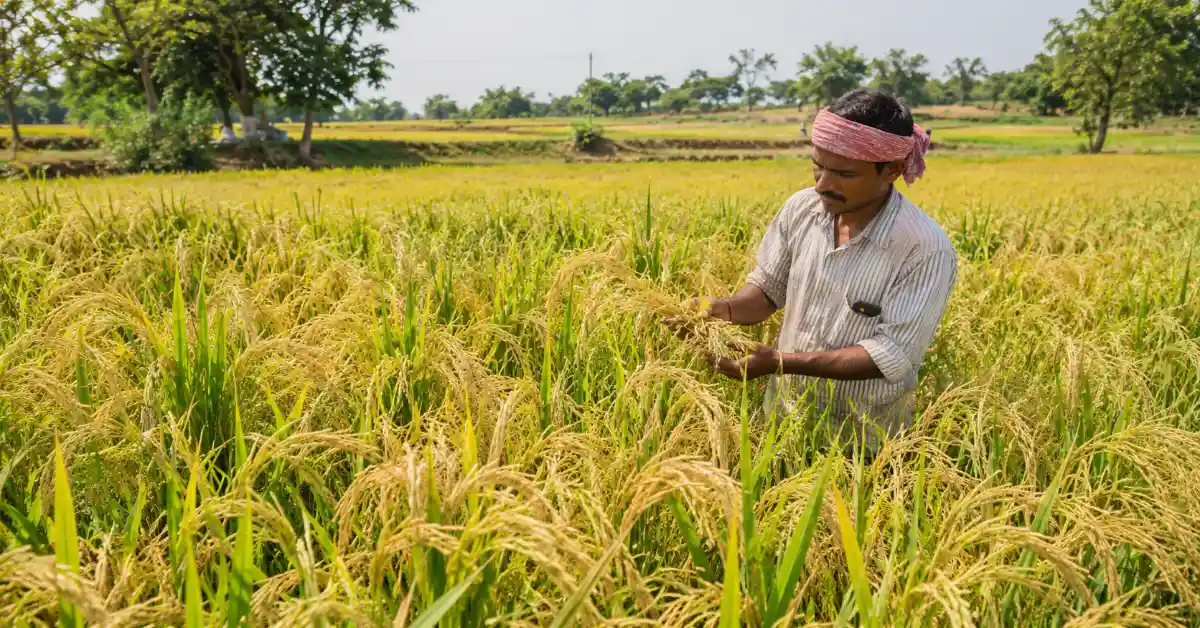
Rice, the largest component of India’s kharif foodgrain production, is expected to record a decline from the previous year.
According to the first advance estimates, kharif rice production is projected at 1,219.05 lakh tonnes, equivalent to approximately 121.91 million tonnes.
This compares with approximately 124.75 million tonnes in 2025–26, indicating a decline of around 2.84 million tonnes, or 2.3%.
Rice is one of India’s most important food crops and accounts for a significant share of the country’s agricultural exports.
As a major producer and exporter of rice, India plays an important role in international foodgrain trade. Changes in its harvest can influence global supply expectations and market prices.
However, a lower production estimate does not necessarily mean that India’s rice exports will decline or that domestic consumers will face higher prices.
The eventual impact will depend on actual harvesting results, government procurement, available foodgrain stocks, domestic consumption and subsequent export policy decisions.
Chouhan said India had sufficient rice and wheat stocks and was continuing to strengthen its position in global agricultural markets.
According to the minister, Indian rice exports had increased by 5%, reflecting continued overseas demand.
The government has not announced new rice export restrictions in connection with the November 26 production estimates.
Apart from rice, the ministry estimated the production of nutri-cereals and coarse cereals at 381.05 lakh tonnes during the 2026–27 kharif season.
Maize production is projected at 260.64 lakh tonnes, while bajra output is estimated at 89.43 lakh tonnes.
Jowar production is expected to reach 14.79 lakh tonnes, followed by ragi at 12.48 lakh tonnes and small millets at 3.71 lakh tonnes.
The ministry has estimated total kharif pulses production at 71.32 lakh tonnes.
Within this category, tur production is projected at 31.22 lakh tonnes, moong at 16.59 lakh tonnes and urad at 14.49 lakh tonnes. Other pulses are expected to contribute 9.02 lakh tonnes.
Pulses are an important source of protein in Indian diets, and changes in their production can influence domestic supply and market conditions.
The government has also estimated kharif oilseed production at 239.47 lakh tonnes.
Groundnut is expected to account for 111.68 lakh tonnes, while soybean production is projected at 102.44 lakh tonnes.
Other oilseed estimates include castor at 18.97 lakh tonnes, sesame at 4.91 lakh tonnes, sunflower at 1.17 lakh tonnes and niger seed at 0.30 lakh tonnes.
Oilseeds are particularly important for India’s edible oil industry, which relies on both domestic production and imports to meet demand.
The ministry also released production estimates for major commercial crops.
Sugarcane production is projected at 4,543.39 lakh tonnes, while cotton production is estimated at 248.66 lakh bales, with each bale weighing 170 kilograms.
Jute and mesta production is expected to reach 97.06 lakh bales, with each bale weighing 180 kilograms.
Separately, the government released the final production estimates for the 2025–26 agricultural year, placing total annual foodgrain output at a record 3,785.38 lakh tonnes, equivalent to approximately 378.54 million tonnes.
This represented an increase of 208.06 lakh tonnes over the 2024–25 agricultural year.
According to the ministry, total rice production reached a record 1,551.54 lakh tonnes in 2025–26, compared with 1,501.84 lakh tonnes in the previous year.
Wheat production also increased to 1,220.64 lakh tonnes, while total pulses production reached 272.40 lakh tonnes.
The record 2025–26 foodgrain production figure covers the entire agricultural year, including different crop seasons, and should not be directly compared with the separate kharif-only estimate for 2026–27.
The Agriculture Ministry said the latest estimates were prepared using information received from states and Union Territories, along with remote sensing, digital crop surveys and assessments of weather and crop conditions.
The figures underwent a three-tier validation process before publication.
However, the 2026–27 kharif figures remain preliminary and will be revised as additional harvesting data becomes available.
According to the ministry, subsequent estimates will incorporate actual yield information collected through crop-cutting experiments.
The expected decline in kharif foodgrain and rice production could affect food procurement, buffer stock management, domestic market prices and decisions concerning agricultural exports.
However, the latest estimates do not establish that the lower forecast has already caused a nationwide food shortage or directly resulted in higher consumer prices.
The November 26 figures indicate that India’s kharif foodgrain production may fall below the previous year’s harvest while remaining above its recent five-year average.
The final production outcome, together with available government stocks and market conditions, will determine whether the weaker forecast translates into significant pressure on domestic food supplies or rice exports.
Read also: India’s Space Industry Needs $2 Billion in Annual Private Investment Through 2036, Says Report
Read also: Government issues new guidelines to address rural workers’ complaints over jobs and wages