
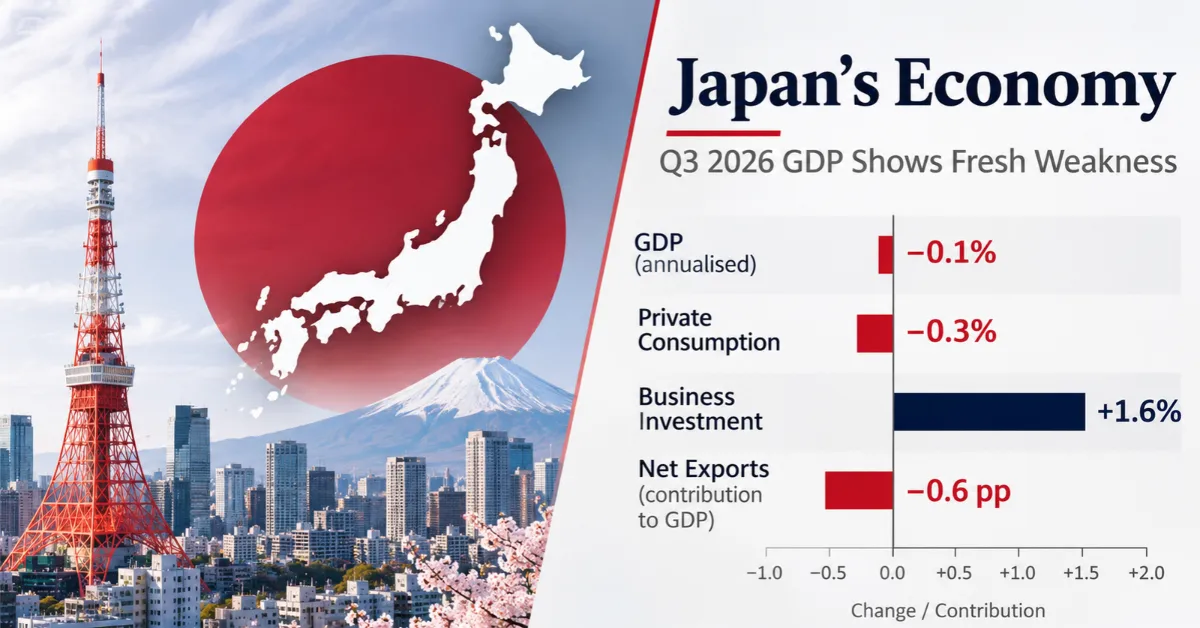
Tokyo, November 16: Japan’s economy unexpectedly contracted in the July–September quarter of 2026, recording its first decline in four quarters as weak household consumption and a negative contribution from international trade offset stronger business investment, according to preliminary government data released on Monday.
Real gross domestic product (GDP) declined at an annualised rate of 0.1%, compared with a median forecast of 0.3% growth in a Reuters poll of economists.
The contraction followed a revised 1.7% annualised expansion in the April–June quarter, highlighting the uneven pace of Japan’s economic recovery amid persistent inflation and pressure on household budgets.
On a quarter-on-quarter basis, real GDP declined by approximately 0.02%, leaving economic output virtually unchanged from the previous quarter.
The figures were released by Japan’s Cabinet Office on November 16 as its first preliminary estimate of economic activity during the third quarter.
The unexpected contraction has raised fresh questions about the strength of domestic demand and the timing of further interest-rate increases by the Bank of Japan.
Private consumption, which accounts for more than half of Japan’s economic output, declined by 0.3% quarter-on-quarter, compared with economists’ expectations of a 0.2% fall.
The decline marked the second consecutive quarter of falling household consumption, following a revised 0.3% contraction in the April–June period.
According to Reuters, elevated living costs, unfavourable weather conditions and reduced purchases of durable goods weighed on consumer activity during the quarter.
Heavy rainfall and typhoons also affected household spending, while demand for automobiles and air conditioners weakened after receiving temporary support in the preceding quarter.
The figures indicate that Japanese households remained cautious about spending despite improvements in wages and employment conditions.
International trade also weighed on economic activity during the quarter.
Net exports, which measure the difference between exports and imports, subtracted 0.6 percentage points from quarterly GDP growth, exceeding the 0.4-percentage-point negative contribution anticipated by economists.
According to the Cabinet Office, exports of goods and services declined by 0.2% quarter-on-quarter, while imports increased by 2.5% in real terms.
The increase in imports partly reflected higher purchases of oil and other energy products as Japan adjusted its procurement arrangements amid disruptions associated with the conflict in the Middle East.
Japan’s heavy dependence on imported energy leaves its economy exposed to fluctuations in international oil prices, shipping conditions and foreign exchange rates.
A weaker yen can also increase the domestic cost of imported goods, potentially adding pressure to household budgets and business operating expenses.
However, business investment provided a positive contribution to economic activity.
Private non-residential investment increased by 1.6% quarter-on-quarter, slightly exceeding economists’ expectations of 1.5% growth.
Investment in labour-saving technologies and artificial intelligence-related projects helped support corporate spending.
The increase suggests that some Japanese companies continued investing in productivity improvements and technological infrastructure despite subdued household demand.
The Cabinet Office also reported that domestic demand contributed 0.6 percentage points to quarterly GDP growth.
However, changes in public inventories accounted for 0.5 percentage points of that contribution, indicating that the positive domestic-demand figure did not reflect a broad-based recovery in household consumption.
The combination of weak consumer spending, higher imports and stronger corporate investment illustrates the uneven performance of Japan’s economy.
The latest GDP figures are expected to receive close attention from the Bank of Japan as policymakers assess whether economic conditions can support further monetary tightening.
The central bank raised interest rates in June and September 2026, bringing its policy rate to 1.25%.
The unexpected economic contraction has complicated the outlook for further increases because policymakers must balance persistent inflation against signs of weakening domestic demand.
Higher interest rates can help contain inflationary pressures but may also increase borrowing costs for households and businesses.
Conversely, delaying further increases could provide additional support to economic activity while leaving the central bank with continued challenges in managing inflation.
According to Reuters, Bank of Japan board member Hajime Takata has supported further monetary tightening, while investors have been assessing the possibility of another rate increase in December or January.
However, those expectations do not represent an official decision, and the central bank has not announced a new interest-rate change in response to the November 16 GDP figures.
The weaker-than-expected economic data also drew attention to Japan’s currency and financial markets.
The yen traded at approximately ¥159.69 per US dollar in early Asian trading on November 16, near a two-month low, as investors weighed the GDP figures against the outlook for further Bank of Japan rate increases.
A weaker yen can support the competitiveness of Japanese exporters but may also increase the cost of imported energy, raw materials and other goods.
Changes in interest-rate expectations can also influence Japanese government bond yields and international investment flows.
Japan’s monetary policy remains important to global financial markets because investors have historically used the relatively low-cost yen to finance investments in higher-yielding assets elsewhere.
These transactions, commonly known as carry trades, can become less attractive when Japanese borrowing costs rise or the yen strengthens.
A significant change in interest-rate expectations could therefore influence international capital flows and investment strategies.
However, the latest GDP figures do not establish that a major unwinding of carry trades or disruption in Japanese government bond markets has occurred.
Despite the unexpected quarterly contraction, economists continue to anticipate modest economic growth over the coming years.
A survey by the Japan Center for Economic Research, cited by Reuters, projected economic growth of 0.89% in fiscal 2026 and 1.02% in fiscal 2027.
These forecasts suggest that Japan could continue expanding gradually, although household spending, imported energy costs and global economic conditions remain important sources of uncertainty.
The Cabinet Office’s November 16 figures are preliminary and may be revised as additional economic information becomes available.
For policymakers, the central question is whether the third-quarter contraction reflects temporary weakness or a more persistent slowdown in domestic demand.
The latest figures show that Japan’s economy contracted at an annualised rate of 0.1% in July–September, missing expectations of growth and reversing the expansion recorded in the preceding quarter.
While stronger business investment offered some support, declining household consumption and the negative contribution from net exports have raised fresh uncertainty about the economic recovery and the Bank of Japan’s next interest-rate decision.
Read also: ADB and ASEAN sign five-year partnership, target $13 billion for water security and digital economy