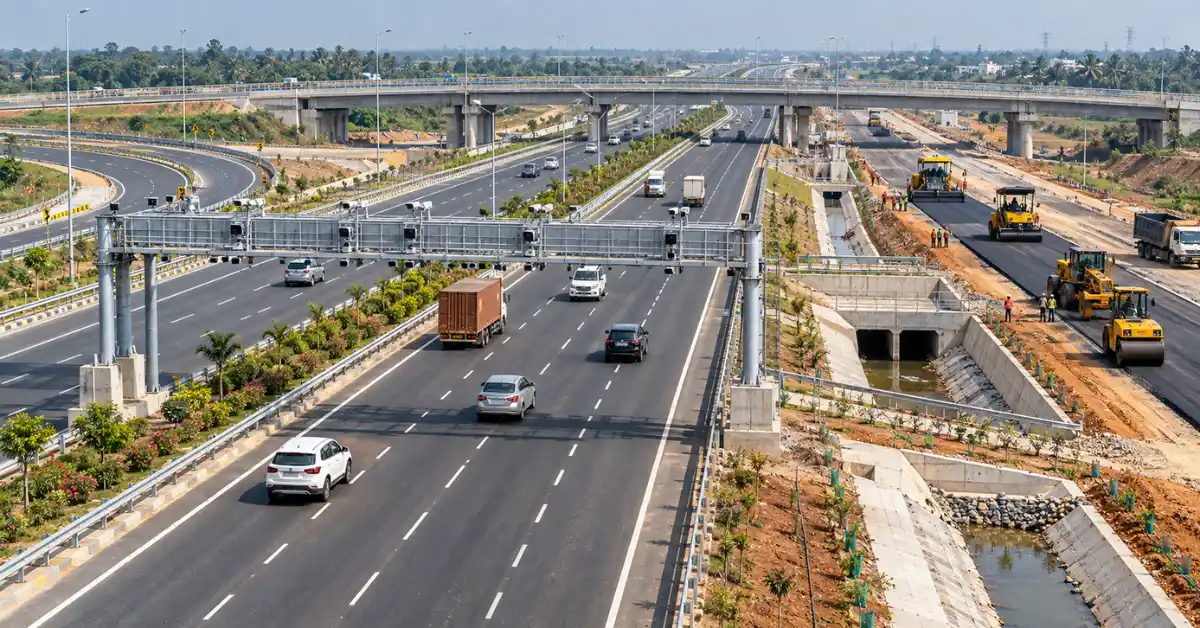
The National Highways Authority of India (NHAI) has issued comprehensive guidelines for the planning and design of high-speed access-controlled National Highways, covering traffic assessment, technology-enabled construction, Multi-Lane Free Flow (MLFF) tolling, drainage and landscaping.
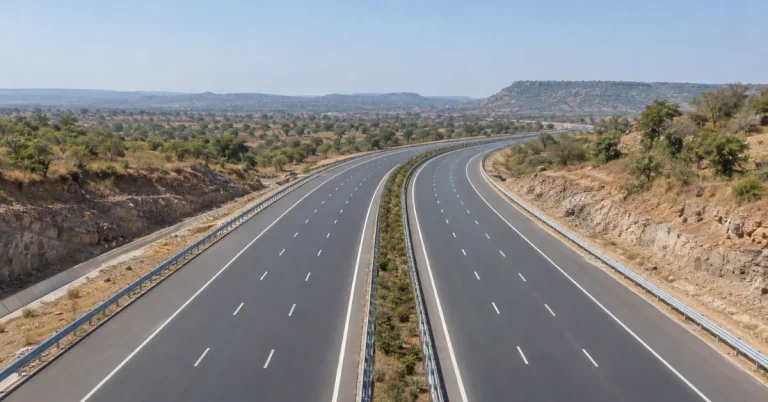
The guidelines will apply to upcoming four- and six-lane Greenfield and Brownfield high-speed access-controlled National Highways, excluding Expressways.
The latest guidelines follow an earlier NHAI announcement on 21 September that laid down planning and design parameters for this category of highways, including lane configuration, structures, right-of-way requirements and traffic thresholds.
Traffic Projections To Include Future Freight Demand
NHAI has directed that traffic assessment for upcoming high-speed corridors should account for existing traffic, traffic expected to shift to the new corridor and future growth in freight movement linked to economic and commercial activity.
Toll data and other reliable sources will also be used for traffic estimation.
Under the framework announced on 21 September, corridors with traffic of up to 15,000 vehicles are envisaged as four-lane highways with four-lane structures and a 60-metre right of way.
For traffic between 15,000 and 25,000 vehicles, four-lane highways are proposed with structures designed for six lanes and a 70-metre right of way.
Corridors carrying between 25,000 and 40,000 vehicles are envisaged as six-lane highways with six-lane structures and a 70-metre right of way.
AI-MC Technology For Highway Construction
The guidelines provide for the use of Automated and Intelligent Machine-aided Construction (AI-MC) technology for constructing embankments and highway pavements in accordance with Ministry of Road Transport and Highways guidelines.
The technology uses digitally controlled construction equipment to improve accuracy, consistency and monitoring during road construction.
NHAI has previously tested AI-MC technologies on highway projects, including the Lucknow-Kanpur Greenfield Expressway, where equipment such as GPS-aided motor graders, intelligent compactors and stringless pavers was deployed.
Provision For Multi-Lane Free Flow Tolling
Upcoming high-speed corridors will also make provision for Multi-Lane Free Flow tolling.
MLFF allows vehicles to cross tolling points without stopping at conventional toll barriers, using technologies including FASTag and Automatic Number Plate Recognition for identification and toll collection.
NHAI has begun introducing MLFF at selected locations, including tolling points in Gujarat and on the Delhi-Jaipur corridor.
The new guidelines require provisions for MLFF to be incorporated while planning high-speed National Highway corridors.
Drainage Planning To Be Part Of DPR
Comprehensive drainage planning will form part of the Detailed Project Report for high-speed National Highways.
The DPR will have to identify rainwater disposal points and provide arrangements for managing runoff from the highway as well as surrounding areas.
Water-harvesting structures will be provided in loop areas and other suitable locations, particularly where there is no natural outlet for rainwater.
Special drainage arrangements will also be made around underpasses, flyovers, depressed medians and other structures to reduce waterlogging and damage to highway infrastructure.
Landscaping And Drip Irrigation
Landscaping and plantation will be incorporated into highway planning at locations including interchange loops, areas below flyovers, medians and other suitable spaces.
Plantation plans will take local climate, topography and environmental conditions into account.
The guidelines also provide for drip irrigation systems on National Highway medians to improve water use and assist plantation maintenance.
High-Speed Corridor Network
The guidelines come as the government expands India’s network of access-controlled high-speed road corridors.
NHAI said on 21 September that the government’s long-term roadmap envisages around 50,000 km of access-controlled high-speed corridors by 2047.
Government data released in July 2026 showed that 10,389 km of National High-Speed Corridors had been awarded. Of this, 4,809 km had been completed and 5,580 km was under implementation.
The new guidelines will apply to upcoming four- and six-lane Greenfield and Brownfield high-speed access-controlled National Highways and are intended to standardise their planning and design across projects.
Read also: UP Cabinet approves six-lane plan for Chitrakoot Link Expressway at revised cost of ₹1,008.67 crore
Read also: ₹997.44 crore Indora-Dighori flyover set to open in Nagpur, promising smoother traffic on NH-353D