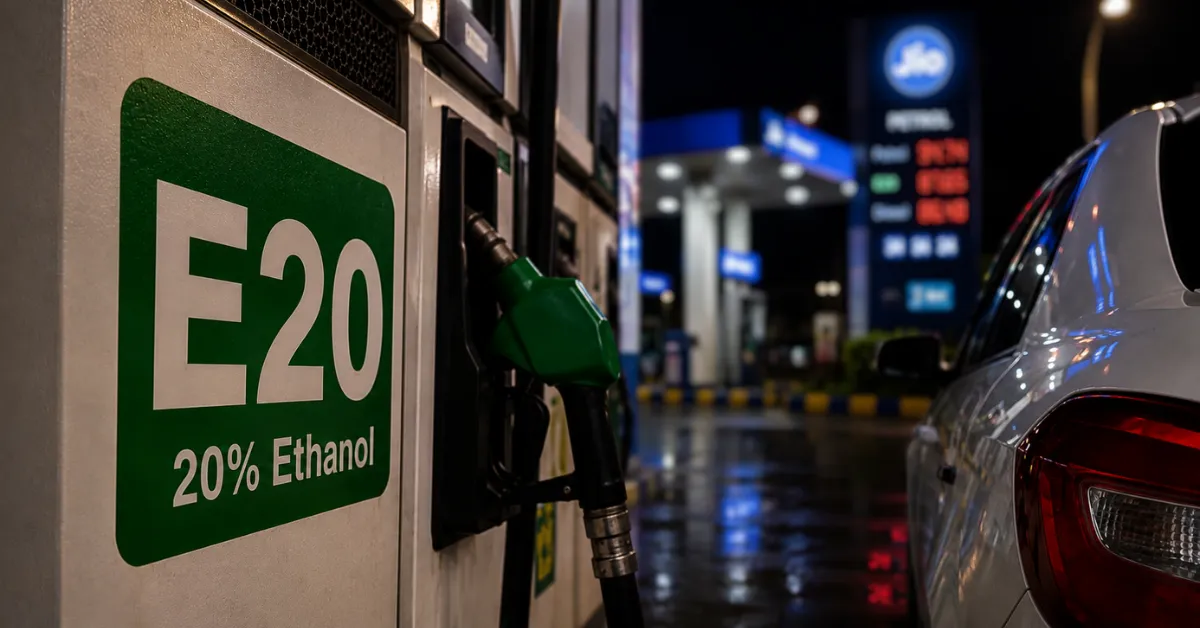
New Delhi, July 30: The government said there is no verified evidence of widespread engine failure, abnormal wear or vehicle breakdowns linked to the use of E20 (20 per cent ethanol-blended petrol), citing scientific studies, field trials and operational data gathered during the nationwide rollout of the fuel. The assertion was made in a written reply tabled in the Lok Sabha.
The Ministry of Petroleum and Natural Gas said the Ethanol Blended Petrol (EBP) Programme was implemented through a phased and scientifically validated process involving NITI Aayog, automobile manufacturers, Oil Marketing Companies (OMCs), the Automotive Research Association of India (ARAI), the Society of Indian Automobile Manufacturers (SIAM), the Indian Institute of Petroleum (IIP) and other technical institutions. According to the Ministry, higher ethanol blends were introduced only after extensive consultations with industry stakeholders and testing agencies.
The Ministry said laboratory studies and field trials assessed engine durability, drivability, startability, corrosion resistance, material compatibility, emissions and fuel efficiency before E20 was introduced. It said the studies found E20 safe for use under prescribed standards and did not establish any significant adverse impact on the performance, durability or material compatibility of legacy vehicles.
According to the government, its assessment is also based on large-scale operational experience following nationwide implementation of the programme. It said around 8 crore vehicles visit fuel retail outlets every day, while E15+ petrol has been in widespread use for more than three-and-a-half years and E19-E20 fuel for over two-and-a-half years. During this period, more than 20 crore two-wheelers and over 3 crore petrol cars have operated on these blends without any verified evidence of widespread engine failure or vehicle breakdown attributable to ethanol blending. Manufacturer service data have also not shown abnormal corrosion, wear or reduced vehicle life linked to E20 fuel, the Ministry said.
The Ministry further said a leading automobile manufacturer serviced 2.84 crore vehicles during 2025-26, including about 1.5 crore vehicles that were not originally certified as E20-compatible, and reported no E20-linked corrosion, abnormal wear or reduction in component life. Another leading two-wheeler manufacturer reported similar field experience, while ARAI reaffirmed that vehicles undergo rigorous validation before reaching consumers.
According to the Ministry, SIAM and ARAI have also stated that E20 fuel improves acceleration and ride quality while reducing carbon emissions. It said ethanol’s higher octane rating supports modern high-compression engines and its higher heat of vaporisation contributes to improved combustion efficiency.
The statement comes as the government continues to expand ethanol blending under the Ethanol Blended Petrol Programme. The Ministry maintained that scientific validation, industry consultations and operational experience support the continued rollout of E20 fuel across the country.