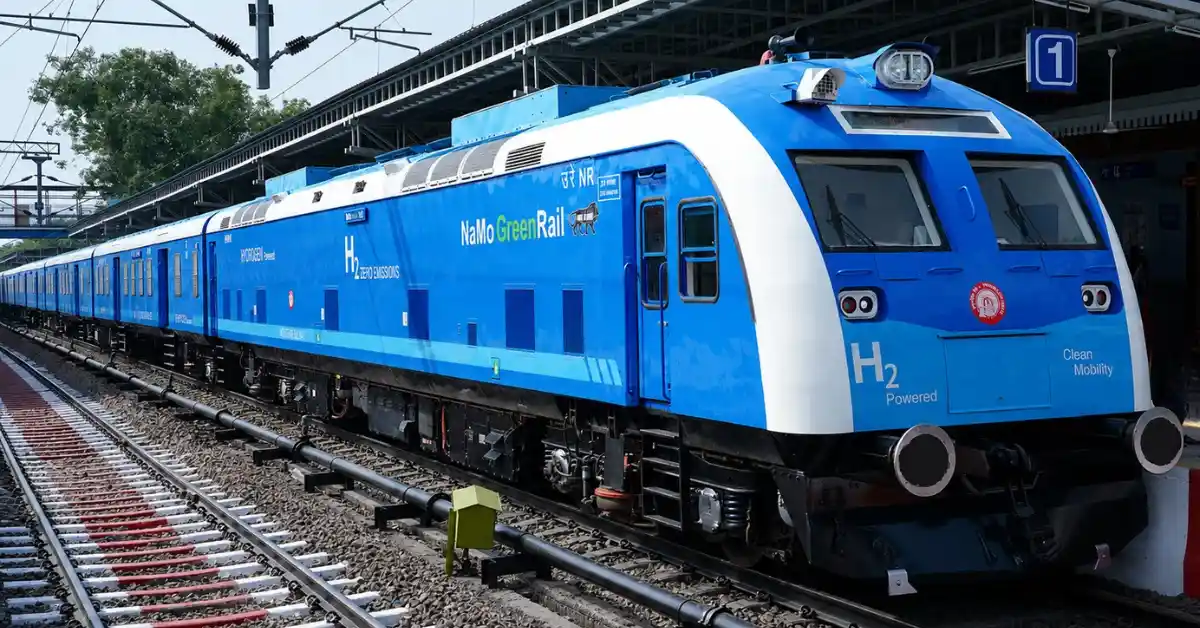
Indian Railways is set to flag off India’s first Hydrogen Fuel Cell Trainset, marking a new stage in its shift towards cleaner rail mobility.
The train generates electricity onboard using hydrogen and oxygen instead of drawing power from overhead electric lines or burning diesel. At the point of use, its direct by-product is water vapour and heat, with no smoke or tailpipe carbon emissions.
The development comes after rapid electrification across Indian Railways. More than 99% of Broad Gauge routes are now electrified, reducing dependence on diesel. The hydrogen train is being positioned as the next step for clean mobility, especially for routes where onboard clean power can be demonstrated under regular operating conditions.
How the hydrogen train works
The train uses a Proton Exchange Membrane fuel cell, which acts like a small onboard power plant.
Hydrogen stored in cylinders combines with oxygen from the surrounding air inside the fuel cell. This electrochemical reaction produces electricity, which powers the traction motors and turns the wheels.
The train consists of two Hydrogen Driving Power Cars and eight Trailer Coaches. Each power car houses fuel cells, lithium iron phosphate batteries and hydrogen storage cylinders.
The two power cars, placed at either end of the train, produce 1,200 kW, or 1,600 hp, each. Together, they can push the train up to its design speed of 110 kmph.
Route, capacity and scale
The Hydrogen Fuel Cell Trainset will initially operate on the Jind-Sonipat section of Northern Railway.
The route is 89 km long and connects Jind Junction, Gohana Junction and Sonipat, along with several intermediate stations and proposed halts.
On this route, the train will operate at 75 kmph. The section has been selected to demonstrate the operational viability, safety and reliability of hydrogen-powered passenger train services.
Globally, many hydrogen passenger trains are two-coach or three-coach sets used mainly on short regional routes. In comparison, the Indian train has been configured as a 10-coach passenger train with capacity for around 2,600 passengers.
Read also : ₹3,907 crore rail upgrade to expand Odisha-Jharkhand network by 145 km by 2030-31
Refuelling system at Jind
Indian Railways has set up a hydrogen refuelling facility at Jind in Haryana to support the train.
The facility produces hydrogen on site through electrolysis, a process in which water is split into hydrogen and oxygen using electricity.
The hydrogen is then compressed to 500 bar and dispensed into the train at 350 bar through two independent dispensers.
This allows both Hydrogen Driving Power Cars to be refuelled at the same time, reducing turnaround time.
The facility can store nearly 3,000 kg of hydrogen and its storage and supply system has been approved by the Petroleum and Explosives Safety Organisation.
Safety systems and testing
Hydrogen is highly inflammable, so the train and refuelling ecosystem have been designed with multiple safety layers.
The train and plant are fitted with systems to detect hydrogen leaks, heat, flames and smoke. Ventilation systems prevent hydrogen from accumulating. Automatic shut-off systems can cut hydrogen supply if abnormal conditions are detected.
The project follows international standards including NFPA-2 and the ISO 19880 series. It has also undergone independent third-party safety assessment by TÜV SÜD, Germany.
Before operational deployment, the train went through load box testing, radio frequency trials, oscillation trials, emergency brake distance trials, statutory inspections and safety assessments.
Indigenous development and future use
The train has been designed, engineered and integrated in India.
RDSO formulated the technical specifications and led design approval while Medha Servo Drives integrated the trainset and Integral Coach Factory contributed to its theme and exterior design.
Indian Railways is also exploring hydrogen technology for heritage routes, including Kalka-Shimla, using experience gained from the Jind-Sonipat hydrogen train project.
Read also : Mumbai-Ahmedabad Bullet Train Project completes launch of all 13 heavy portal beams in Ahmedabad