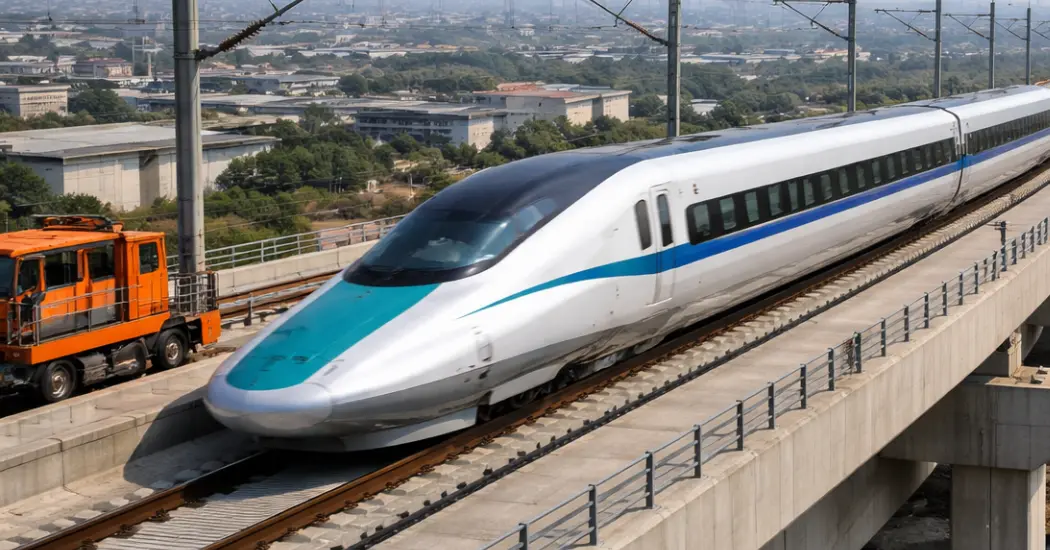
India’s first bullet train corridor, the Mumbai-Ahmedabad High-Speed Rail project, is being developed not only as the country’s first dedicated high-speed rail route but also as the template for future bullet train corridors.
According to a statement by the Ministry of Information and Broadcasting, India is nearing completion of the Mumbai-Ahmedabad High-Speed Rail corridor, which will mark the country’s entry into dedicated high-speed rail operations.
The corridor has a design speed of up to 350 kmph and an operational speed of 320 kmph.
The 508 km corridor will connect Mumbai and Ahmedabad in about 1 hour and 58 minutes.
It will have 12 stations along the route, with the first high-speed rail service expected to commence in August 2027.
The first section to open will be between Surat and Vapi.
The ministry said the Mumbai-Ahmedabad project is now being used to develop a standardised template for upcoming high-speed rail corridors.
The aim is to use proven engineering designs, construction methods and operational practices from the first corridor to improve efficiency and speed up execution of future projects.
Under this approach, future bullet train corridors will follow a replicable construction model.
Foundations will be designed according to the soil characteristics of each location, while major subsystems such as piers, viaducts, tracks, station structures, overhead electrification and signalling systems will follow common engineering standards.
The government expects this standardisation to simplify spare-part management, training and procurement across the high-speed rail network. It is also expected to support faster construction, improve quality and reduce costs across future corridors.
India has identified seven high-speed rail corridors for future development, covering nearly 4,000 km. The proposed network is expected to attract investment of around ₹16 lakh crore.
Read also : Indian Railways freight rises 4% in June as passenger traffic reaches 63.81 crore
The identified corridors include Delhi-Varanasi, Varanasi-Patna-Siliguri, Chennai-Bengaluru, Bengaluru-Hyderabad, Chennai-Hyderabad, Mumbai-Pune and Pune-Hyderabad.
The projected travel time on the Delhi-Varanasi corridor is 3 hours and 50 minutes, while the Varanasi-Patna-Siliguri corridor is expected to take 2 hours and 55 minutes.
The Chennai-Bengaluru corridor is projected at 1 hour and 13 minutes, Bengaluru-Hyderabad at 2 hours, Chennai-Hyderabad at 2 hours and 55 minutes, Mumbai-Pune at 48 minutes, and Pune-Hyderabad at 1 hour and 55 minutes.
The Mumbai-Ahmedabad corridor is being developed using Japanese Shinkansen technology and operational practices.
The project includes advanced systems for traction, electrification, track infrastructure and train operations.
More than 20,000 overhead electrification masts are planned across the corridor. The project uses a 2×25 kV overhead traction system based on Shinkansen-style overhead electrification cantilever designs. It will also have 12 traction substations, two depot traction substations and 16 distribution substations.
The J-Slab ballastless track system is being introduced in India for the first time under the project.
Dedicated track construction bases are also being developed for storage and handling of rails, track slabs, machinery and other equipment.
Three rolling stock depots are being constructed at Sabarmati and Surat in Gujarat, and Thane in Maharashtra.
Alongside construction of the corridor, Indian Railways is also promoting indigenous high-speed rail manufacturing under the Make in India and Aatmanirbhar Bharat initiatives.
Integral Coach Factory, in collaboration with Bharat Earth Movers Limited, is designing and manufacturing indigenous 280 kmph high-speed train sets.
The ministry said India is also developing the tooling, testing and production ecosystem required for future high-speed rail projects.
Indian companies are increasingly manufacturing specialised components, construction equipment and slab-track systems needed for high-speed rail.
A newly inaugurated specialised complex named Aditya in Bengaluru is designed for the development of B-28 coaches.
Research by IITs, specialised training and adoption of Japanese engineering practices are also being used to strengthen India’s high-speed rail capabilities.
The Mumbai-Ahmedabad corridor is therefore expected to serve as the engineering, manufacturing and operational base for India’s future bullet train network.
Read also : Indian Railways clears ₹226 crore electronic interlocking upgrade for 13 Durg-Taroki section stations