
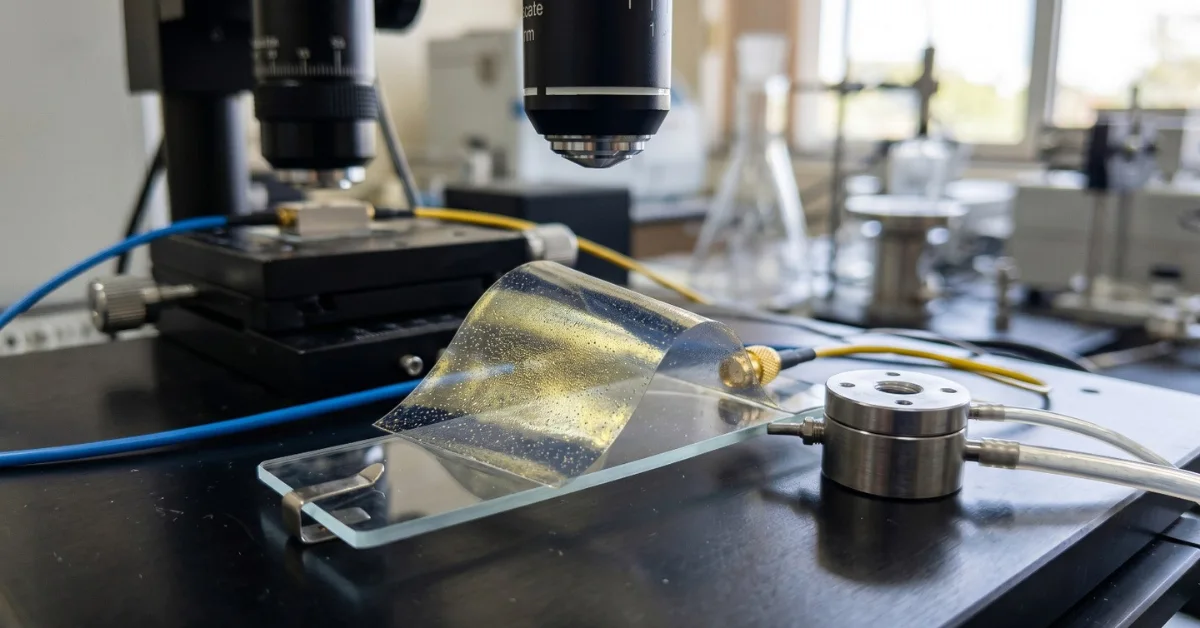
Indian researchers have developed an ultrathin flexible film embedded with nano-gold that can efficiently convert small temperature fluctuations into electrical signals, opening a possible path for self-powered sensors, wearable electronics and low-power smart devices.
In a statement on Monday, 18 May, the Ministry of Science and Technology said that the film could support future smart photodetectors, low-grade heat harvesters and advanced flexible electronic systems relevant to healthcare, environmental monitoring and energy-efficient devices.
The research has been carried out by scientists from the Institute of Nano Science and Technology, Mohali, an autonomous institute of the Department of Science and Technology.
The team was led by Professor Dipankar Mandal and collaborators, including Sudip Naskar.
According to the ministry, there is strong demand for lightweight, flexible and low-power materials that can convert tiny thermal fluctuations into usable electrical signals for next-generation smart devices and autonomous sensors.
Earlier plasmonic-pyroelectric and PVDF composite systems have shown improved thermal-to-electrical conversion, but many such approaches depend on micron-thick devices or less controlled hybrid interfaces. This limits their use in thin, wearable and low-power electronics.
The INST team demonstrated that embedding a minute amount of nanogold into a common ferroelectric polymer can sharply improve its pyroelectric performance, or its ability to generate electricity from changes in temperature.
The researchers engineered ultrathin films made from polyvinylidene fluoride, or PVDF, a flexible polymer widely used in electronic and sensing applications.
Read also : New shoe testing laboratory at NTH Ghaziabad to support India’s footwear manufacturing sector
They designed a low-dose in-situ nanogold strategy to study how nanoscale gold-polymer interactions, dipole orientation and confined plasmonic excitations can be used to tailor pyroelectric performance in very thin films.
By incorporating hexagonal nanogold particles into films thinner than 100 nanometres, the researchers achieved a nearly pure polar phase of PVDF with highly ordered dipoles.
The ministry said this structure is essential for efficient pyroelectric behaviour.
The research, published in Advanced Functional Materials, shows that a polymer-supported metastable hexagonal closed pack phase of gold nanoparticles and a highly ordered polar phase of a PVDF matrix can be integrated into a robust 2D hybrid thin film.
The ministry said plasmon-dipole-electron coupling in the hybrid film acts cooperatively to enhance pyroelectricity, dipole ordering and broadband optical absorption.
The work demonstrated efficient pyroelectric energy conversion in an ultrathin film over a small temperature fluctuation range of 294 to 301 K.
According to the ministry, this addresses an important requirement for ambient-temperature thermal sensing and wearable energy-harvesting technologies.
The development is significant because it focuses on harvesting low-grade thermal changes that are usually too small to be used efficiently, while keeping the material thin, flexible and suitable for future electronics.
The ministry said the advance could help in the development of healthcare sensors, environmental monitoring devices and energy-efficient flexible electronics that require low power and compact materials.
Read also : Tata Electronics, ASML sign pact to advance India’s first commercial semiconductor fab in Dholera