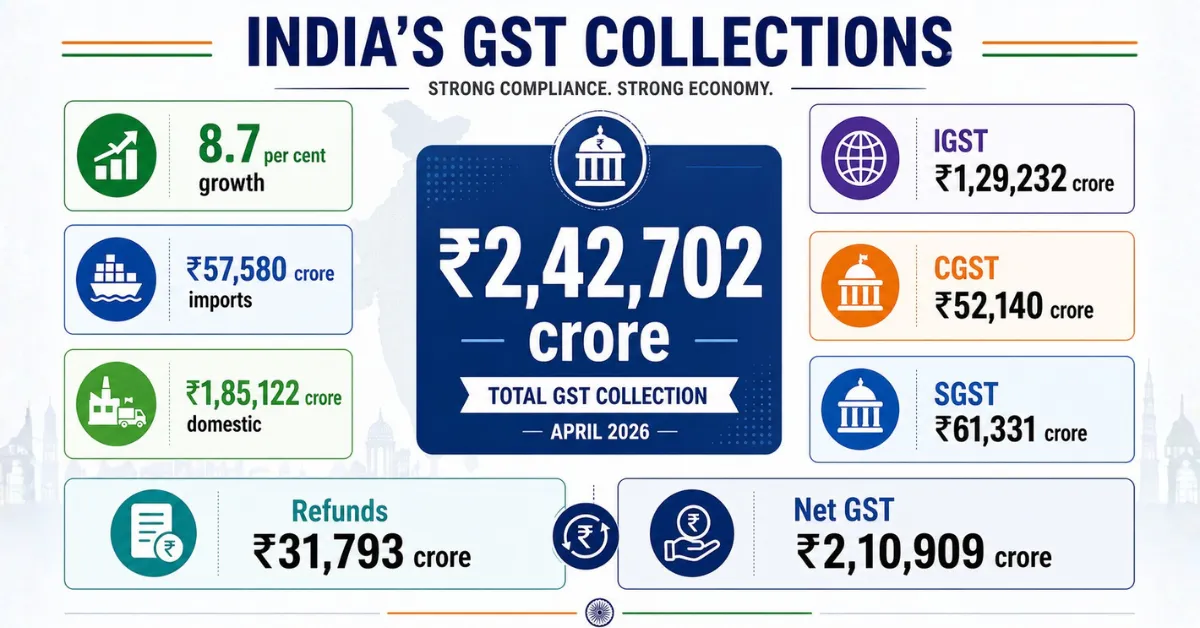
India’s gross Goods and Services Tax (GST) collections rose to ₹2,42,702 crore in April 2026, marking an 8.7 per cent year-on-year increase from ₹2,23,265 crore in April 2025, according to official data.
The April figure is the highest-ever monthly GST collection, indicating strong economic activity at the start of the financial year.
The growth was supported primarily by import-linked revenues, while domestic collections showed relatively moderate expansion. Gross GST revenue from imports stood at ₹57,580 crore, registering a 25.8 per cent increase year-on-year, while domestic revenue grew by 4.3 per cent to ₹1,85,122 crore.
Integrated GST (IGST), which includes revenues from inter-state transactions and imports, stood at ₹1,29,232 crore, forming the largest share of total collections. Central GST (CGST) collections were ₹52,140 crore, while State GST (SGST) stood at ₹61,331 crore.
Total refunds during the month rose by 19.3 per cent year-on-year to ₹31,793 crore, with domestic refunds increasing sharply by 54.6 per cent, reflecting faster settlement of claims.
After adjusting for refunds, net GST revenue stood at ₹2,10,909 crore, marking a 7.3 per cent increase over the previous year.
State-level data shows mixed trends, with several large states recording strong post-settlement growth, while some regions saw moderation in pre-settlement collections. Jammu and Kashmir recorded a 19 per cent rise in pre-settlement SGST and a 51 per cent increase in post-settlement SGST, indicating improved revenue flows after adjustments.
The continued rise in GST collections reflects sustained formalisation of the economy and improved tax compliance. The strong growth in import-related revenues suggests increased external trade activity, while domestic collections indicate stable consumption trends.
With GST collections consistently remaining above the ₹2 lakh crore mark in recent months, the tax system continues to serve as a key indicator of economic momentum. Going forward, domestic demand, global trade conditions and compliance trends will remain the primary drivers of GST performance.
Read also : India-New Zealand FTA explained: What the pact means for trade, jobs, investment and mobility