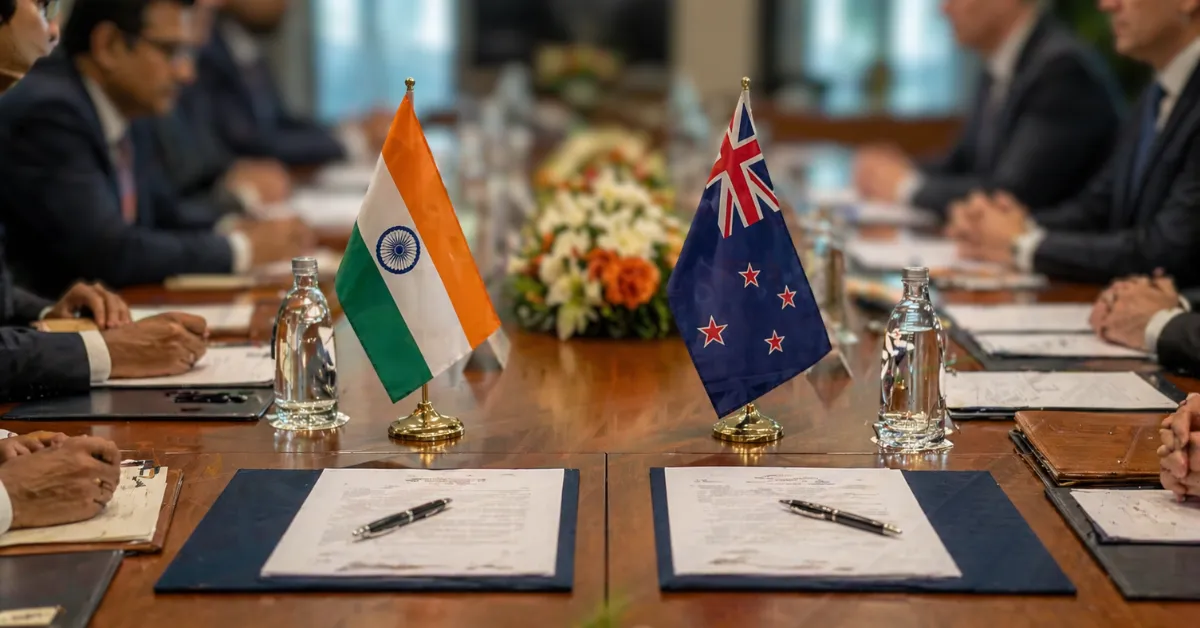
India and New Zealand are set to sign their Free Trade Agreement (FTA) today, 27 April, in Agra, Uttar Pradesh, formalising a deal concluded in December 2025 after negotiations that began on 16 March 2025 and were completed in a record nine months.
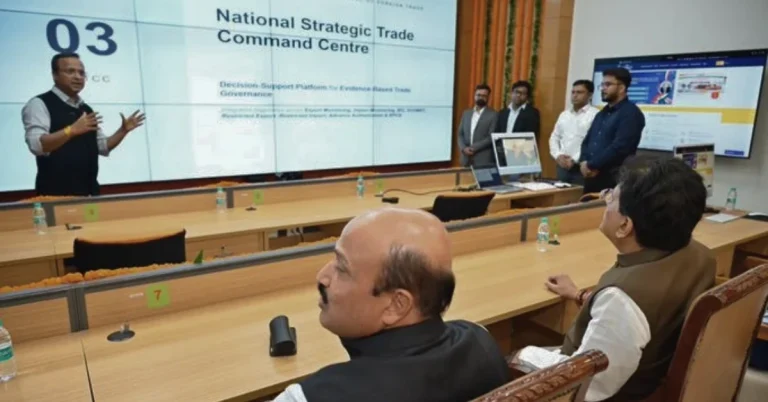
Ahead of the signing, Union Commerce and Industry Minister Piyush Goyal and New Zealand’s Trade and Investment Minister Todd McClay held an industry engagement in Agra on Sunday, 26 April, with stakeholders from leather and footwear, pharmaceuticals, medical devices, engineering and MSMEs.
Zero-Duty Access For Indian Exports
The agreement provides zero-duty access on 100 per cent of Indian exports to New Zealand from the date of entry into force, covering labour-intensive sectors such as textiles, apparel, leather, footwear, engineering goods, agricultural products, automobiles, gems and jewellery and handicrafts.
In return, India has offered tariff liberalisation across 70 per cent of tariff lines, covering 95 per cent of bilateral trade. However, sensitive sectors including dairy, milk, cream, cheese, yoghurts, whey, caseins, edible oils, sugar, spices, coffee, onions and rubber have been excluded to protect domestic producers.
Services Access Across 118 Sectors
Beyond goods trade, the agreement significantly expands India’s access in services. New Zealand has opened 118 services sectors to Indian providers, including IT and IT-enabled services, professional services, financial services, education, construction, telecommunications, tourism and business services. It has also extended Most-Favoured Nation commitments in about 139 sub-sectors.
Mobility Pathways And Visa Quotas
The pact establishes a mobility framework for Indian talent. It provides post-study work rights of up to 3 years for STEM bachelor’s and master’s graduates and up to 4 years for doctoral scholars, with no numerical caps on student mobility pathways. In addition, it creates a quota of 5,000 Temporary Employment Entry visas with a stay of up to 3 years and 1,000 Work and Holiday visas.
These mobility provisions cover a wide range of professions including IT, engineering, healthcare, education, construction, as well as specialised roles such as AYUSH practitioners, yoga instructors, chefs and music teachers.
$20 Billion Investment Commitment
On the investment front, New Zealand has committed to facilitate investments worth $20 billion into India over a 15-year period.
Faster Pharma And Medical Device Approvals
The agreement also addresses non-tariff barriers through regulatory cooperation. It enables faster approvals in pharmaceuticals and medical devices through acceptance of GMP and GCP inspection reports from comparable global regulators, including US FDA, EMA and UK MHRA.
Agriculture Safeguards And Productivity Push
In agriculture, the agreement focuses on productivity enhancement rather than unrestricted imports. It provides for Centres of Excellence for apples, kiwifruit and honey, along with technology transfer, research collaboration and value chain development. Market access for these products will remain restricted through quotas and minimum import prices.
Manufacturing Input Support
The pact also provides duty-free access to key inputs for Indian manufacturing, including wooden logs, coking coal and metal scrap.
Current Trade Base
Bilateral trade between India and New Zealand stood at around $2.4 billion in goods and services in 2024, including approximately $1.3 billion in merchandise trade in 2024-25. The FTA provides a framework to expand bilateral trade, investment, services and workforce mobility.
With the agreement set to be signed today, the India-New Zealand FTA moves from the conclusion of negotiations towards implementation, marking a significant step in deepening economic engagement between the two countries.