NITI Aayog has launched the DPI@2047 for Viksit Bharat roadmap, setting out the next phase of India’s Digital Public Infrastructure journey with a focus on inclusive, non-linear and productivity-led growth.
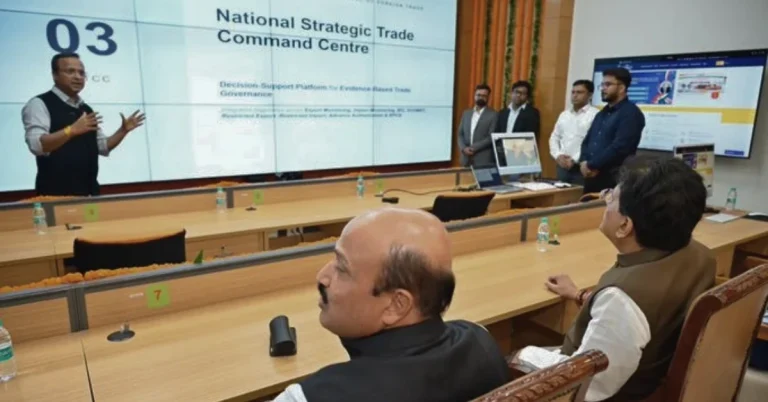
The roadmap was launched on Monday, 27 April, by NITI Aayog Vice Chairman Suman Bery and Principal Scientific Adviser to the Government of India Prof. Ajay Kumar Sood, in the presence of NITI Aayog CEO Nidhi Chhibber, Chief Economic Advisor V. Anantha Nageswaran, NITI Aayog Distinguished Fellow Debjani Ghosh, EkStep Foundation Co-Founder and CEO Shankar Maruwada, and other guests and dignitaries.
Industry leaders, start-ups and development partners also participated in the launch, signalling a broad-based commitment to India’s next phase of digital transformation.
The central argument of the roadmap is that the rules of technology-led competition are changing. Advantage no longer comes from innovation alone, but from the ability to connect innovation across sectors, institutions and ecosystems, and then diffuse it rapidly at population scale. In this context, the document places digital rails at the centre of India’s next growth phase.
Developed in partnership with EkStep Foundation and Deloitte, the roadmap proposes a two-phase path for India’s digital transformation.
DPI 2.0, covering 2025 to 2035, is aimed at driving livelihood-led growth at scale.
DPI 3.0, covering 2035 to 2047, is intended to enable broad-based prosperity.
The immediate focus is DPI 2.0.
Read also: India-New Zealand FTA explained: What the pact means for trade, jobs, investment and mobility
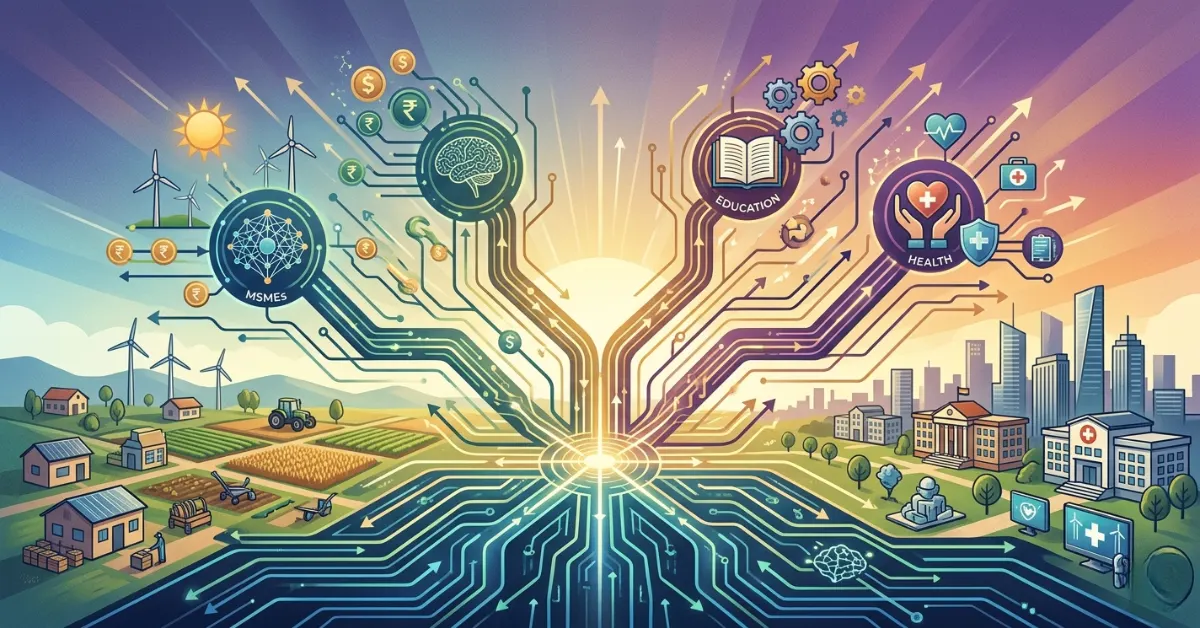
Under DPI 2.0, the roadmap identifies eight sectoral transformations to address structural bottlenecks across MSMEs, agriculture, education and health. It also seeks to strengthen systemic enablers such as credit, decentralised energy and benefit delivery.
To move from intent to outcomes, the roadmap lays down four execution imperatives: district-led demand aggregation, scaling technology entrepreneurship, leveraging artificial intelligence, and deploying cross-sector unlocks through better data use, digital transactions, stronger human capacity and the democratisation of AI.
At its core, DPI 2.0 marks an attempt to extend India’s digital rails beyond identity, payments and welfare into the engines of livelihoods, productivity and market access.
This marks a larger shift in how growth will be created in the coming years. The emphasis is not only on inventing new technologies, but on building the connective infrastructure that allows innovation to work together, move faster and reach more people.
By combining open digital infrastructure with trusted data flows and ecosystem-led innovation, the roadmap seeks to create conditions for technologies such as AI to spread at scale across citizens and small enterprises.
This represents an important evolution in India’s digital journey, moving from digital inclusion alone to enabling capability, productivity and opportunity at scale.
Execution has been identified as the priority. The roadmap is grounded in district-level adoption and local realities, while being anchored in trust, interoperability and safeguards.
NITI Aayog said DPI 2.0 offers a practical pathway for technology adoption to drive broad-based growth and support India’s transition towards a non-linear, productivity-led growth trajectory for Viksit Bharat 2047.
Speaking at the launch, Suman Bery said the focus has shifted from GDP to productivity.
Higher quality employment, stronger incomes and better living standards, he said, depend on rising productivity.
He noted that DPI 1.0 had shown the importance of harnessing networks, and that the next phase of India’s development would be shaped by how AI and DPI raise productivity at scale.
Prof. Ajay Kumar Sood said technology leadership will increasingly be defined by the ability to translate science and innovation into scalable, trusted public outcomes.
He said India’s DPI had demonstrated the power of open, interoperable systems at population scale, and that the next phase must build on this foundation by integrating frontier technologies with scientific rigour and safeguards.
Nidhi Chhibber said a significant part of the NITI Frontier Tech Hub roadmap focuses on supporting states in their transformation journeys. The intent, she said, is to equip states with practical pathways they can adapt and implement. She added that when states grow fast, India grows faster, and DPI can become a significant enabler in accelerating inclusive growth for states.
Debjani Ghosh said the roadmap sets out how DPI 2.0 can move India from digital inclusion to productivity-led, livelihood-centred growth on the road to Viksit Bharat 2047. She said the global AI race is no longer only about frontier models, chips and capital, but increasingly about a country’s ability to connect digital infrastructure with economy-wide diffusion and impact.
According to her, India enters this next phase with a structural advantage in the form of its Digital Public Infrastructure.
By combining DPI, AI and entrepreneurship, India can build an inclusive, vernacular and population-scale model of AI adoption that improves lives, strengthens livelihoods and unlocks productivity across critical sectors.