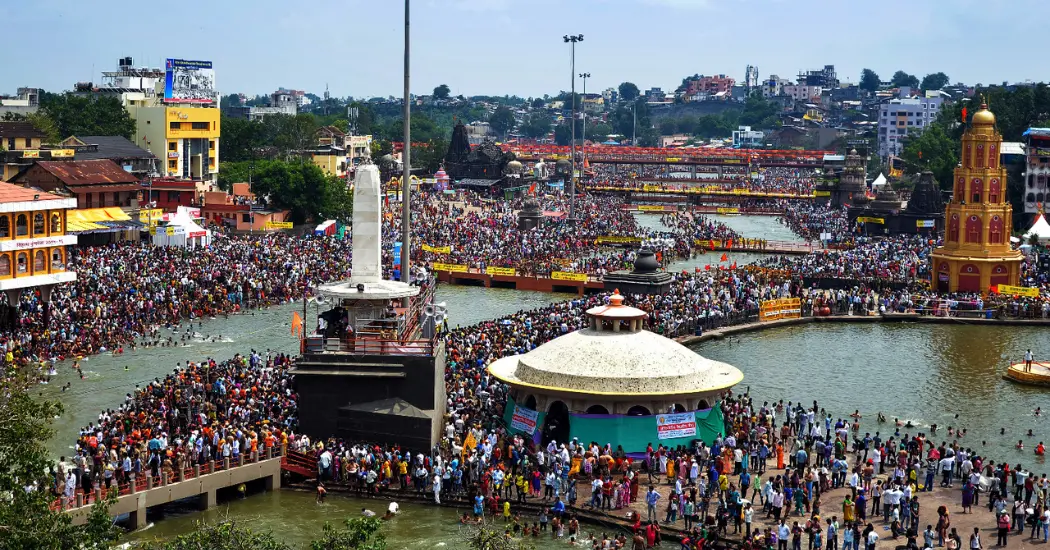
The Maharashtra government is undertaking development works worth ₹35,000 crore to prepare Nashik-Trimbakeshwar for the upcoming Simhastha Kumbh Mela, with a focus on infrastructure, river rejuvenation, and pilgrim facilities.
Maharashtra Chief Minister Devendra Fadnavis said the planning aims to make the religious gathering “grand and unforgettable,” while ensuring that devotees are provided with adequate amenities.
He emphasised that guidance from saints and mahants will play a key role in shaping the preparations.
Speaking at the conclusion of the two-day meeting of the All India Sant Samiti National Executive Committee at Tapovan in Nashik on Sunday, 5 April, the Chief Minister outlined a series of projects spanning transport, water management, and religious infrastructure.
Measures are being implemented to ensure clean and continuous flow of the Godavari river at Trimbakeshwar, including efforts to make the river perennial.
A water purification project has been initiated for Kushavarta, a key pilgrimage site.
Infrastructure upgrades include improvement of the Trimbakeshwar road and Nashik Parikrama route, expansion of railway station facilities, and increase in both the number and length of ghats.
The plan also covers conservation of old temples, widening of access roads leading to temples, and expansion of Ozar Airport to handle increased traffic.
The state government has decided to permanently acquire land for Sadhugram, where dedicated infrastructure will be developed for saints and religious orders.
Authorities are also setting up the Nashik-Trimbakeshwar Kumbh Mela Development Authority on the lines of Prayagraj to oversee planning and execution.
Officials from Nashik have already visited Prayagraj to study the planning model used for the Kumbh Mela there.
The state expects nearly ten times more devotees compared to the previous edition, and preparations are being aligned accordingly.
Fadnavis said inputs from saints, mahants, and akhadas will be incorporated into project execution.
He highlighted the role of spiritual traditions in preserving Indian culture, noting that such traditions have ensured continuity despite historical challenges.
Describing the Kumbh Mela as the largest spiritual congregation in India, the Chief Minister said it represents both purification of the mind and a platform for exchange of ideas among spiritual leaders.
He added that participation from people across communities makes the event a symbol of national unity.
The Chief Minister also said the proposed Maharashtra Freedom of Religion Bill would help curb malpractices and enable strict action against fraudulent practices.
The event was attended by several religious leaders, ministers, and public representatives, including members of the All India Sant Samiti and Akhil Bharatiya Akhada Parishad.