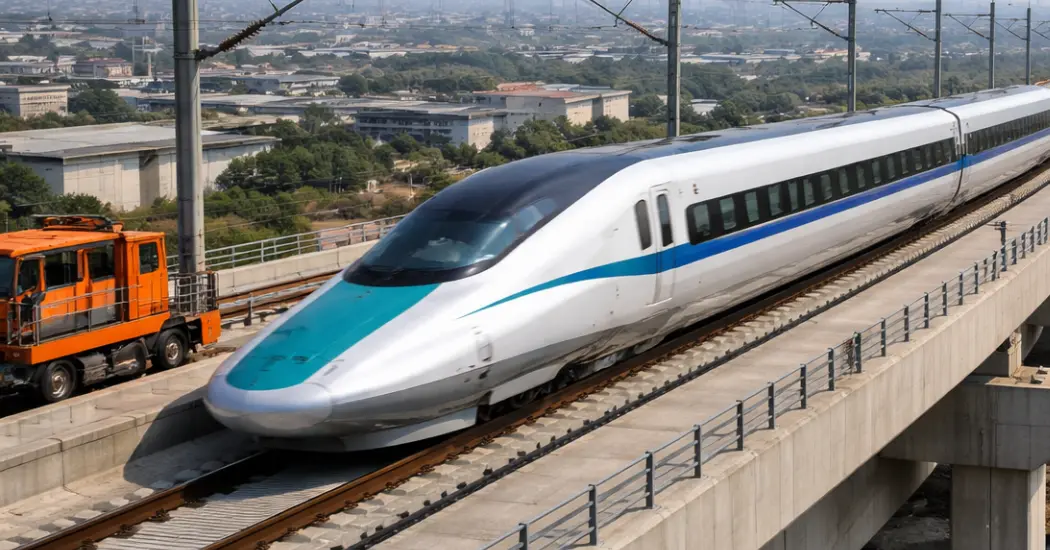
The Ministry of Railways has said that the under-construction Mumbai-Ahmedabad High Speed Rail project, which is India’s first bullet train corridor, has been a “good platform for learning, indigenising and executing bullet train projects in the country”.
In its submission to the Parliamentary Standing Committee on Railways, the ministry provided details about the roadmap for expanding indigenous manufacturing of components under the Make-in-India initiative, specific components being indigenised and timelines and institutional mechanisms put in place for enhanced domestic capacity development.
The ministry stated that multiple steps have been undertaken to indigenise both technical expertise and physical systems under the high-speed rail programme.
While the principal design for the project has been carried out by a Japanese entity, design variations arising during construction have been handled by Indian agencies and validated by Centres of Excellence such as the IITs, according to the ministry.
The ministry said this process has helped create a domestic knowledge base for high-speed rail design and execution.
The ministry said that dynamic effect i.e. train-structure interaction including deck acceleration, resonance effects (vibration), superstructure displacement, train running safety and riding comfort parameters increase with train speed and this increase becomes significant at speeds greater than 200 kmph i.e. High Speed Railway (HSR).
“Carrying out dynamic analysis for every superstructure span and for different rolling stock is an iterative and time-consuming process. Details regarding dynamic analysis for HSR, which were not made available by the principal designer, have been independently developed (i.e. dynamic design charts nomograms) by Indian side for various rolling stocks in association with IIT Mumbai,” the ministry said.
The ministry has stated that in case of long-span steel truss girders designed in Japan and fabricated in Indian workshop, performance parameter for dynamic loading were not provided by the principal Japanese designer, Indian agencies have undertaken instrumentation-based studies in collaboration with IIT Kanpur.
“To ascertain the dynamic performance parameter instrumentations have been installed in collaboration with IIT Kanpur, this will help in validation of high speed designs parameters through analytical modelling and field measurements by the instruments on these girders,” the ministry said.
These efforts are aimed at validating high-speed design parameters through field measurements and analytical modelling, thereby enabling the development of indigenous standards for such structures, which were earlier limited to speeds of 160 Kmph.
On the manufacturing side, the ministry highlighted that heavy construction machinery including moulds, Straddle carrier, bridge gantry, girder transporters and launching gantries (all 5 types of machines used for full span launching method), which were initially imported, has now been indigenised and is being produced within India.
A similar transition has been achieved in track systems, where most materials required for Japanese slab track technology, including fittings, sleepers and inserts, are now being manufactured domestically, with efforts underway for development of balance 25% materials, according to the ministry.
“CAM as per indigenous components have been developed in association with IIT Kharagpur and same can be adopted after field trials,” the ministry said.
The ministry also noted that track Machineries (like rail feeder car, track slab laying car, track motor car, carriage wagons, CAM injection car) required for Shinkansen track technology has been developed and manufactured indigenously.
According to the ministry, to prevent displacement of girders in the event of an earthquake, each girder is provided with four seismic stoppers.
“These stoppers, made of steel boxed provided with rubberised surfaces, designed for High Speed Viaduct, were initially planned to be procured from Japan. However, the same have now been indigenously developed and manufactured in India for Mumbai- Ahmedabad HSR Project,” the ministry said.
The Make in India push outlined by the Ministry extends beyond components into project methods and systems.
It said simulation software for OHE and pantograph interaction has been developed under NHSRCL, while an “indigenous simulation model for design and validation of traction power supply system” has been developed with IIT Delhi.
The ministry also highlighted execution-side innovations adopted on the corridor.
It said a full-span launching method for prestressed box girders weighing around 1000 MT has been used extensively in the MAHSR project, with a 40 m girder capable of being launched within 16 hours.
“For the first time in the country, a full span launching method has been adopted for launching of prestressed box girders weighing around 1000MT. The method has been extensively used in the MAHSR project and quite unique to the world for this size of launching. The process has been highly optimised in terms of quality, safety and speed of construction. A girder of 40m length, with this technology, can be launched within 16 hours,” the ministry said.
It further said indigenously produced noise barriers are being installed across the entire elevated stretch of the bullet train corridor.
The ministry noted that simulation software for OHE and Pantograph interaction have been developed under the National High-Speed Rail Corporation Limited (NHSRCL), which is the implementing agency for the bullet train project.
In addition to this, “Indigenous simulation model for design and validation of traction power supply system” has also been developed in collaboration with IIT Delhi, the ministry said.
Further, the ministry informed that committee that an innovative methodology for erection of Over Head Equipment (OHE) masts and other components of overhead equipment have been developed and used for speedier construction surpassing the methodology used in Japan.
On skills, the ministry informed the committee that around 1000 Indian engineers and skilled workers have been trained in Japanese track methodology, and that track works are now being executed under their supervision.
A special track training facility has also been created at Surat for training and refresher courses.
Special fittings like Rail Turnover Prevention Device (RTPD) which prevents turnover of rails even if the rail fasteners are damaged or destroyed by the wheels of the train at the time of or after the derailment, have also been developed and manufactured indigenously, according to the ministry.
Further, the Railways is also developing an indigenous high-speed train with design speed of 280 kmph.
The 508 Km MAHSR corridor, currently under execution across Maharashtra and Gujarat, has already seen completion of 430 Km of piers, 341 Km of girders, 174 Km of track bed and 153 Km of OHE masts.
Railway Minister Ashwini Vaishnaw had earlier in January said the first bullet train service is expected to run on 15 August 2027, starting with the Surat-Bilimora section.
The corridor will be opened in phases, covering the Vapi-Surat, Vapi-Ahmedabad, and Thane-Ahmedabad stretches before the entire Mumbai-Ahmedabad section becomes operational in the final stage.