The Union Cabinet has approved India’s updated Nationally Determined Contribution (NDC) for the period 2031-2035, enhancing India’s climate ambition under the United Nations Framework Convention on Climate Change and the Paris Agreement.
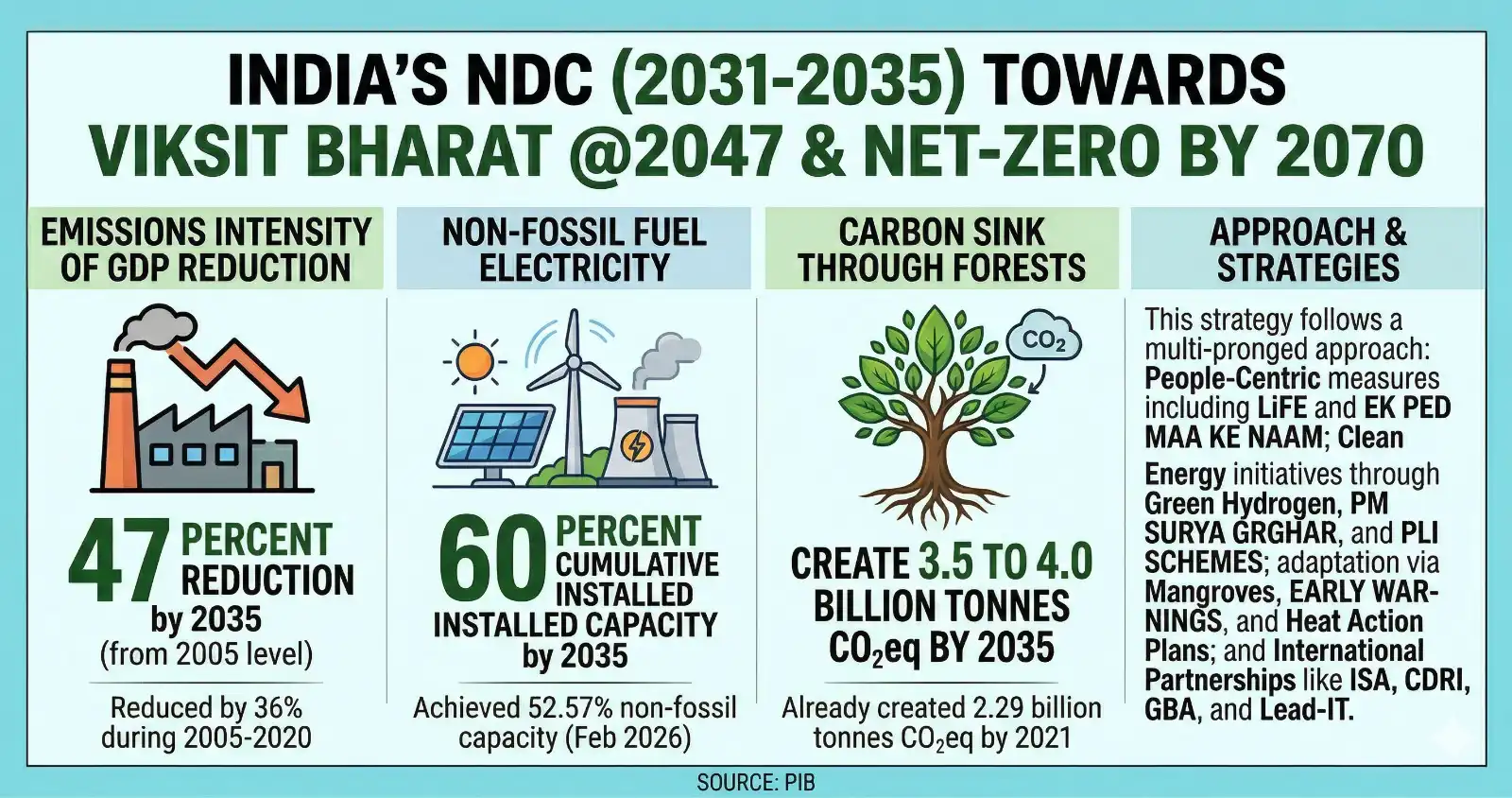
The revised commitments include reducing the emissions intensity of GDP by 47 per cent by 2035 from 2005 levels, increasing the share of non-fossil fuel-based installed electric power capacity to 60 per cent, and creating an additional carbon sink of 3.5 to 4.0 billion tonnes of CO2 equivalent through forest and tree cover.
These targets build on India’s earlier climate commitments, many of which were achieved well ahead of schedule.
The country met its earlier targets of 33-35 per cent emissions intensity reduction and 40 per cent non-fossil capacity 11 years and 9 years ahead of the committed timelines, respectively.
India had already reduced emissions intensity by 36 per cent between 2005 and 2020 and achieved 52.57 per cent non-fossil fuel capacity as of February 2026.
On carbon sinks, India had already created 2.29 billion tonnes of CO2 equivalent through forest and tree cover by 2021, with afforestation and ecosystem restoration continuing to support future targets.
The updated NDC aligns with India’s long-term vision of achieving net-zero emissions by 2070 and supports the broader goal of Viksit Bharat by 2047.
The government has emphasised balancing economic growth with environmental sustainability.
India’s climate strategy will be implemented through a series of measures including large-scale renewable energy expansion, battery storage systems, green energy corridors, green hydrogen initiatives, and cleaner manufacturing processes.
Key schemes supporting this transition include the Green Hydrogen Mission, PM Surya Ghar: Muft Bijli Yojana, PM-KUSUM, and Production Linked Incentive schemes.
The framework also places strong emphasis on climate adaptation measures, including coastal protection through mangrove restoration, glacier monitoring in Himalayan regions, early warning systems for extreme weather events, and implementation of Heat Action Plans across states.
India’s climate action approach continues to follow a whole-of-government and whole-of-society model, with inputs from ministries, industry, and civil society.
The updated commitments are designed to remain ambitious yet achievable while safeguarding energy security, livelihoods, and food security.