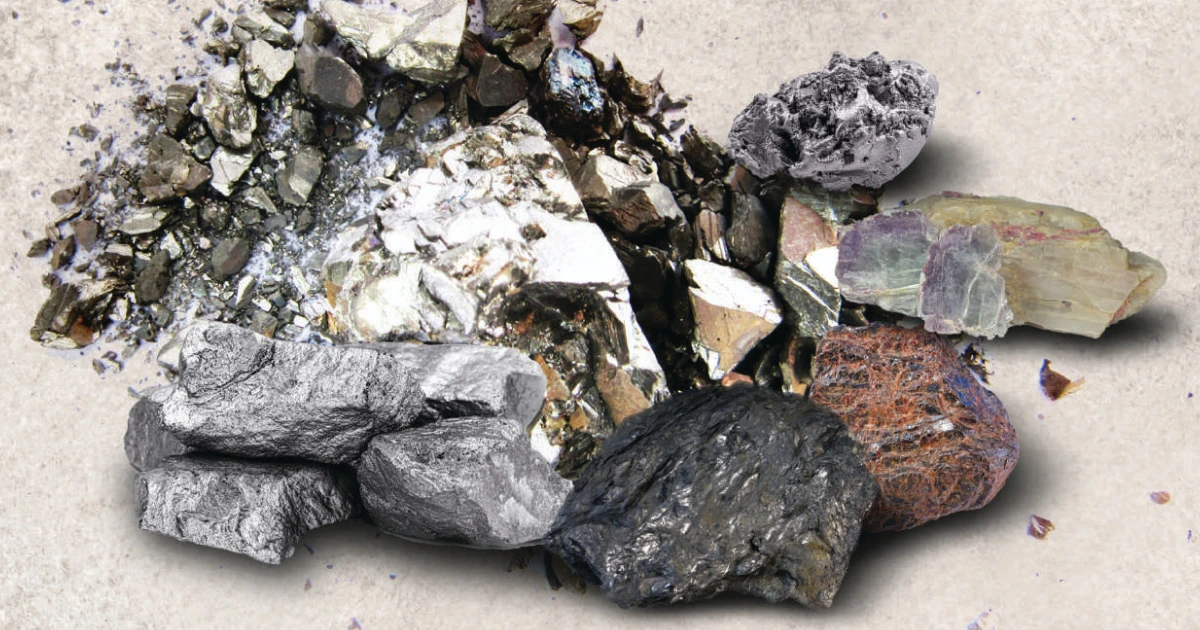
The government has allocated ₹500 crore for developing a National Critical Mineral Stockpile to secure supplies of strategic and critical minerals for domestic use, the Ministry of Mines informed Parliament.
In a written reply to a question in the Rajya Sabha on 9 March, Minister of State for Coal and Mines Satish Chandra Dubey said the initiative is being implemented under the National Critical Mineral Mission (NCMM) to strengthen India’s critical mineral supply chain.
“Union Cabinet has approved the National Critical Mineral Mission (NCMM) on 29 January 2025 to secure a long-term sustainable supply of critical minerals (including REE) and strengthen India’s critical mineral value chain encompassing all stages from mineral exploration and mining to beneficiation, processing and recovery from end-of-life products,” Dubey said.
The Union Cabinet had approved the launch of the National Critical Mineral Mission (NCMM), for a period of seven years from 2024-25 to 2030-31, with a proposed expenditure of ₹16,300 crore and an expected investment of ₹18,000 crore by Public Sector Undertakings (PSUs) and other stakeholders.
The minister said that under the framework of the mission, provision has been made for a joint initiative between central public sector undertakings or private companies to develop the National Critical Mineral Stockpile programme.
Read also : India’s inflation near lower limit of RBI target band; government sees limited impact from crude price rise
“Mission provides for a joint initiative between central Public Sector Undertakings (PSUs) or with private companies to develop National Critical Mineral Stockpile Programme, for stockpiling critical and strategic minerals, to guard against supply disruptions and aid mineral supply for domestic utilization,” the minister said.
“The government has allocated ₹500 Crore for developing the National Critical Mineral Stockpile,” he added.
The minister noted that rare earth element processing globally is currently dominated by one country (an apparent reference to China), and the government is taking steps to increase domestic production and diversify supply sources of critical minerals.
As part of these efforts, the Geological Survey of India has intensified exploration of critical and strategic minerals.
In 2024-25, GSI carried out 78 mineral exploration projects on rare earth elements and during 2025-26 has taken up 92 projects exclusively for rare earth elements across the country.
The government has also auctioned 46 critical mineral blocks, including seven blocks containing rare earth elements, while seven exploration licence blocks have also been auctioned by the Centre, which include two blocks of REE.
Other measures listed by the ministry include the recognition of nine premier institutes as Centres of Excellence under the NCMM for research and development, approval of a ₹1,500 crore incentive scheme to promote recycling of critical minerals, issuance of guidelines on 14 November 2025 for funding pilot projects for recovery of critical minerals, including rare earth elements, from overburden, tailings, fly ash and red mud, and customs duty exemptions on several critical minerals and inputs used in their processing.
The minister also said Khanij Bidesh India Limited (KABIL), a joint venture under the Ministry of Mines, has been created to acquire overseas mineral assets such as lithium, cobalt and rare earth elements.
Read also : After NSE, Bombay Stock Exchange eyes expansion in Mumbai’s Bandra Kurla Complex