Kavach version 4.0 commissioned on 1,297 Route Km across high-density Delhi-Mumbai and Delhi-Howrah corridors has been successfully implemented on 1,297 Route Kilometres, covering the high density Delhi-Mumbai and Delhi-Howrah routes, the Ministry of Railways informed the Lok Sabha.
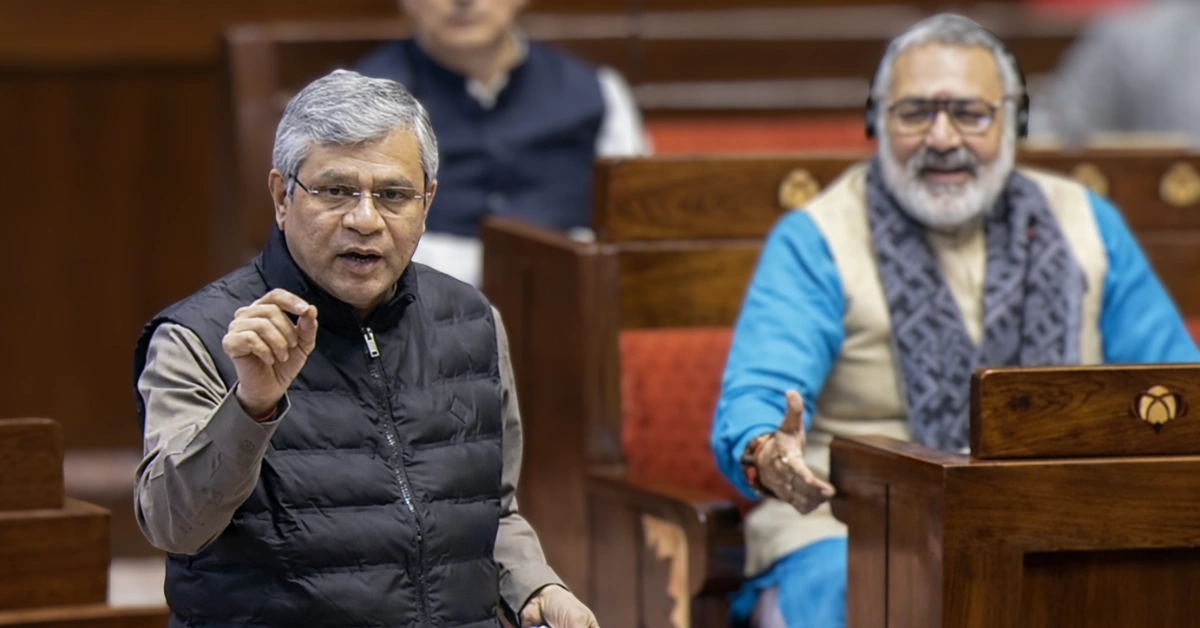
The information was provided by Union Minister for Railways Ashwini Vaishnaw in a written reply to a question regarding the installation of Kavach on railway routes across the country.
Kavach is an indigenously developed Automatic Train Protection system that requires safety certification of the highest order (SIL-4).
Kavach was first field-tested on passenger trains in February 2016 and was adopted as the national Automatic Train Protection system in July 2020.
The system assists loco pilots in operating trains within specified speed limits by automatically applying brakes if the pilot fails to act, while also helping trains run safely during inclement weather.
On the Delhi-Mumbai corridor, Kavach version 4.0 has been commissioned on the Junction Cabin-Palwal-Mathura-Nagda section covering 667 Route Kilometres, the Vadodara-Virar section spanning 336 Km, and the Vadodara-Ahmedabad section extending 96 Km.
On the Delhi-Howrah route, the system has been deployed on the Gaya-Sarmatanr section (93 Km) and the Howrah-Bardhaman section (105 Km).
The minister stated that the Kavach specification version 4.0 was approved by the Research Designs and Standards Organisation on 16 July 2024 after improvements were made based on deployment of version 3.2 across 1,465 Route Kilometres on South Central Railway.
The upgraded version features increased location accuracy, improved signal aspect information in larger yards, enhanced station-to-station interface on optical fibre cable, and direct integration with existing electronic interlocking systems to enable large-scale deployment across Indian Railways.
According to the minister, trackside Kavach implementation has been taken up on 23,360 Route Kilometres covering the Golden Quadrilateral, Golden Diagonal, High Density Network and other identified sections of Indian Railways.
As of 30 January 2026, progress on key infrastructure includes laying of 8,570 Km of optical fibre cable, installation of 938 telecom towers, commissioning of station data centres at 767 stations, deployment of trackside equipment across 5,672 Route Kilometres, and provisioning of Kavach in 4,154 locomotives.
The minister added that the Railways has finalised a tender to equip 6,300 electric locomotives with Kavach version 4.0, while another tender for equipping 2,679 diesel locomotives is under finalisation.
Specialised training programmes are being conducted at centralised training institutes to build operational capacity. About 48,000 technicians, operators and engineers have been trained on Kavach technology so far, including approximately 45,000 loco pilots and assistant loco pilots, with courses designed in collaboration with the Indian Railways Institute of Signal Engineering and Telecommunications.
The cost for providing trackside and station equipment is approximately ₹50 lakh per Km, while the cost of equipping locomotives is around ₹80 lakh per locomotive.
Funds utilised on Kavach works up to December 2025 stand at ₹2,573.36 crore, and ₹1,673.19 crore has been allocated for 2025-26, with requisite funds being made available as per project progress, the minister informed.