
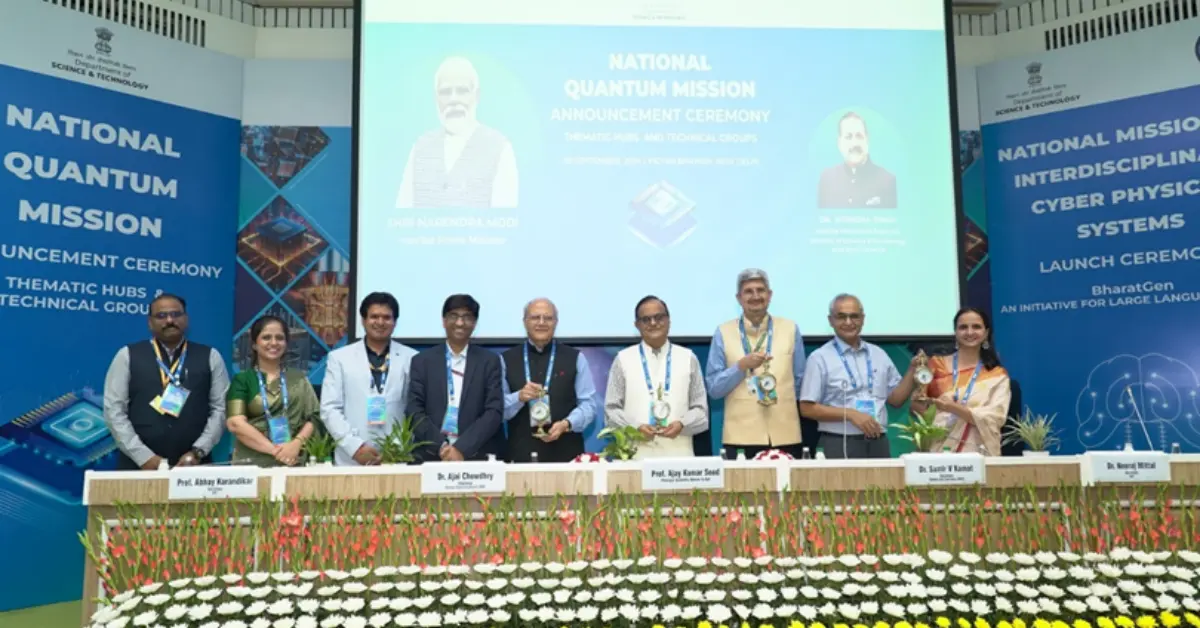
India is targeting the development of quantum computers with up to 1,000 physical qubits within the next eight years as part of its National Quantum Mission, alongside plans for secure ground-to-ground communication networks and inter-city Quantum Key Distribution spanning 2,000 Km.
The objective forms part of a broader national strategy that also includes enabling long-distance quantum communication and strengthening secure digital infrastructure.
The announcement was made by Union Minister of State (Independent Charge) for Science and Technology Jitendra Singh while addressing the foundation ceremony of the Amaravati Quantum Valley in Andhra Pradesh.
“This is not merely the foundation stone of a building, but the foundation stone of India’s quantum future,” Singh said.
He described quantum technology as a strategic necessity rather than an option, stating that leadership in the domain will be essential for safeguarding communication systems, defence architecture, healthcare innovation, and India’s global technological standing in the coming decades.
India is among a select group of nations with a dedicated quantum programme, backed by an allocation of approximately ₹6,000 crore.
The National Quantum Mission spans 43 institutions across 17 States and 2 Union Territories and is structured around four thematic hubs focused on Quantum Computing, Quantum Communication, Quantum Sensing and Metrology, and Quantum Materials and Devices.
According to the minister, quantum encryption could make sensitive data virtually impossible to breach, potentially requiring astronomical timeframes to decode, thereby offering unprecedented protection in defence and cybersecurity.
He also highlighted emerging healthcare applications, including precision radiation therapies capable of targeting tumours without collateral damage while adapting to organ movement, as well as advances expected in satellite communication and sensing technologies.
The Amaravati event featured the launch of IBM and TCS Quantum Cloud Services, the establishment of an IBM-TCS Quantum Innovation Centre, a Quantum Talent Hub, and multiple industry partnerships.
Singh noted that while India entered the information technology revolution later than some countries, it will not repeat that delay in emerging technologies, pointing to parallel national missions in Artificial Intelligence, biotechnology, space, and deep ocean exploration as part of a coordinated push into next-generation sectors.
Read also : India moves to strengthen financial system against emerging cyber threats