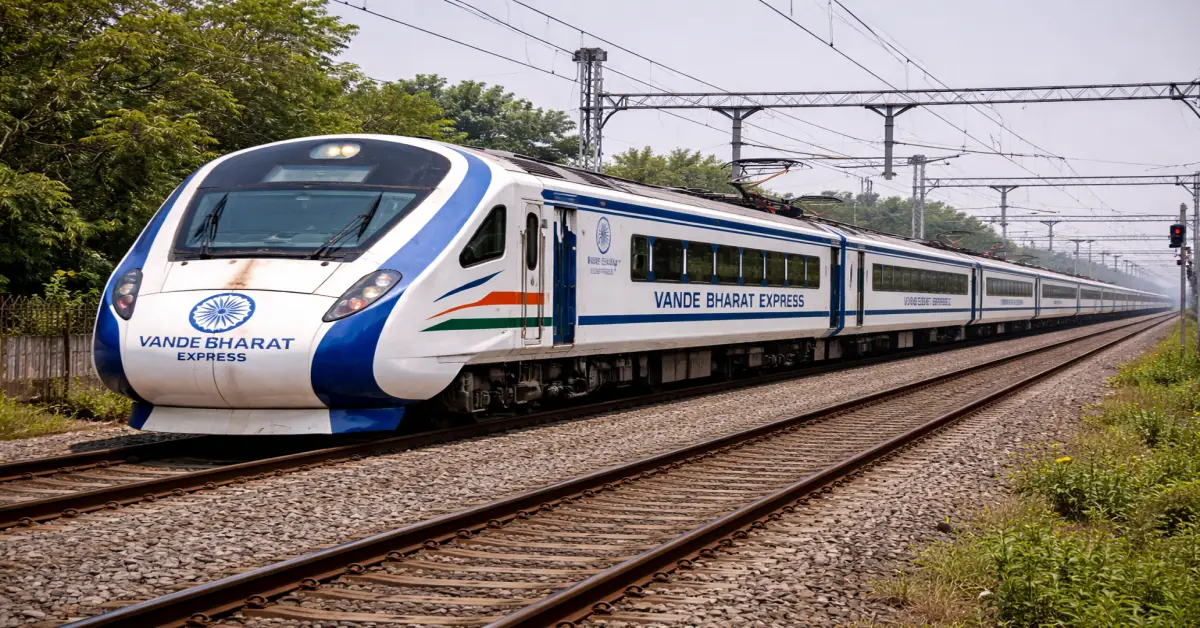
New Delhi: Indian Railways is set to advance its flagship semi-high-speed programme with the rollout of Vande Bharat 4.0, the next-generation evolution of the Vande Bharat Express platform. The upcoming trainsets will introduce sharper safety architecture, higher comfort benchmarks and future-ready performance aligned to dedicated high-speed corridors, as outlined in an official Press Information Bureau explainer.
Hard numbers define the shift. Current Vande Bharat variants operate at 160 kmph, with a design speed of 180 kmph, subject to route readiness. Vande Bharat 3.0 already accelerates from 0 to 100 kmph in about 52 seconds, matching global semi-high-speed standards on existing tracks. Vande Bharat 4.0 is being engineered to integrate Kavach 5.0, the next iteration of India’s indigenous Automatic Train Protection system, while positioning the platform for future dedicated corridors capable of supporting speeds up to 350 kmph-a capability tied to new infrastructure rather than conventional lines.
The technological leap comes amid sustained demand. By December 2025, 164 Vande Bharat services were operational across 274 districts, carrying over 7.5 crore passengers. Occupancy exceeded capacity-102.01 per cent in 2024-25 and 105.03 per cent in 2025-26 (up to June)-underscoring strong acceptance of faster, cleaner inter-city rail. Journey times have fallen by up to 45 per cent on several corridors, with flagship routes delivering 40 to 50 per cent faster schedules than legacy services.
What changes with 4.0: Alongside Kavach 5.0, the new trainsets will focus on improved seating ergonomics, upgraded toilets, finer interior finishes, and higher coach build quality, aiming to raise comfort and durability to global benchmarks. Officials also flag export potential, reflecting growing confidence in indigenous rail engineering and manufacturing.
The expansion is not limited to daytime services. The Vande Bharat Sleeper, launching January 2026, extends the platform to overnight travel. Designed for 180 kmph testing speeds, the 16-coach sleeper set will debut on the Howrah-Guwahati corridor, cutting travel time by nearly 3 hours compared to existing options, and offering capacity for around 823 passengers.
Scale-up roadmap: The government’s medium-term target is about 800 Vande Bharat trainsets by 2030, subject to infrastructure and manufacturing capacity, with a long-term vision of around 4,500 trainsets by 2047. Together, these milestones place Vande Bharat 4.0 at the centre of India’s rail modernisation-bridging today’s 160 kmph operations with tomorrow’s 350 kmph high-speed ambitions.