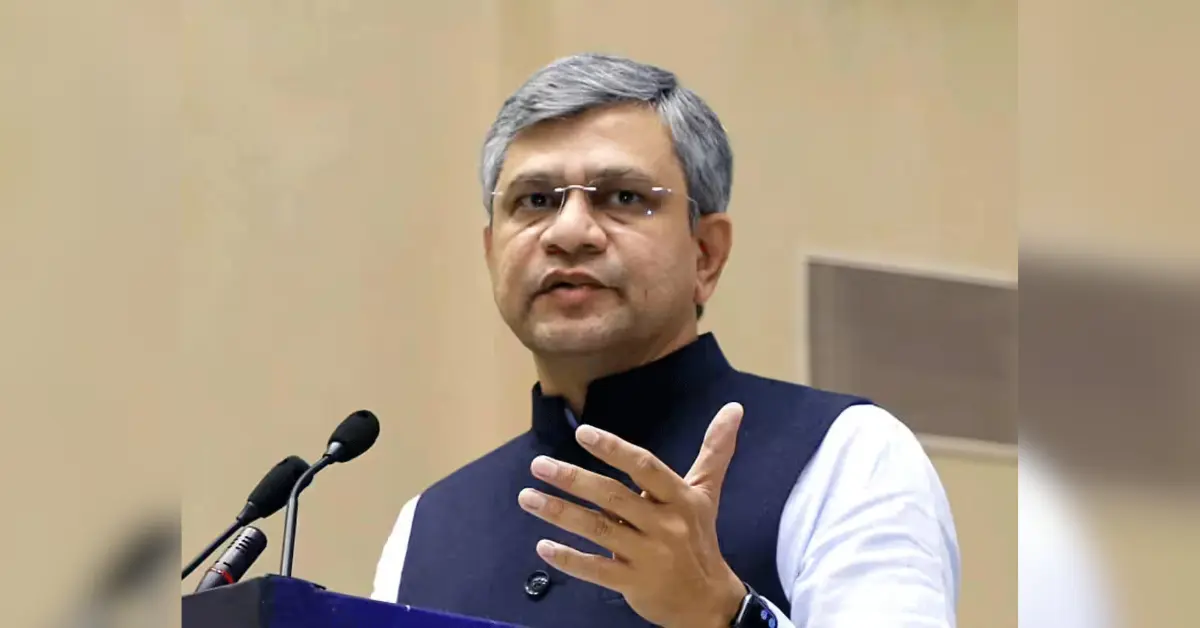
Railways Minister Ashwini Vaishnaw on Tuesday, 3 March, outlined an ambitious roadmap for expanding India’s high-speed rail network, unveiling a vision to develop 7,000 Km of bullet train corridors by 2039-40.
Addressing the Budget Webinar on “Sustaining and Strengthening Economic Growth: Infrastructure, Logistics & Freight”, the minister said Prime Minister Narendra Modi has approved seven new high-speed passenger corridors spanning 4,000 Km, with an estimated investment of ₹16 lakh crore, to be completed over the next 10 years.
To meet this target, Indian Railways will need to commission nearly 500 Km of high-speed rail annually — effectively building a corridor equivalent to the Mumbai-Ahmedabad High-Speed Rail project every year.
Plans are also underway to sanction an additional 3,000 Km, taking the total envisioned network to 7,000 Km by 2039-40, with a long-term projection of 15,000-21,000 Km.
Highlighting progress on the Mumbai-Ahmedabad High-Speed Rail Corridor, Vaishnaw described it as a steep learning curve, noting that operations beyond 160 Km per hour increase design and operational complexity exponentially.
Through collaboration with IITs, industry partners, and railway engineers, India scaled up construction speed from an initially estimated 2 Km per month to 15 Km per month.
The minister emphasised that achieving the high-speed rail vision will require synchronized capacity expansion across industry and government.
Rolling stock manufacturers, signalling experts, equipment suppliers, electrical conductor producers, construction firms, and operations and maintenance teams will need to align their capacities with the accelerated rollout plan.
Calling for stronger quality standards and tighter tender norms in railways, Vaishnaw stressed the need to reduce excessive subcontracting and prevent underbidding that leads to disputes and arbitration.
He underlined that rail projects demand domain expertise across track systems, overhead electrification, signalling networks, station development, rolling stock operations, and integrated maintenance frameworks.