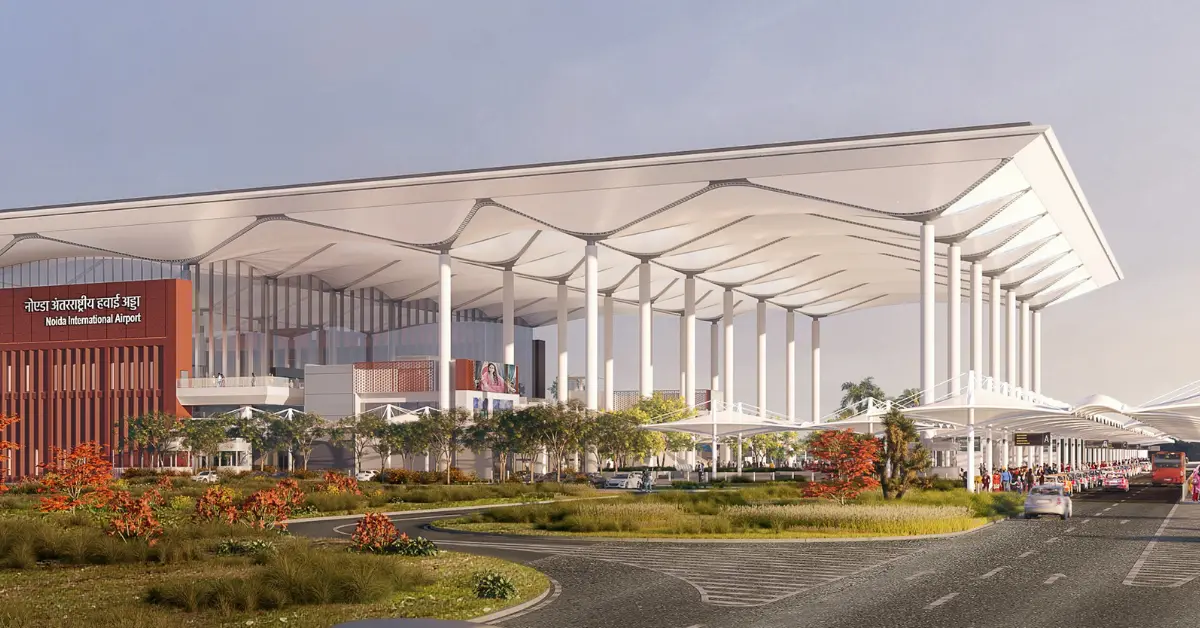
The Airport Economic Regulatory Authority of India has fixed the User Development Fee for Noida International Airport, with domestic departing passengers to be charged ₹490 and international departing passengers ₹980 from 15 June 2026 to 31 March 2027.
This comes ahead of the launch of the commercial flight operations from the airport on 15 June.
According to AERA’s order on aeronautical tariffs for Noida International Airport’s first control period, domestic arriving passengers will be charged ₹210 as UDF during the same period, while international arriving passengers will be charged ₹420.
The tariff order covers the first control period from 2026 to 2031, during which user development fees will gradually increase for both domestic and international passengers.
The order, issued on Tuesday, 12 May, says the tariff will be effective from 15 June 2026.
The rates approved by the regulator are ceiling rates and exclude taxes, if any.
For the 2027-28 financial year, AERA has fixed the UDF at ₹541 for domestic departing passengers and ₹1,083 for international departing passengers. Domestic arriving passengers will be charged ₹232, while international arriving passengers will be charged ₹464.
The fee will increase further in 2028-29, with domestic departing passengers to pay ₹598 and international departing passengers to pay ₹1,197. The UDF for domestic arriving passengers has been fixed at ₹256, while international arriving passengers will pay ₹516.
For 2029-30, the regulator has approved ₹661 as UDF for domestic departing passengers and ₹1,322 for international departing passengers. Domestic arriving passengers will pay ₹283 and international arriving passengers will pay ₹567.
In the final year of the first control period, from 1 April 2030 to 31 March 2031, the UDF will be ₹693 for domestic departing passengers and ₹1,461 for international departing passengers. Domestic arriving passengers will be charged ₹297, while international arriving passengers will be charged ₹626.
Read also : IndiGo to start flights from Noida Airport to Hyderabad, Jammu, Bengaluru and Amritsar from 15 June
AERA has also listed categories exempt from levy and collection of UDF. These include children below two years, holders of diplomatic passports, airline crew on duty, persons travelling on official duty on aircraft operated by the Indian Armed Forces, persons travelling on official duty for United Nations peacekeeping missions, and transit or transfer passengers meeting the specified conditions.
The authority has also approved Common User Terminal Equipment and Common Use Self Service charges of ₹75 per domestic embarking passenger and USD 1 per international embarking passenger. These charges will apply to UDF-paying passengers.
Apart from passenger charges, the tariff card also sets landing charges for airlines. For domestic flights, landing charges will begin at ₹725 per metric tonne from 15 June 2026 to 31 March 2027 and rise to ₹1,081 per metric tonne by 2030-31.
For international flights, the landing charge will begin at ₹1,088 per metric tonne and rise to ₹1,622 per metric tonne by 2030-31.
The order also provides for parking charges after a free parking period of two hours.
For all domestic and international aircraft, AERA has fixed parking charges at ₹25 per hour per metric tonne for the first two hours after the free parking period in 2026-27, rising to ₹28 in 2027-28, ₹31 in 2028-29, ₹34 in 2029-30 and ₹37 in 2030-31.
For parking beyond four hours, the charge has been fixed at ₹50 per hour per metric tonne in 2026-27, rising to ₹55, ₹61, ₹67 and ₹75 across the subsequent years of the first control period.
Under the general conditions, AERA has said Aviation Security Fee will apply as prescribed by the Ministry of Civil Aviation from time to time.
Flights operating under the Regional Connectivity Scheme will be completely exempt from aeronautical charges as per the authority’s 31 March 2017 order.
AERA has directed the airport operator to submit its Multi-Year Tariff Proposal for the second control period in a timely manner as per the authority’s 2011 guidelines.
Read also : India looks to scale aircraft leasing ecosystem as fleet is projected to cross 2,250 aircraft by 2035