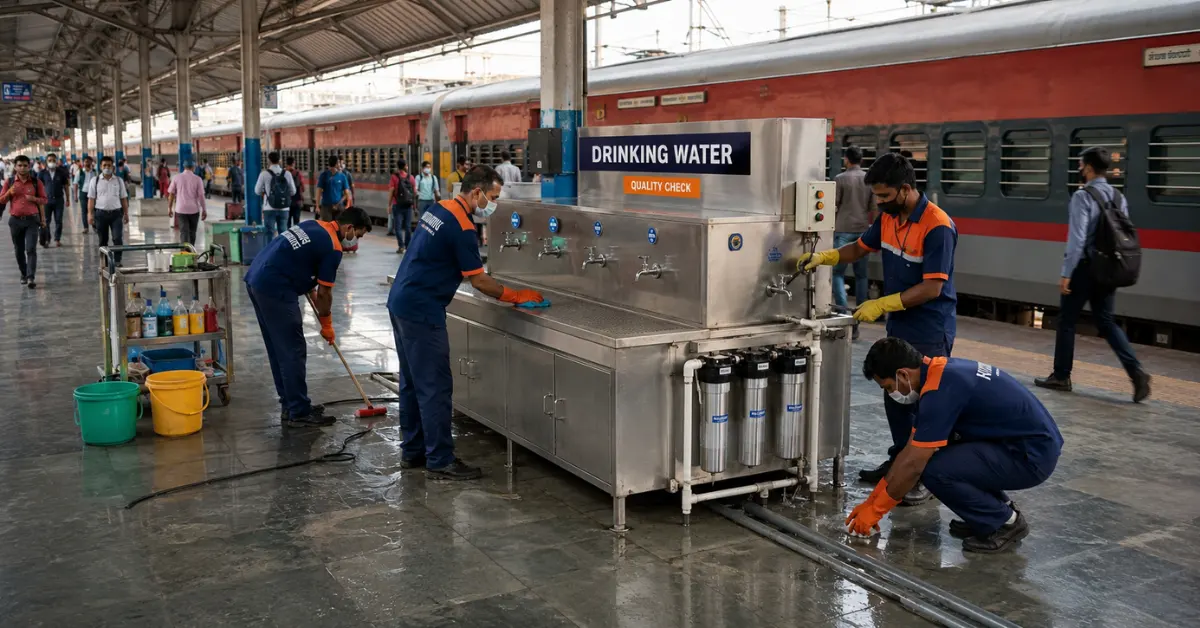
New Delhi: Indian Railways has launched a special cleanliness drive across the railway network to clean and disinfect drinking-water tanks and filtration systems, as part of efforts to ensure safe and hygienic drinking water for passengers at railway stations.
The initiative is part of a broader action plan to strengthen drinking-water quality management. Zonal Railways have been asked to frequently inspect and maintain the entire drinking-water system and test water quality both at the source and at the point of consumption.
During the drive, railway authorities will inspect water sources, treatment and filtration plants, underground and overhead tanks, PVC tanks, water booths, taps and other water-dispensing points.
All drinking-water tanks will be drained, desludged, scrubbed and disinfected. Tank covers will also be checked and vents and overflow points protected against contamination from birds, animals and algae.
Damaged tanks, pipelines and filters identified during inspections will be repaired or replaced wherever required. Railways will also check for cross-connections between potable and non-potable water systems and inspect drinking-water pipelines for leakages.
Special attention will be given to locations where hand pumps and borewells are used for drinking water, with Zonal Railways required to ensure that water from such sources remains free from contamination and safe for consumption.
The Railway Board has also advised comprehensive inspection of water coolers and purification systems. Cooler tanks will be cleaned, leakages in coolers, pipelines and taps addressed, and hygiene maintained around water-dispensing areas.
UV and RO purification systems will be checked for proper functioning and provided wherever required. Scheduled maintenance, servicing, overhauling and replacement of filter candles and other components will also be undertaken. New or replacement UV and RO systems will be taken up in mission mode based on their condition and requirement.
The same cleaning, purification and quality-monitoring measures will apply to Water Vending Machines operating across the railway network.
Officials will conduct physical, chemical and bacteriological testing of water samples from identified locations, including water sources, post-treatment outlets, tanks, coolers, vending machines and representative taps or booths, wherever feasible.
Daily monitoring of residual chlorine will also be undertaken, with immediate re-chlorination or other corrective action wherever required.
The Railway Board has directed Zonal Railways to monitor and expedite works already sanctioned for replacement and construction of new overhead and underground water tanks. Fresh sanctions will also be processed wherever required.
Railways is also working on suitable filtration and purification systems for different situations, including at-source and at-tap filtration, to identify and prevent contamination at different stages of the drinking-water supply chain.
Zonal Railways will submit station-wise details of deficiencies identified during the drive and the corrective action taken, allowing issues to be monitored and addressed in a time-bound manner.
Similar measures are also planned for drinking-water infrastructure in railway colonies and workplaces, extending the initiative to Railway personnel.
Read also: Indian Railways approves ₹153 crore four-lane ROB on Geratpur-Ahmedabad section in Gujarat