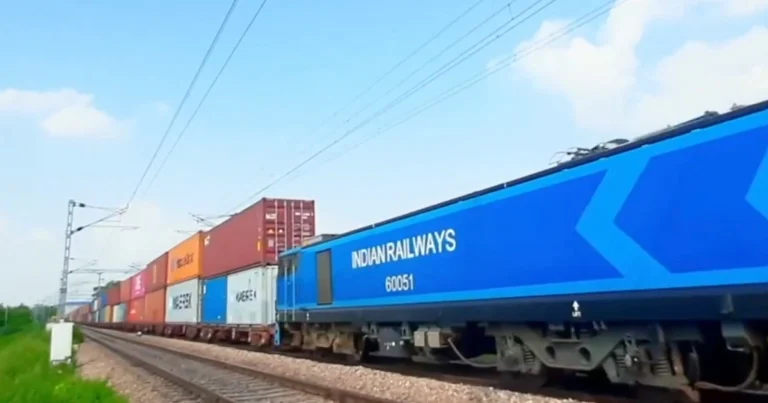
Indian Railways has approved a comprehensive set of rail infrastructure projects across multiple zones aimed at eliminating congestion, enhancing line capacity, strengthening safety systems, and enabling faster passenger and freight movement nationwide.
The approvals cover Southern, Northern and South Eastern Railways and include line doubling, third and fourth lines, bypass corridors, and advanced electronic interlocking systems.
Among the largest projects is the Barbenda-Damrughutu doubling and Damrughutu-Bokaro Steel City third and fourth lines in Jharkhand, sanctioned at ₹815.32 crore.
The corridor currently operates at 108 per cent utilisation, handling 78 trains daily and supporting freight throughput of 35.22 MTPA, with utilisation projected to rise to 132 per cent by 2028-29 without intervention.
The expansion is expected to strengthen connectivity to major industrial and energy hubs, including coalfields, cement and steel plants, petroleum depots, and the Bokaro Steel City ecosystem, thereby improving supply-chain efficiency and industrial output.
To enhance safety and operational efficiency, Indian Railways has also approved Electronic Interlocking at 34 stations on Northern Railway routes where Kavach is being deployed, at a total cost of ₹421.41 crore.
This includes 21 stations in the Delhi Division costing ₹292.24 crore and 13 stations in the Ambala Division costing ₹129.17 crore.
These upgrades are designed to enable faster and safer train operations, improve signalling reliability, support higher train frequencies on high-density routes, and complement modern train protection systems.
The 13.46 km Rajpura Bypass Line, approved at ₹411.96 crore, will enhance capacity on the busy Ambala-Jalandhar section by allowing freight trains to bypass the congested Rajpura Yard through direct connectivity between the New Shambhu Dedicated Freight Corridor station and Kauli station.
In Kerala, the Alappuzha-Ambalapuzha doubling project of 12.66 km, worth ₹324.16 crore, will remove a key single-line constraint, enabling nine additional passenger trains per day in each direction, adding 2.88 MTPA freight capacity, and generating ₹3.23 crore in annual earnings.
Another Kerala project, the Palakkad Town-Parli bypass line of 1.80 km costing ₹163.57 crore, will eliminate engine reversal at Palakkad Junction, reducing passenger train detention by 40 to 44 minutes and freight detention by up to 120 minutes per train, while improving punctuality on key routes.
Meanwhile, the Irugur-Podanur doubling of 10.77 km in Tamil Nadu, approved at ₹277.42 crore, is expected to allow 15 additional passenger trains per day and increase freight capacity by 3.12 MTPA, with annual net earnings projected to rise by ₹11.77 crore.
Line utilisation on this section is forecast to reach 131 per cent by 2027-28, underscoring the project’s strategic importance.
With adjoining quadruplication works already underway, this doubling will help transform the Chennai-Coimbatore-Podanur belt into a high-capacity four-line corridor, benefiting industrial hubs such as Coimbatore and supporting new train services.