The Ministry of Road Transport and Highways has notified the National Highways Fee (Determination of Rates and Collection) Fourth Amendment Rules, 2026, aimed at strengthening enforcement and rationalising fee collection for overloaded vehicles on national highways.
In a statement on Tuesday, 14 April, the ministry said the amended rules will come into force from tomorrow, 15 April.
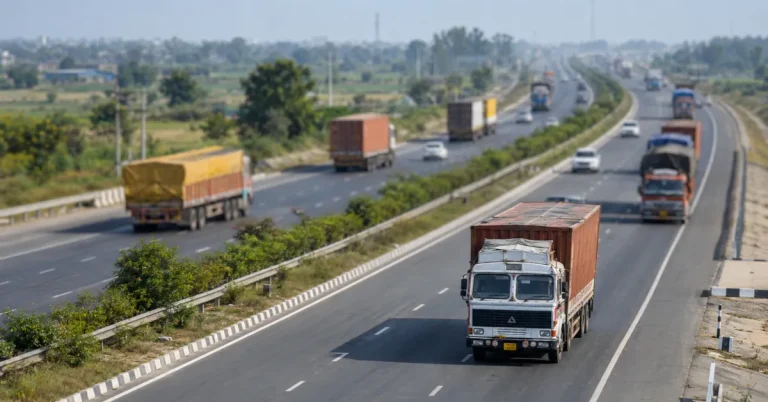
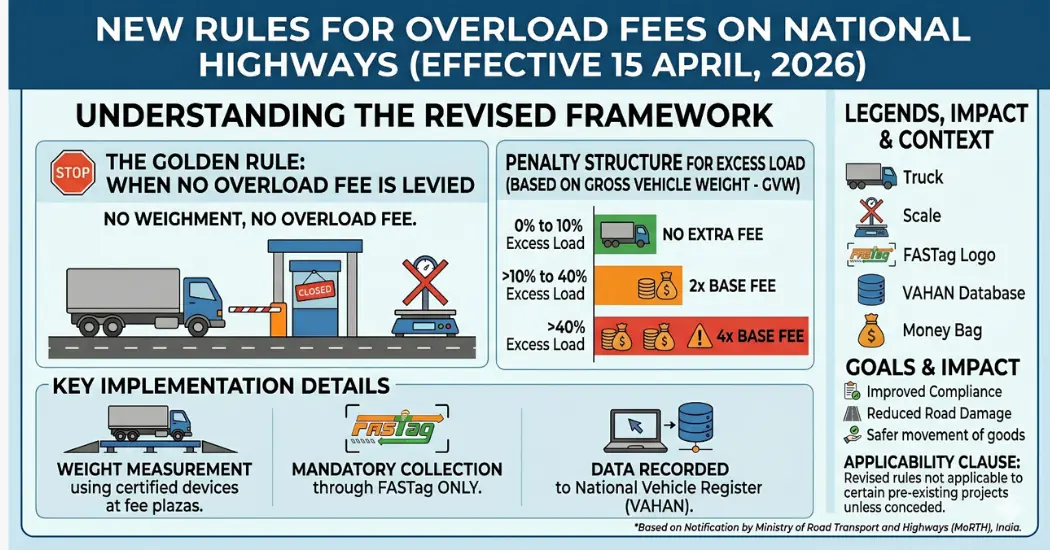
A revised framework has been introduced under Rule 10 for levy of fees on vehicles carrying loads beyond the permissible Gross Vehicle Weight (GVW).
Under the new structure, vehicles carrying up to 10 per cent excess load will not be charged any overload fee.
Vehicles carrying over 10 per cent and up to 40 per cent excess load will be charged a fee at 2 times the base rate, while those carrying more than 40 per cent excess load will be charged 4 times the base rate.
The ministry stated that overloading will be determined using certified weight measurement devices installed at fee plazas.
It also specifies that in cases where weighment facilities are not available at fee plazas, no overload fee shall be levied.
As part of the amendment, collection of overloading fees has been mandated through FASTag only.
Details of overloaded vehicles will be recorded and reported to the National Vehicle Register (VAHAN) to strengthen monitoring and compliance.
The provisions also clarify that vehicles entering national highways without a valid FASTag will attract applicable provisions under existing rules.
An applicability clause has been included stating that the revised rules will not apply to certain private investment projects executed prior to commencement, unless concessionaires consent to adopt the new framework.
The notification includes a detailed illustration explaining the calculation of overload fees for different categories of vehicles based on permissible weight limits.
The ministry stated that the amendment is expected to improve compliance, reduce road damage caused by overloaded vehicles, and promote safer and more efficient movement of goods across National Highways seamless with WIM.