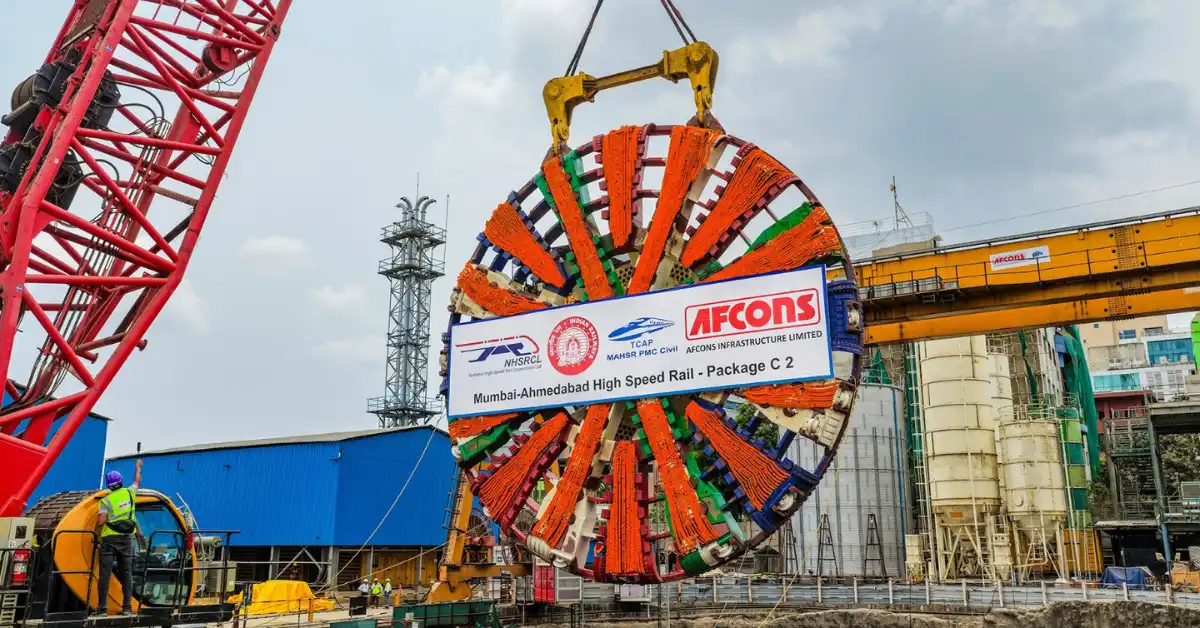
The cutterhead of the second Tunnel Boring Machine (TBM) for the 21 km tunnel section of the Mumbai-Ahmedabad bullet train project was lowered at Sawli near Ghansoli in Maharashtra, marking another major step in the construction of India’s first high-speed rail corridor, the National High Speed Rail Corporation Limited (NHSRCL) said in a statement on Saturday, 23 May.
The NHSRCL is the implementing agency for the 508-km Mumbai-Ahmedabad bullet train project, India’s first high-speed rail corridor.
The cutterhead has a diameter of 13.6 metres and weighs 350 tonnes.
According to NHSRCL, the lowering of the component marks the final step in the primary assembly of the TBM’s main shield.
The second TBM will begin its tunnelling journey from Sawli near Ghansoli and move towards Vikhroli.
The cutterhead for the first TBM was lowered earlier this week at Vikhroli.
Both TBMs will now undergo final assembly and commissioning trials before beginning their initial drive in the first week of July 2026.
The TBMs are being deployed for the Mumbai underground section of the bullet train corridor.
The cutterhead is designed to excavate a single tunnel large enough to accommodate both the up and down lines of the high-speed rail corridor.
The unit is equipped with 84 cutter discs, 124 scrapers and 16 bucket lips to cut and remove muck during excavation.
Read also : IRCTC launches revamped Golden Chariot luxury train for 2026-27 tourist season with promotional offers
NHSRCL said two TBMs have been received for the tunnelling work.
TBM 1 weighs 3,080 tonnes, while TBM 2 weighs 3,184 tonnes.
Both machines are Mix Shield or slurry-based TBMs, designed for controlled excavation in complex underground conditions.
Each TBM measures 95.32 metres in total length and includes several key components, including the cutter wheel, main bearing, jaw crusher, erector, main shield, tail shield and four specialised gantries to support tunnelling operations.
The machines can operate at a maximum cutterhead speed of 4 RPM and have a maximum excavation rate of 49 mm per minute.
NHSRCL said this would enable steady and controlled tunnelling progress while maintaining high safety standards.
The 21 km tunnel is one of the most technically complex components of the Mumbai-Ahmedabad bullet train project.
Around 5 km of the tunnel excavation has been done using NATM method, while the remaining 16 km will be excavated using the TBMs.
Read also : India’s first bullet train corridor advances with completion of 14 out of 28 planned steel bridges