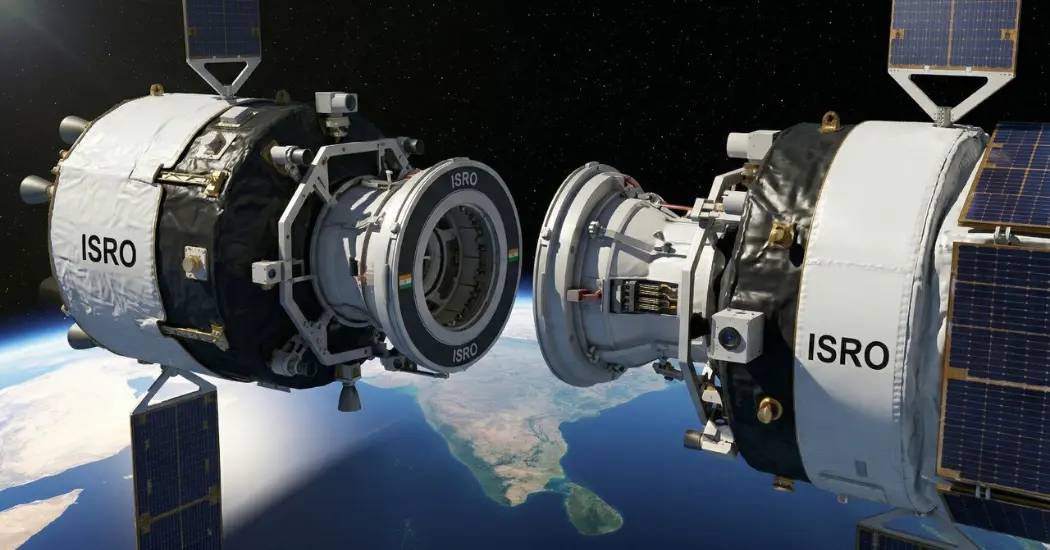
India is preparing the next phase of its space docking programme with two upcoming missions – SPADEX-2 and SPADEX-3 – aimed at advancing orbital docking capabilities critical for future human spaceflight and space station operations.
In a written reply to a question in the Rajya Sabha on 19 March, Union Minister Jitendra Singh said that ISRO is studying SPADEX-2 to replicate docking in a highly elliptical orbit aligned with the Chandrayaan-4 (Lunar Sample Return) mission, while SPADEX-3 will demonstrate docking in a circular orbit as a precursor to operations for the proposed Bharatiya Antariksh Station.
“ISRO is studying two orbital docking experiments viz., SPADEX-2 replicating the docking in highly elliptical orbit meeting Chandrayaan-4 (Lunar Sample Return) mission and SPADEX-3 replicating docking in circular orbit as a precursor mission for docking in Bharatiya Space Station,” Singh said.
The planned experiments will focus on docking and undocking of spacecraft in different orbital conditions.
Objectives include transfer of samples between modules in highly elliptical orbit and docking between two pressurised modules in circular orbit using the Bharatiya Docking System (BDS).
These missions will build on the successful ISRO’s Space Docking Experiment (SPADEX), which demonstrated rendezvous, docking, and undocking technologies in low-Earth orbit using two spacecraft – SDX01 (Chaser) and SDX02 (Target).
The first docking under SPADEX was achieved on 16 January 2025, followed by undocking on 13 March 2025.
A second docking was completed on 20 March 2025, with subsequent undocking and closed-loop circumnavigation achieved on 25 April 2025, validating multiple operational scenarios in orbit.
The docking capability demonstrated through SPADEX is considered a foundational requirement for India’s Gaganyaan human spaceflight programme, enabling crew transfer, module assembly, and future operations aboard the Bharatiya Antariksh Station.
Beyond human spaceflight, the technology is also expected to support on-orbit servicing, refuelling, and deep-space mission architectures, forming a critical building block for long-term space presence.
Read also : Rajnath Singh calls for mission mode push to make India global drone manufacturing hub