Union Commerce and Industry Minister Piyush Goyal on Saturday, 4 July, said the government will establish modern testing facilities across toy manufacturing clusters in the country, as India looks to improve product quality and expand its presence in the global toy market.
Addressing the 17th Toy Biz International B2B Exhibition 2026 in New Delhi, Goyal said the facilities will be developed through the Bureau of Indian Standards, National Test House and other government and semi-government laboratories.
He asked toy manufacturers to identify the testing equipment required for the sector so that Indian toys can meet higher quality standards for both domestic and international markets.
The move comes at a time when India’s toy exports have increased by 239 per cent over the last four years, while toy imports have declined by 32 per cent.
Goyal asked the industry to build on this momentum and work towards tenfold growth in the coming years.
The minister said India’s toy sector has strengthened under Make in India and the National Toy Action Plan launched in 2020.
More than 50 toy clusters have been established across the country, while around 21,000 MSME units are associated with toy manufacturing.
According to the ministry, India’s toy market is estimated at around ₹18,000 crore. Imports now account for around ₹2,500-3,000 crore of this market, with the remaining demand being met by domestic manufacturers.
Goyal asked MSMEs in the sector to scale up operations and said export turnover is not counted while determining MSME status, allowing enterprises to expand their overseas business while continuing to benefit from the MSME framework.
He also asked industry leaders to establish skill development centres and work with Industrial Training Institutes to train workers in advanced manufacturing practices. The minister proposed a public-private partnership model for Centres of Excellence with facilities for testing, product development, innovation and design.
The minister said Indian toy manufacturers need to adopt CAD-CAM technologies, CNC machining and modern manufacturing processes to improve precision, quality and efficiency.
He also stressed the need for better stitching, superior thread quality, machine-stitched products, safe edges, durable materials, high-quality paints and improved finishing.
Goyal said the global toy market is estimated at around $120 billion and India can capture a larger share if the industry focuses on quality, branding, design and scale.
The minister also asked manufacturers to use India’s free trade agreements to reach high-income markets.
He said Indian companies should send business delegations to countries covered under India’s FTAs and engage with overseas brands, supermarkets, e-commerce platforms and local industries.
He said the India-UK Free Trade Agreement would become operational from July 15 and asked manufacturers to immediately explore opportunities in the UK market.
He also pointed to opportunities in Europe, Australia, New Zealand, the Middle East and other markets.
Goyal said sustainability will be important for future growth and asked the industry to focus on sustainable products and manufacturing practices.
He also stressed the need to build domestic capability in motors, electronics, dies and moulds used in toy manufacturing.
The minister assured support under the Export Promotion Mission for overseas exhibitions, brand-building and market expansion.
He also suggested that Indian toy companies should explore warehousing facilities abroad to improve just-in-time delivery in export markets.
On Quality Control Orders, Goyal said the government remains committed to protecting quality standards and domestic manufacturers against unfair imports and dumping.
He said companies facing such challenges can approach DGTR, DPIIT or other authorities for support.
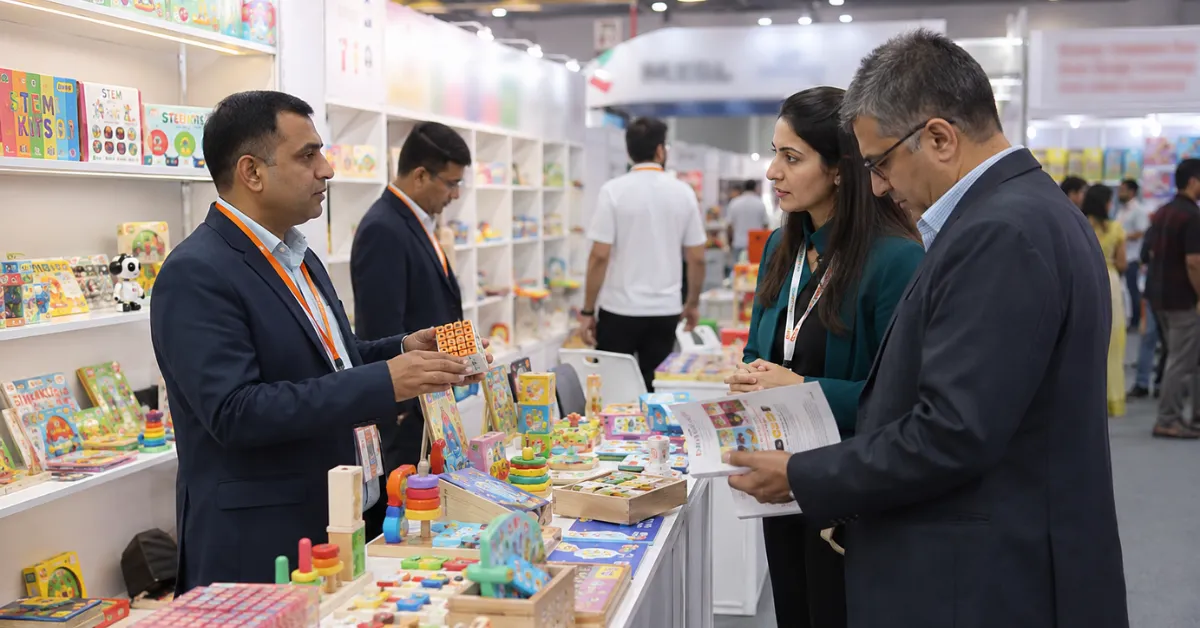
The Toy Biz exhibition brought together more than 400 Made-in-India toy brands, over 15,000 business visitors, participants from more than 50 countries and stakeholders from across the toy manufacturing ecosystem.
Read also : Centre opens applications for medical device industry scheme to boost local manufacturing and innovation