The Bureau of Civil Aviation Security (BCAS) and Rashtriya Raksha University (RRU) on Monday, 6 April, signed a Memorandum of Understanding to establish a dedicated indigenous aviation security equipment testing centre, aimed at strengthening India’s certification ecosystem and advancing self-reliance in aviation security.
The agreement was signed in New Delhi in the presence of Union Civil Aviation Minister Ram Mohan Naidu Kinjarapu, along with senior officials from the Ministry of Civil Aviation, BCAS and RRU.
The partnership establishes a formal institutional framework for cooperation between BCAS and RRU in areas such as testing, certification, research, training and standards development related to aviation security equipment.
Under the MoU, RRU, in collaboration with BCAS, will establish and maintain a dedicated Testing Centre for conducting trials of Full Body Scanners and other aviation security equipment in accordance with directives issued by BCAS.
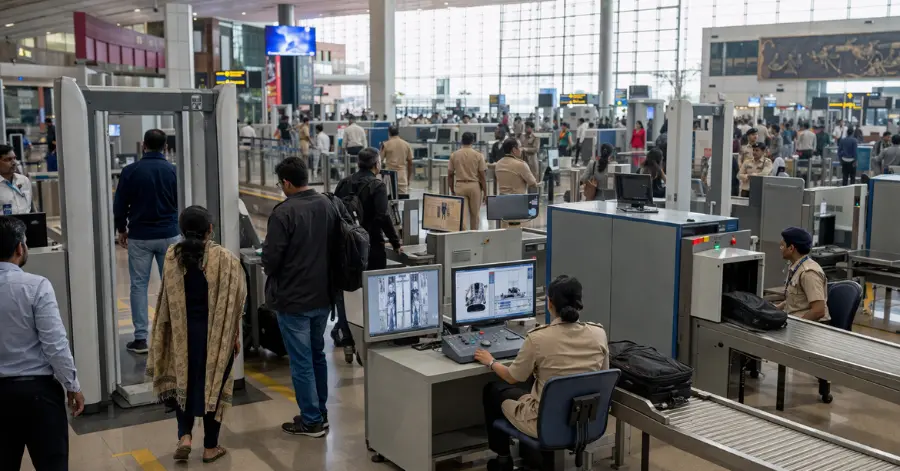
According to the Ministry of Civil Aviation, the proposed centre will conduct trials, performance evaluation and certification of Full Body Scanners and other security screening equipment used at Indian airports.
The facility will undertake independent evaluation, verification and certification of equipment supplied by original equipment manufacturers, and and submit impartial and scientifically robust assessment reports for regulatory consideration.
Speaking on the occasion, the Civil Aviation Minister said the initiative aligns with the government’s focus on research, innovation and capacity building in security, adding that the collaboration is aimed at building an Atmanirbhar and secure aviation ecosystem.
Read also : India’s major ports handle 915.17 MT cargo in FY26, surpass target with 7.06 per cent growth
He said the testing ecosystem should evolve to support Indian manufacturers while aligning with global certification practices, with the long-term aim of positioning India as a hub for aviation security certification.
The MoU also provides for the establishment of advanced testing laboratories at RRU aligned with global standards to carry out performance, safety and interoperability assessments.
It will support the development of an accreditation framework to ensure that only equipment meeting technical and operational benchmarks is deployed in critical aviation environments.
The collaboration further includes academic and training initiatives, workshops and knowledge-sharing programmes to build expertise in testing, accreditation and emerging aviation security technologies.
The partnership will also promote research and innovation in the field of aviation security, enabling continuous refinement of testing methodologies, accreditation criteria and deployment protocols in response to evolving threat scenarios and technological developments.
It will additionally facilitate national and international collaborations to align India’s testing and certification ecosystem with global best practices.
The minister noted that the initiative comes amid rapid expansion in the aviation sector, with the number of airports increasing from 74 in 2014 to 165 at present.
Airports are currently handling 250 to 300 aircraft movements per hour and 40,000 to 45,000 passengers every hour, while air cargo volumes have grown by nearly 50 per cent over the last decade.
Read also : Low-cost airport food and beverage push expands as UDAN Yatri Café expands to 24 airports