Indian Railways has conducted its first successful trial using stainless steel containers for transporting salt on the Bhimasar-Gandhidham section under the Ahmedabad Division, aimed at improving safety, speed and efficiency in freight movement.
The containers have been specially designed to transport salt and other corrosive bulk materials. Built from stainless steel, they significantly reduce corrosion, improving durability while ensuring cargo safety. The design also lowers cleaning and maintenance requirements, helping reduce operational effort and expenditure.
Container design enables faster handling
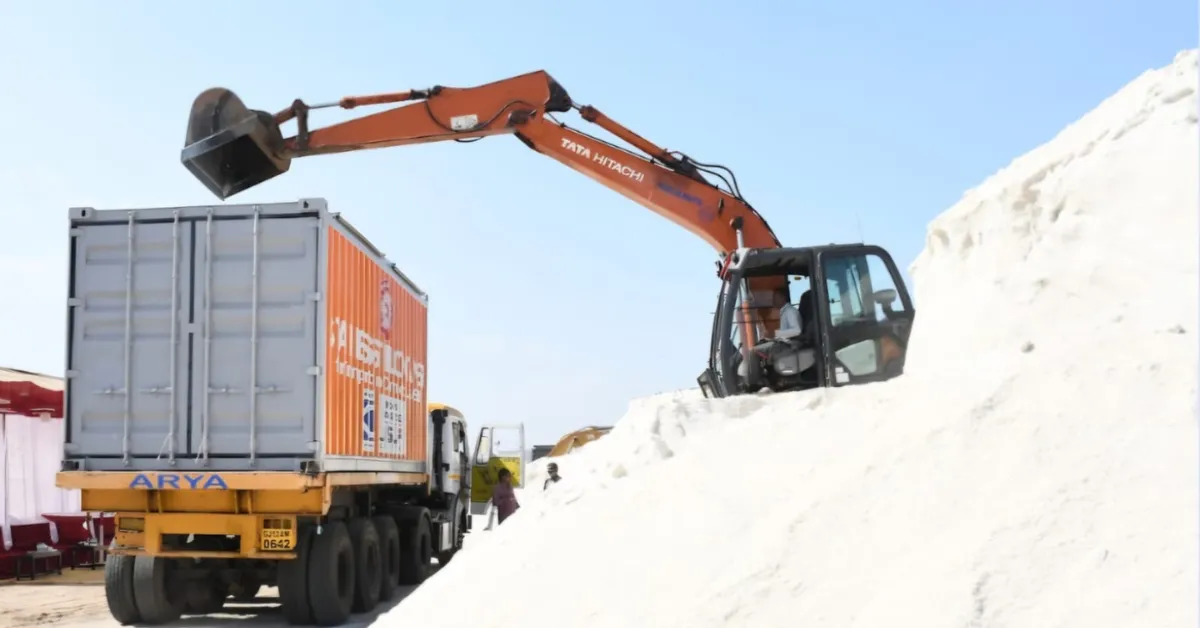
Each container is equipped with two large top openings measuring 7 x 4 feet, allowing direct loading through a silo system or from above using a Poclain machine. This configuration simplifies the loading process and enhances operational convenience.
During the trial, salt was loaded into a single container in less than 15 minutes, demonstrating a notable improvement over conventional methods. Unloading was equally efficient. By tilting the container with a hydraulic tipper truck, the entire cargo was discharged in under five minutes. Side doors enable the salt to flow out automatically, leaving no residue and eliminating the need for cleaning.
Read also : Railways approves major projects across India to enhance capacity, safety, and operational efficiency
Capacity comparable to conventional wagons
The tare weight of each stainless steel container is approximately 3 tonnes, with two containers accommodated on a single wagon. This allows up to 68.4 tonnes of salt to be transported per wagon, matching the capacity of conventional systems. A full rake of 48 wagons can carry roughly 3,300 tonnes of salt, enabling large-scale and timely transportation.
Operational gains over traditional methods
The enclosed container design removes the need for manual wagon cleaning, tarpaulin covers or protective coatings. Faster loading and unloading reduce wagon turnaround time, improving operational efficiency.
Additionally, the sealed structure minimises the risk of moisture ingress, contamination or adulteration, helping maintain cargo quality and strengthening service reliability. The trial is also expected to create opportunities for transporting other corrosive and bulk commodities using similar containers.
The trial marks a milestone for Indian Railways and supports its efforts to build a modern, safe and reliable logistics network.