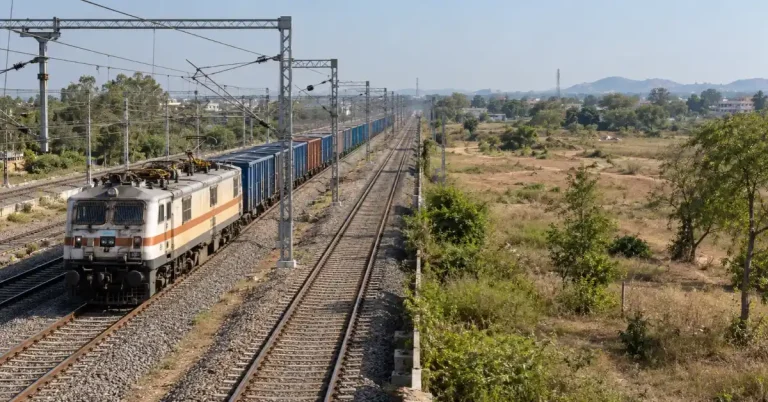
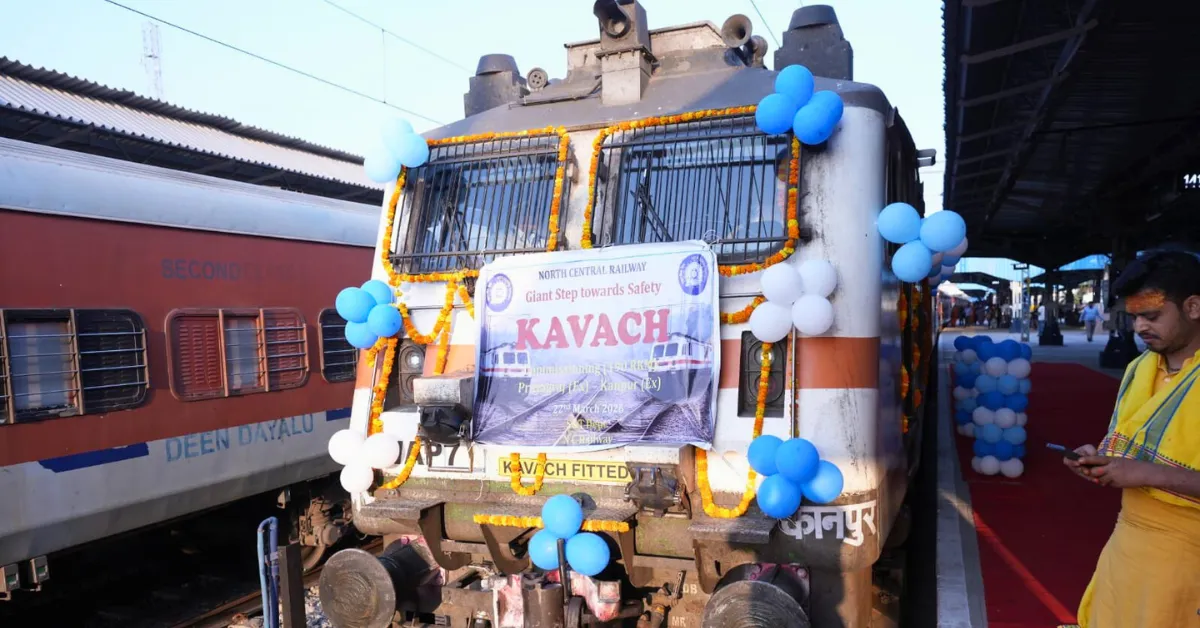
Indian Railways has implemented the Kavach automatic train protection system on the Prayagraj-Kanpur section of North Central Railway, covering 190 route Km.
The system was formally introduced today, 22 March, through train number 14163.
North Central Railway General Manager N P Singh boarded the locomotive of train number 14163 and carried out a ‘footplate inspection’ from Subedarganj to Manauri station to assess the performance of the Kavach system, according to a Railways statement.
In the first phase, Kavach will be operational on 8 pairs of trains running on this route: 14113/14114, 14163/14164, 12307/12308, 12417/12418, 22437/22438, 15003/15004, 20433/20434 and 12403/12404.
Additional trains, including Vande Bharat services, will be brought under the system gradually.
The rollout marks a key step towards running trains at speeds of up to 160 kilometres per hour on one of Indian Railways’ most important sections, while also improving railway safety and operational efficiency.
Before commissioning the system, North Central Railway carried out extensive tests under multiple operating conditions.
These included trials with a WAP-7 locomotive hauling formations of 8, 16 and 22 LHB coaches, as well as a 20-coach Vande Bharat rake, to verify the system’s reliability.
Passenger trials were also conducted using train number 15003/15004, the Chauri Chaura Express.
According to the Railways statement, more than 20,000 Km of passenger trial runs were completed successfully, and all system checks were found satisfactory.
Kavach is an automatic train protection system developed in India under the Make in India initiative.
The system is designed to improve railway safety through features such as automatic train protection, prevention of signal passing at danger, and automatic braking in case of human error.
Indian Railways is introducing the system in phases to strengthen safety and modernise train operations.
In the next phase, Kavach will be installed by North Central Railway on the Ghaziabad-Tundla section as part of Mission Raftaar, to enable train operations at speeds of 160 kilometres per hour.