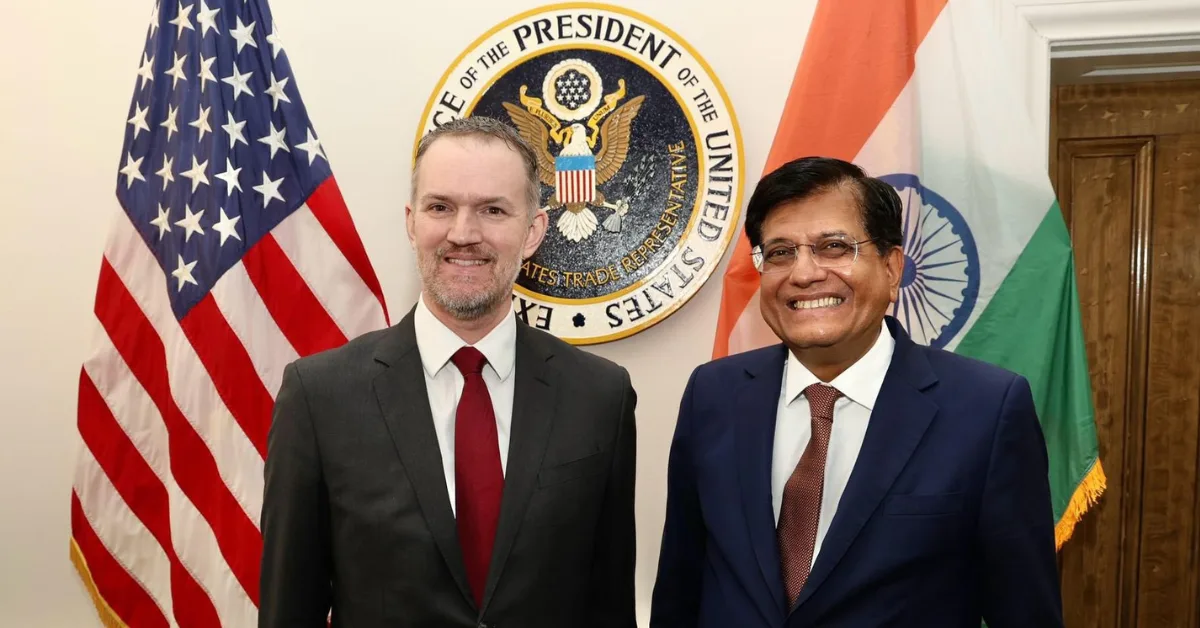
A United States delegation led by its Chief Negotiator will visit New Delhi from 1 June to 4 June 2026 for the next round of discussions on the proposed India-US Bilateral Trade Agreement, as both sides work to finalise details of an interim trade agreement and continue wider negotiations on market access, investment and supply chain issues.
In a statement on Wednesday, 27 May, the Ministry of Commerce and Industry said that the visit will carry forward discussions under the broader Bilateral Trade Agreement framework between India and the United States.
According to the ministry, the two sides are proposed to finalise the details of the Interim Agreement and take forward negotiations under the broader BTA across multiple areas.
These include market access, non-tariff measures, customs and trade facilitation, investment promotion and economic security alignment.
The upcoming talks follow an in-person round of meetings held in Washington D.C. from 20 April to 23 April 2026, when an Indian delegation met its U.S. counterparts to discuss the Interim Agreement and the wider trade pact.
In that round, both sides discussed market access, non-tariff measures, technical barriers to trade, customs and trade facilitation, investment promotion, economic security alignment and digital trade.
The Commerce Ministry had said after the Washington meetings that discussions were held in a constructive and positive spirit and had enabled progress on key matters.
The present phase of negotiations is linked to the India-U.S. joint framework announced on 7 February 2026 for an Interim Agreement on reciprocal and mutually beneficial trade.
That framework reaffirmed the commitment of both countries to the broader Bilateral Trade Agreement negotiations.
The interim framework came after the BTA process was launched by Prime Minister Narendra Modi and U.S. President Donald Trump during their meeting on 13 February 2025.
In the joint leaders’ statement issued after that meeting, both leaders set a target of more than doubling bilateral trade to $500 billion by 2030 under what they described as “Mission 500.”
The February 2025 statement said both countries would work towards negotiating the first tranche of a mutually beneficial, multi-sector Bilateral Trade Agreement.
It also said the two sides would focus on increasing market access, reducing tariff and non-tariff barriers and deepening supply chain integration across goods and services.
The trade talks have since moved through several stages, with the 7 February 2026 interim framework marking a major step in narrowing the agenda towards concrete commitments.
The framework mentioned tariff-related commitments, including India’s proposed elimination or reduction of tariffs on several U.S. industrial goods and a wide range of U.S. food and agricultural products.
On the U.S. side, the framework referred to the application of an 18 per cent reciprocal tariff rate on originating goods of India, along with removal of reciprocal tariffs on a wide range of identified goods subject to the successful conclusion of the Interim Agreement.
These areas are significant for Indian export sectors such as textiles and apparel, leather and footwear, plastic and rubber, organic chemicals, home décor, artisanal products and certain machinery.
The negotiations are being watched closely because they cover both immediate tariff-related issues and the longer-term structure of India-U.S. trade relations.
Apart from goods trade, the wider BTA is expected to shape discussions around supply chain resilience, investment promotion, digital trade, economic security and regulatory barriers.
Read also: Cabinet approves SARTHAK-PDS with ₹25,530 crore central outlay to modernise ration delivery system